Showing posts with label graphic novels. Show all posts

Saturday, August 3, 2024

Breakout Session: The Art of Crafting a Successful Graphic Novel Pitch Packet with Chelsea Eberly

Chelsea Eberly of
Greenhouse Literary
What do agents and editors look for in a graphic novel pitch? How can you be sure to put your best foot forward when showcasing your work? Chelsea Eberly's session walks through the ins and outs of how to create a pitch packet that will attract agents and editors, plus a great batch of Q&A with attendees at the end. 

Chelsea Eberly is the Director of Greenhouse Literary Agency. She represents middle grade, young adult, and women’s fiction, as well as graphic novelists and illustrators who write picture books. She was a Senior Editor at Random House for a decade where she edited the Newbery Medal winning When You Trap a Tiger by Tae Keller as well as bestselling authors such as Tamora Pierce, Leigh Bardugo, Marie Lu, Sarah J. Maas, Mark Siegel, and Kim Johnson.

Chelsea's session was incredibly tactical and practical, as both an agent and former editor she shares laser-focused expertise on crafting successful pitch packets for graphic novels and walks us step by step and page by page through a case study of a successful graphic novel pitch packet.

Wherever you are in your graphic novel journey this session is highly recommended watching, knowing all that has to be shared in a pitch can only help sharpen and clarify your project, and the graphic novel pitch case study had professional level design of complicated material—these are the pitches that sell! You'll want to follow Chelsea's 9-part pitch packet framework as shared in the session.

Prior to building those nine pitch elements you'll want to do a little imagining. It is common writing advice to go to a bookstore and imagine where your book might be in it, but Chelsea challenges attendees to go much deeper and broader on this experience and use it for your pitch as well: "All of your queries, all of your ideas, and your pitch packet itself, when you're going out on submission those all exist in this sort of "bookstore" of potential books that can be published."

Chelsea talks about how agents and editors have hundreds of pitch packets in their inboxes at a given time, competition similar to being on the shelf of a bookstore or library.

Put yourself in the acquiring shoes, what former editor Chelsea would have said when receiving a pitch packet: "I only have so much of the company's money that I can make offers with, what am I going to put my resources and the company's resources behind? What do I want to spend the next couple of years working on, reading eight to 10 times?"

Brainstorm how your pitch can outshine a hundred other pitches. To get to stand-out level you'll need to read voraciously inside and outside of your category, be constantly consuming the type of art that you're trying to create, and also art that might inspire you in unique ways. 

I loved Chelsea's focus on the bookstore/library experience for reverse engineer marketing: When you're not shopping for a specific title notice how you end up buying, did you have a wish list or were you in a mood for a specific category or genre like beach read or fantasy? How could your pitch and project pique a similar interest at each of these moments of choice?

Pitch Packet Case Study of HAMSTERS IN MY HEAD
out with Random House Graphic in 2026


Saturday, August 5, 2023

The Art of the Pause: Illustrating Graphic Novels with Rivkah LaFille

Rivkah LaFille (pronounced “lah-fee”) is a children’s writer, illustrator, and graphic novelist who currently teaches online at Kids Comics Unite while also working on a graphic novel about Creative Writing with First Second as well as a YA graphic novel with Candlewick.

Rivkah's session was the perfect one-hour craft class—I was blown away by how well paced the session (on pacing!) was—and am sure session attendees will all become comics pacing experts (a reminder the Zoom replays of all the breakout sessions are free to all registered conference attendees for up to a month after they've been posted). 

If you're reading this before September 9, 2023 then you may still have the excellent opportunity to sign up for SCBWI Nebraska's amazing sounding, virtual 16-week(!) graphic novel writing workshop with Rivkah.

Rivkah's session explored the many ways pacing can be controlled in a comic. To start I loved the way she used the repeated image of a ticking clock to simply and elegantly show how you could speed up or slow down a reader's time on a page by adjusting panel size and amount per page. That variation alone lets the comics maker achieve different visual rhythms per page similar to how authors vary sentence length in prose to vary reading tempo:


Real world examples of various visual rhythms like in FRIZZY by Claribel Ortega and Rose Bousamra

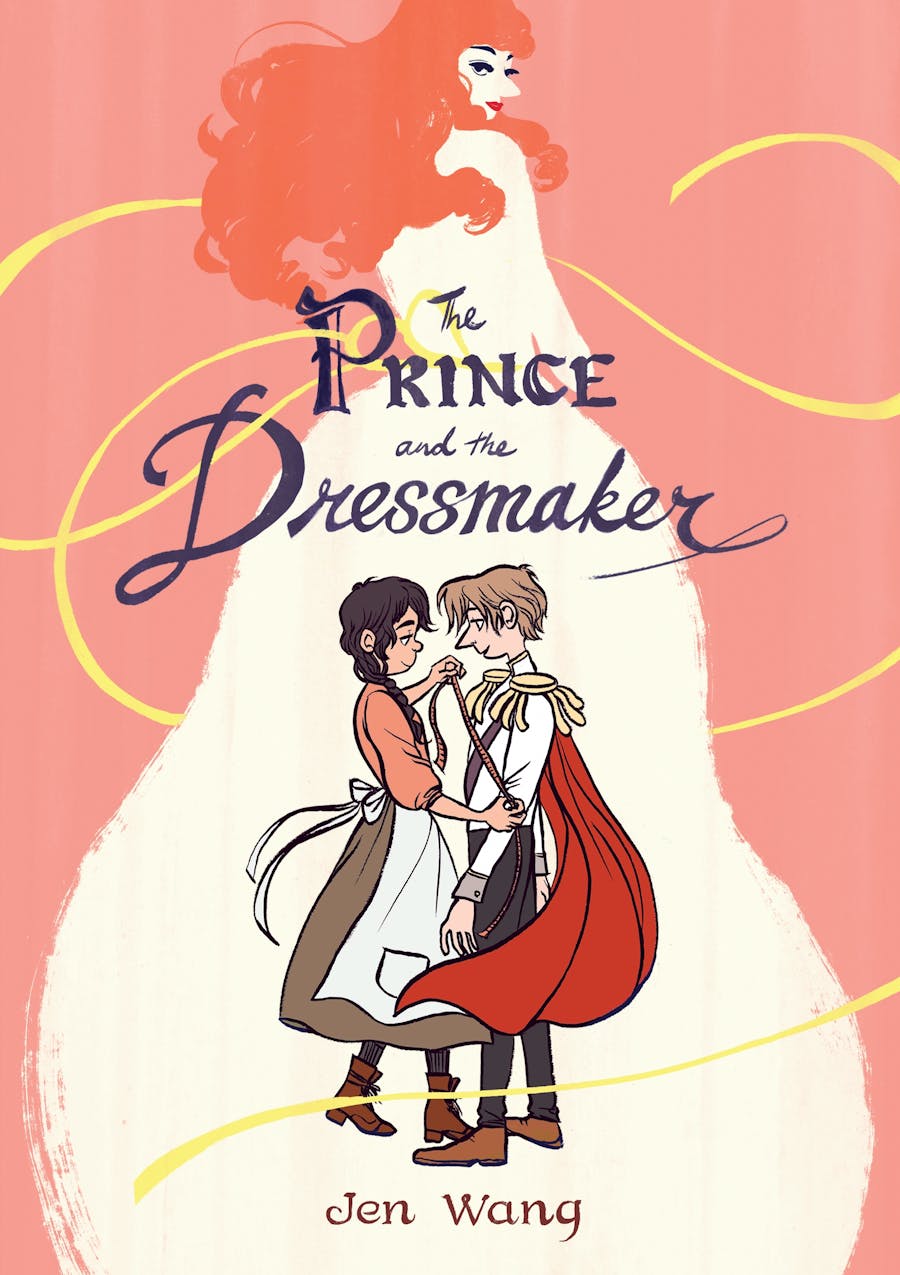
And in Jen Wang's fantastic THE PRINCE AND THE DRESSMAKER


Besides panel frequency and sizing, Rivka shares with attendees the other key ways comics makers can control the speeding up or slowing down of a scene, for example how and where lettering and/or speech bubbles are placed in a layout using, among others, pages from Vera Brosgol's BE PREPARED and Raina Telgemeier's GUTS:


Rivkah also shared a really cool drawing and writing exercise attendees could do at home to try out on their own work to vary and improve pacing. Excellent session for any comics creators wanting to learn how to make humorous scenes more effective, dramatic scenes more tense, gain better control over action scenes, and have better control over a book's tone and pacing in general.

Really hope to check out Rivkah's next workshop:


Saturday, February 11, 2023

Creative Lab: Breaking the Frame: Exploring the Expanding Universe of Graphic Novel Illustration with Jen Wang

Jen Wang is the award-winning NYT Bestselling author and illustrator of several graphic novels for young readers including Stargazing, The Prince and The Dressmaker, In Real Life (co-written with Cory Doctorow), and Koko Be Good. She is also a co-founder and organizer for Comic Arts LA where she lives in Los Angeles.

She started off the graphic novel creative lab with Writing with Pictures: Applying Art to Narrative, a deep dive into the fundamentals of visual storytelling in comics. Jen shared how she uses her layouts, pacing, and panel composition to convey emotion, manipulate timing, and enhance the narrative. Jen doesn't consider herself an illustrator first. She really only illustrates for her stories, so she thinks of herself as a writer who does drawings to support her words.

Jen believes being a seasoned illustrator is not what makes for a great comic, it’s more important what you have to say. The combination of a personal style and voice is what makes it unique to that person.

Jen wants people to not feel intimidated to consider exploring, comics are a medium available to however you want to express yourself.

But they DO require an intensive amount of drawing, at minimum you’ll have done at least a hundred pages of drawing, if not more typically 200 pages! So by the time you’re done, you’ve basically Malcolm Gladwelled yourself into being a legit graphic novelist. Jen learned many things from her first forays into long-form comics, knowledge that continues to inform how she works even today.

Lessons on layouts, pacing, and panel composition are illustrated with examples from a variety of comic works, including Jen’s own books, as well as inspiration from film/tv and photography

Participants in the lab then did some simple drawing exercises to explore our voices and approach with the techniques learned during the lab.


Saturday, August 6, 2022

Kayla Miller: Illustrating The Graphic Novel #scbwiSummer22


Kayla Miller is the author and illustrator of the New York Times best-selling Click graphic novel series and co-author of its spin-off series Besties. They studied at the University of the Arts in Philadelphia and graduated with a BFA in Illustration. Kayla currently lives and works in New York state, and when not writing or drawing, they enjoy watching bad movies, trying to cook new recipes, playing board games, and reading other people’s graphic novels.  More info at Kayla-Miller.com, Twitter @Kayke, Instagram at @Kayke.

In this session, Kayla talked about illustrating graphic novels, ably assisted by ASL interpreters: Steve and Jenny.

In school, Kayla said that in school, there weren't many courses that dealt directly with graphic novels. Kayla took some creative writing classes but felt they were missing out on visual narrative, so they also took a Narrative Cinema course. They point out both graphic novels and cinema use many similar techniques.


Graphic novels, however, have a smaller budgets and smaller teams. If you're a graphic novel creator, you need to learn how to be organized, meet deadlines, wear many different hats, working closely with others.


The illustrator needs to decide what the characters look like. You need to design the characters that you can easily draw many, MANY times. Here's Kayla's lineup of characters for some of their books:


Don't count on having room for text. Kayla pointed out that you can convey so much about the character in the illustrations in other ways:


Using film terminology can help with communication. Kayla gave examples such as distance, establishing shot, close up, etc. 

Kayla showed us how varying aspects like just the angle can change the emotional impact, character info, and reader experience. Lighting can show passage of time as well as conveying mood. Decisions about staging the shot can also convey info that is not necessarily known by the character in the story as well as focusing a reader's attention on a particular aspect.

Kayla suggests using a mirror or webcam to try out different emotions as well as body language, to better learn how to "push it" in your illustrations. Kayla says they will watch videos of someone skateboarding if having to draw someone skateboarding, to help get a better sense of the physicality.


You can use panels to control pacing, says Kayla. Having a series of similar small panels will convey the feeling of time passing slowly. Big panels can help convey big emotions or stop time in a single moment. Kayla also discussed how varying the shape of panels can change the mood.

When designing panels, it's important to keep readability in mind, and how alignment can control how a reader will read the page. Kayla showed how grouping and ungrouping panels via gutter placement can help readers (especially young readers) not get confused. Kayla also discussed the importance of word bubble design, and how to be aware of readability over a full spread.


Throughout, Kayla is always aware of reader experience. They even mentioned how they vary the horizontal gutters because in some e-readers, the pages might end up close together and get confusing.

In the Q&A, Kayla said they do all their work on their iPad now. They use Photoshop for easier workflow when working with their team. Kayla keeps spreads organized by name.

When trying to get noticed via webcomics, Kayla advises formatting your webcomics so that they will be easy to translate to print in terms of paging. With support from a colorer and a letterer, Kayla can do a graphic novel in a year.

Wow, what an amazing session! Anyone interested in illustrating graphic novels definitely needs to watch Kayla's session replay.


Sunday, July 31, 2016

Jenni Holm is here today to tell us that currently, children's graphic novel/comics publishing is a veritable Wild Wild West, the processes of acquisition and production are different for all publishing houses, but the ones that ARE making kids comics are behind them whole hog, which is great to hear!

She recommends you read the Comics Making Bible, aka Understanding Comics by Scott McCloud. (I'd add the New Testaments of Comics Making are Jessica Abel and Matt Madden's Drawing Words & Writing Pictures plus the follow up, Mastering Comics.)

She briefly tells us how comics were written, and shows us how the actual script pages compare: the old standard Stan Lee Method, the exhaustive/OCD Alan Moore method, and the classic, screenwriting style of script like a Joss Whedon would use. Jenni recommends using a screenplay format or her storyboard format as mentioned below, but probably NOT the Marvel Comic or Alan Moore format, which most traditional children's book editors might not be familiar with.

All do in some way separate out visually in the script the dialogue vs. action vs. narration. How do you use each part in your graphic novel script?

Dialogue: Same as prose, only now in speech bubbles!

Narration: More complicated, primarily used for scene transitions, major backgroun set-up, or increasingly internal monologue, occasionally even as a character, like the snarky narrator in BABYMOUSE.

Action: Stage directions/everything else that happens.

Jenni shares with us the various ways you rough out a comic, different types of storyboards, some of which are artist driven (sketches are fairly fleshed out and laid out and basic composition is done), some that are author driven.


HOW A BABYMOUSE GETS MADE:

Jenni and Matt's graphic novels always start with story first. Jenni and Matt come up with a log line, and then Jenni starts planning the story with this sort of storyboard:


Jenni already knows that the final published BABYMOUSE is going to be 96 pages, which equals about 56 pages of this storyboard.

After Jenni writes it all out, it goes to Matt, and then the editor, and when everybody loves it, it goes back to Matt for thumbnailing.

Those thumbnails get laid out page by page and are then sent to the art director who double checks it for clarity and printing guidelines.

After that it goes back to Matt to do the final art and color spotting!

TADA!

Jenni lists the children's publishers doing kid's comics today:

GRAPHIX (probably biggest commercial titles publisher via Scholastic)
First Second (all ages/arty)
Random House (younger/elementary school)
ABRAMS (Nathan Hale and Cece Bell, Wimpy Kid)
TOON BOOKS (via Candlewick, super young end of spectrum)
DC and MARVEL (may want to start YA)
BOOM STUDIOS (Lumberjanes)

Monday, August 2, 2010

Mac McCool Graphic Novel Premium Workshop

What's totally awesome?


Today was the last day of Mac's workshop. He spent the time critiquing each person's page of panels or page of a graphic novel script. For some, it was their first time drawing a comics page, but all felt it had been a great place to learn and experiment.

For readability, it's all about bubble placement, baby.
Mac critiqued story arc, text, pacing, as well as bubble design, inking, color, panel style, final art, and lettering. He took great care to translate art or comics terms that may be foreign to authors or even some illustrators.

Everyone put their art up and we all had a chance to check stuff out. These were some of my favorites:

Eric Sailer of New York

Elizabeth Oh of Hawaii
Lucy Mara Taylor of California  
Brooke Boynton Hughes of Colorado
And here's Brooke holding another assignment about character silhouettes.
Please, please, let's do this again! And, HEY! Did you spot the celebrity in the first picture?

Saturday, July 31, 2010

Nick Eliopulos - Graphic Novels

I caught the last half of Nick Eliopulos's Saturday breakout session on graphic novels. He was giving advice to the illustrators in the room about taking advantage of the Artist Alleys at comics conventions and recommended putting examples of your work (or even story segments) on the web (like Raina Telegmeier's SMILE or Jeff Kinney's DIARY OF A WIMPY KID.)

When asked what makes a good graphic novel, Nick said it's the same elements that make a good non-graphic novel: plot, character, and voice.

"Graphic novels are a medium that can accommodate any genre you can imagine. The sky's the limit."

"Lots of book to graphic novel adaptations happening now, some of it's cynical, but some, like CITY OF EMBER, are great choices."

From Cassandra Diaz's website
One title Nick is excited about is PANDEMONIUM a graphic novel by Chris Wooding, an established British SF/YA author with art by a US artist, Cassandra Diaz. Nick says, "It's basically a prince and the pauper type story. Genuinely funny, great love interest, but everyone seems to have horns and bat wings. Hopefully out in Fall '11."

Nick hopes the current practice of how graphic novels are shelved will change, "This isn't a genre, it's a format."

One of Nick's first graphic novel projects was SONS OF LIBERTY, a serialized historical fiction/fantasy that fits Nick's acquisition wish list—high concept guy book. The first is out and the second in the series should be out this fall.

Questions from the audience included:

Examples of young graphic novels? Nick mentioned the ever-awesome BABYMOUSE by Jenni and Matt Holm and Françoise Mouly and Art Spiegelman's Toon Books series.

What does a graphic novel submission package include and/or look like?
While there's nothing set in stone, Nick said it would be helpful to have: some sample artwork (5 to 20 pages,) the whole manuscript set up as a script (using software that Hollywood screenwriters use (like FinalDraft) or look to Marvel for script samples.) And within your script, you'll want to call out page and panel breaks as well as scenery changes.)

Saturday, August 8, 2009

MELISSA STEWART: "The Art of Science and NonFiction


MELISSA STEWART: "The Art of Science and NonFiction" 


MELISSA STEWART BIO: Award-winning author of more than 100 nonfiction books for young readers. Her latest is UNDER THE SNOW, a Junior Library Guild Selectio. She's a judge for the American Institute of Physics Children's Science Writing Award and a member of the SCBWI Board of Advisors.


Highlights from Melissa's panel on nonfiction writing for children and teens:


-- She provided a handout with lists of books to study for the following areas:


1. STRUCTURE: She recommended books such as "Beaks" by Sneed Collard, "A Place for Butterflies," by Melissa Stewart, and "Team Moon" by Catherine Thimmesh, along with several other recommendations.


2. VOICE: She recommends books like "Army Ant Parade" by April Pulley Sayre, "Lightship" by Brian Floca, and "Mammoths on the Move" by Lisa Wheeler, along with several other recommendations.


3. WORD CHOICE: She recommends "Baboons" by Melissa Stewart," "Move!" by Steve Jenkins and Robin page, and "If You Hopped Like a Frog" by David Schwartz, along with several other recommendations.


-- Her website is listed as www.melissa-stewart.com if you want more information.


-- For style, she showed example of nonfiction from an encylopedia versus an excerpt from a children's book that employed narrative non-fiction. It was very helpful for everyone taking notes on how to elevate their nonfiction from something that read like a magazine article to a narrative book form.


-- She says there's nothing wrong with a more straightforward, authoritative voice for a children's nonfiction book, but there's also room for a more casual, fresh narrative voice, depending on what is the best "voice" and "style" to tell your story and impart educational facts.


A detailed, thorough and meticulous panel that not only taught conference goers how to elevate their nonfiction projects but also provided fiction writers with great information on how to play more with language, word choice, voice, and style.


Posted by Paula Yoo


Brenda Bowen: "Agents Panel: The State of the Business" Part 2

More highlights from Brenda Bowen @ Agents Panel:
  • On revising a client's work: "I was working with an aurhor on a picture book, and he revised it couple times. I said it was good and he said, 'Let's see what an editor says.' (Much laughter from the audience. Brenda shrugs.) Well, I have a different hat on now."
  • As a former editor, Brenda says certain agents who have excellent reputations or cache can influence editors' expectations. When she was an editor, Brenda says, "I was aware that some agents' names in the inbox meant that what was attached, although maybe not perfect for me, was going to be really good for someone in the house, and that it was ready to go. I'd like to be one of those agents, like you folks (she nods to the panel)."
  • Brenda believes in a long-term relationship with her clients. "I spent my time nurturing creative careers. It's not good for us to make one sale and never sell your work again. You have to imagine a partnership, to trust that we're going to give our best to each other and that we'll be there for the long haul."

Posted by Paula Yoo

BRENDA BOWEN: "Agents Panel: The State of the Business" Part 1


BRENDA BOWEN: "Agents Panel: The State of the Business" Part 1


Highlights from the Agents Panel: The State of the Business featuring Brenda Bowen, Sarah Davies, Stephen Frasier, Dan Lazar, Kelly Sonnack, and Marietta Zacker.

Each SCBWI Team Blogger focusing on one agent. 

Stay tuned for live blogs from Lee Wind's blog on Dan Lazar, Alice's blog on Sarah Davies, Jolie's blog on Stephen Fraser, Suzanne's blog on Kelly Sonnack, and Jaime's blog on Marietta Zacker.

I'm focusing on BRENDA BOWEN: She is a literary agent with Sanford J. Greenburger Associates, a full-service agency founded in 1932, and the home of Dan Brown, Fancy Nancy, and Kafka. A former publisher, Brenda specializes in children's books at SJGA, and is always on the lookout for funny books for middle graders.

Highlights from Brenda Bowen's quotes @ the panel:

-- Her imprint, The Bowen Press at HarperCollins, became "a statistic" because it launched in January 2009 and was "axed" in February 2009. "But when a door closes, another one opens," she said to great applause, referring to her new job as a literary agent with Sanford J. Greenburger Associates.

-- What Brenda is looking for: "A strong voice, assured confident writing, and creative use of language."

-- She does like "literary books" but she also has a fondness for funny books and asks that if you plan to submit a funny book, please indicate so! 

-- Find out how to submit via their website: http://www.greenburger.com/

-- For Brenda Bowen, please put "SCBWI-LA" in the subject line of your email query

-- Although Brenda has only been an agent since July, she's already signed some great clients. She says one person had written such a compelling sample via email that she downloaded the entire 15 pages attached and read it immediately and signed the writer right away. "So it does happen," Brenda says, adding that again, the voice was extremely "compelling" which is what sold her on the writer.

Stay tuned for more highlights!

Saturday, January 31, 2009

Jarrett's Graphic Novel Process

Jarrett approached working up his graphi novel similar to the way he does picture books--he created a dummy, then a thumbnail, then tighter sketches. Finally he creates a script, then it all goes off to his publisher. It's very cool to see the images of his process with the illustrations, which are 2-color--black and yellow.