Showing posts with label author panel. Show all posts

Saturday, August 2, 2025

The Ins and Outs of Author Publishing - A Self-Publishing Panel: Lee Wind

 The Ins and Outs of Author Publishing - A Self-Publishing Panel: Lee Wind

Lee is an award-winning author, who is an incredibly powerful advocate for inclusive storytelling, championing young people, and people who write and illustrate.

He also ran the official SCBWI blog and the Conference blog for many years, and recently passed the baton on to me, Justin Campbell and I am so glad to be covering him in this post!

 Lee serves as Chief Content Officer at Independent Book Publishers Association (IBPA), which is one of SCBWI's valued partner organizations.

"I think that the term self-publishing tricks people into thinking that they can just "download the software to their computer", and design the cover of their own book. If you want to publish something that you created, you're now the publisher. You have to hire a team of professionals to help you make your book indistinguishable in quality."

So that's why, at IBPA, the Independent Book Publishers Association, they've begun to use the language of author publishers. "I think it's a really good mental model shift. That's why it's called the Ins and Outs of Author Publishing."

Lee currently has seven books out; his first book being crowdfunded and author-published and the other six being published by independent publishers. 


His most recent is Like That Eleanor, from Cardinal Rule Press, about a little girl who is named after Eleanor Roosevelt by her two dads. Eleanor sees some unfair things happening in her school, and when she talks to her dads about it, they tell her about the real-life Eleanor Roosevelt, her namesake, who inspires young Eleanor to stand up and be an ally to make her corner of the world a little more fair.


His picture book that came out last year, Love of the Half-Eaten Peach, illustrated by Jieting Chen was just named a finalist for the Lambda Literary Award for Picture Books. Congratulations, Lee! 

"The decision about whether to publish a book yourself, or to have it traditionally published is about a particular project, it is not about you as a creator."

That decision has a lot to do with your journey and what you want out of your journey.

Check out the panel posts by Jolie Stekly and Jaime Temairik for the in depth Q&A session. Panel recordings available through September 14th, 2025! 

Lee Wind writes the books that would have changed his life as a young Gay Jewish kid. His latest nonfiction book for readers 11 and up is “The Gender Binary is a Big Lie.” Kirkus’s starred review cheered it as “an accessible, thorough, curiosity-provoking introduction to gender.” Lee is also the author of YA novels including his gay teen homage and critique of James Bond movies, "A Different Kind of Brave," that Foreword Reviews' starred review called “A gem for young adults.” His picture books include "Red and Green and Blue and White"(art by Paul O. Zelinsky) that the New York Times celebrated as “beautiful.” His June 2025 "Like THAT Eleanor" (art by Kelly Mangan) received a starred Kirkus review that praised it as “An ideal guide for readers of any age to learn how to be an ally.”

www.leewind.org/

Friday, August 1, 2025

Writing from the Immigrant Experience - An Author Panel: Hanh Bui / Meera Sriram

 Writing from the Immigrant Experience - An Author Panel

Paulo Yoo: Let's start with introduction! Tell us a little about yourself!

Hanh Bui : Hello, my name is Hanh Bui. My latest book is Ann's New Word.It's inspired by my first teacher in America, Miss Mary Ellen. She is the reason that I grew up to become a teacher as well. I met her at the refugee camp when my family and I came to this country in 1975, at the end of the Vietnam War. She helped me during a time when I was struggling to navigate life in a new country. She made me feel safe and seen, and I knew that I would someday want to grow up to become a teacher as well. I spend a lot of time with children in schools, and is really the highlight of being an author, being able to be with the kids that I write these stories for.
Meera Sriram: Hi, everyone. My name is Meera Sriram. I was born and raised in a very "busy, colorful, chaotic, bustling city" called Chennai in the south of India. I immigrated to the United States when I was 23 years old and I've lived in this country for over 25 years. I currently live in Berkeley, California. I mostly write picture books, My recent title, The Spice Box, is a little boy who wants to cook using the heirloom spice box, which holds more than just the colorful spices. Essentially the story is about the power of family history, their history of migration and hopes and dreams. It's a celebration of the amazing smells, the aroma, and the colors, and the flavors of the different types of curry that we have in Indian cooking. It's a way to decolonize the curry.
Paula: I want to talk about some personal stuff in terms of what about your own background, what specific moments or stories,  inspired you to realize this isn't just an anecdote but a book. 

Hanh: So, in 1975, when my family and I left Vietnam at the end of the Vietnam War, we were rescued at sea by the U.S and that was the beginning of my journey in the resettlement.
After being at sea and the trauma of leaving and losing home, and family, it was scary when I first arrived. I didn't want to speak at all. I only spoke with my family.
And then I met Miss Marilou. I gravitated towards her because she was so kind and gentle in her approach.

This story is actually inspired by a true event. One day, I went to a refugee camp store where I found a sweater. And on the sweater, there was a reindeer stitched on it. And it was Rudolph, but of course I didn't know that, because we didn't have reindeers in Vietnam. So I wenr to school to ask Miss Marilou. I didn't know what the word was so I pointed to it, and she said told me that it was a reindeer, which became my first English word and the inspiration for this book. I also wanted to honor my grandmother, who helped me to be brave, because seeing my grandmother face so many new challenges and learning a new language made me feel if my grandmother can do it, then I can do it too. This year is actually 50 years since we came to the United States i and I reunited with Marilou, my first teacher.

So, Miss Marilou was 19, and I was 8. And she had given me a photo on the last day, and on the back of the photo, she had written, "Hanh, I love you, Marilou Shaida," and because she had written her full name, my husband was able to find her. And I felt like it was really important to write a story that honors the journey that children go through learning a new language and navigating two worlds.

There's so many kids out going through that now and felt it would be comforting for them to know that it's not just about learning a new language—it’s about learning anything new. It's really about trying and not giving up. And so, um, when I go to school visits and kids get to see me, and they know that.

Paula: One of the controversies right now is that there's a growing movement, to try and make English the official language of America. There’s a lot of debate over this. How do you feel about that, and how has being bilingual or multilingual benefitted you both as a person and as a writer?

Hanh: I remember when I first came here, my grandparents kept trying to encourage me to only speak English. Because my grandparents didn't speak much English, I end up being our family translator. But I loved hearing my language at home. Because that's what made me feel safe, especially as I was navigating two world, at school and at the camp was all Vietnamese children.
But once we were sponsored, and I was the only student in my class that was not a Caucasian, I was really nervous, and worried about speaking the language. And so I loved when I could go to my ESL class at school. I could speak English or Vietnamese. And I think that there's so much beauty to having all of our languages heard. And I feel that knowing another language actually helped me to learn English. And so, I encourage that with my children, to speak multiple languages. 

First of all, when I heard that English was to be the official language, I felt like it has always been the official language in this country but I also thought that there's beauty in all of the other languages that I get to hear around me. And I think that it does help us as writers to be open to the experiences of others.

Meera: I'm a strong advocate for bilingualism, and multilingualism. There’s scientific research that has shown considerable brain development in younger kids that speak more than one language.

And also when I speak, I have an accent, and people always ask me, “What language do you write your books in?” I have to tell them English. When they ask, “How come?” I tell them, “If you knew your history of India being colonized by the British, then you would know that most of us in India can speak and understand English.” I am happy to say that one of my books, A Gift for Amma, was probably one of the first books to have a Tamil word on the book cover, in the title. It means mother. So I am always an advocate for including words, and I prefer not to italicize those words. Because it's a form of resistance to keep them in non-italicized. I do what I can to make sure that communities that speak languages other than English feel seen and feel heard.

Paula: I want to talk about family. We started talking about that earlier, and I wanted to return to Han. In your book, The Yellow Áo Dài,  you have a lot going from the grandmother to the mother, to the daughter.  In terms of stories of immigration, why is it so important to bring in the old people? Because these are books for young kids, but we're bringing in the grandmas, the aunties, the uncles. Why is that important, and how do you do it in a way that is engaging for children to learn about those types of connections?

Hanh: Going back to the language conversation, it means so much to me the first time I saw the word Áo Dài on the cover of the book, which is the Vietnamese traditional dress. And now kids in school know what Áo Dài is. 

But when you asked about grandparents, it is about honoring those who came before us. That’s a big inspiration for me as far as wanting to include that in my book because my grandmother would share oral storytelling. She gifted that to me during our whole journey coming to America.
When I was feeling very seasick and very worried, she would calm me with stories of our homeland. And so, I learned that from her, and I do that with my own children. I share our stories, and I honor my grandmother and my mother-in-law.

That's why The Yellow Áo Dài is about my daughter and her grandmother, and their love of being princesses. Their love of our traditional dances, the fan dance and our traditional dress, our Áo Dài. We write stories that are more complex. We write our family stories, and I remember when my daughter was feeling sad that she didn't know her grandmother because she passed away when she was a baby. But when my daughter saw all these photos of grandmother wearing Áo Dài in her favorite color, yellow, she felt closer to her and want to learn about our family history. And I wanted to celebrate my own grandmother. 
I think a lot of children can relate to stories that have to do with their grandparents and those kind of relationships.

***

This panel was full of such rich topics and having so many writers speak on their lived experience and how it influences their work was awe-inspiring. This brought me much hope in a political world that tries to silence storytellers. 

Reminder that this will be available to rewatch until September 14th, 2025 in your SCBWI Membership portal.   


Inspired by her first teacher at the refugee camp, Hanh Bui pursued a master’s degree in Early Childhood Education and taught second grade. Hanh’s commitment to celebrating her heritage includes giving presentations at school visits about her refugee experience to children studying immigration as part of their school curriculum. She serves as co-chair of the Equity and Inclusion Team for the Mid-Atlantic region of SCBWI. She is the author of The Yellow Áo Dài and Ánh's New Word, (Feiwel & Friends, Macmillan). 
Meera Sriram draws from her life straddling the East and West to tell stories for children. She is the author of several picture books including A GIFT FOR AMMA (South Asia Book Award), DUMPLING DAY (featured in The New York Times),  A GARDEN IN MY HANDS (SCBWI Crystal Kite Award Finalist) and the most recent THE SPICE BOX (CALIBA Golden Poppy Award Finalist). Her work has been selected Best Book of the Year by School Library Journal and Bank Street College, included in several state reading lists, and has received starred reviews from Kirkus, SLJ, and Publishers Weekly. Meera also volunteers her time to champion the Equity & Inclusion Awards in her SCBWI region. She lives with her family in Berkeley, California. For more information, please visit:   http://www.meerasriram.com 

Saturday, August 3, 2024

Author Panel: Melissa Iwai


Melissa Iwai is an award-winning author/illustrator of picture books, including Soup Day, Pizza Day, Dumplings for Lili, which was a Crystal Kite Award winner and Bank Street Best Book. Her I Can Read Series, Gigi and Ojiji, was a Junior Library Guild Gold Standard selection, and Gigi and Ojiji was a Theodor Geisel Honor recipient in 2023. When she is not creating, she can be found cooking and doing crossword puzzles with her husband, author Denis Markell, in Brooklyn.

The focus of this panel will be on authentic voices as well as early-reader series, so Melissa will sharing about her GIGI AND OJIJI series. 

Melissa echoes the panelists feeling that these books help readers have an edge to advance and feel pride when they're learning how to read, feeling they can do it. In terms of illustration, the art is helping kid interpret. Like any book, the illustrations compliment the text, but particularly with early reader books you don't want any ambiguity, or for anything to complicate it. 

In GIGI OJIJI Melissa wanted to show her main character's emotions so the facial expressions and body language were key. 

How did Melissa come to the early-reader format? It started during the pandemic. Melissa's agent let her know that a particular editor was looking for early readers featuring diverse characters. She asked Melissa if she had any ideas, and she did. It took meetings, writing a pilot books, and much more before she actually got the contract. 

Melissa shares how important it for kids to see themselves in books, and in her book she was also able to include some Japanese words. For the kids who have that background, they see themselves in those pages, but for those kids who don't, they get to learn a bit about the language and background. 

Melissa found researching other early-readers very valuable, and she looked at a wide range of levels. There are a lot of constraints in the early reader (both in text and illustration). She found those constraints helped to guide her and help her execute her vision. The guidelines shouldn't constrict you, rather guide you. Reading many many books gives you and overall sense of the genre. 

Friday, August 2, 2024

Success Story Panel: Pamela N. Harris


Pamela N. Harris is an award-winning author of young adult novels, which include WHEN YOU LOOK LIKE US and THIS TOWN IS ON FIRE.

Pam's been writing for as long as she can remember. 

As a child when Pam went to the story her parents they would get her a new Lisa Frank notebook that she would immediate fill up with words. And, in second grade she wrote a story called the Troll Princess, and she was selected to read her story to the kindergarteners. In that moment she fell in love with telling stories to others. 

Pam discovered the SCBWI while doing research and seeing that joining the SCWI was recommended by editors and agents. She attended her first conference in LA when Judy Blume was the speaker, and, of course, she cried. 

After getting her first agent, she thought all was going to be great. But it took her subbing three different YAs and a middle grade before she got her first contract. It took nearly 8 years before her break came. Pam stayed focused over that time. She also took a short breather (from writing but not reading) and also stayed connected to the community, listening to the stories of perseverance. 

If you're brand new to the SCBWI, Pam advises taking a break from your writing when you need it, but during that time devour books. - Keep writing. Keep reading. Persevere. Continue to learn. Continue to be eager. And always take care of yourself. 

To those who are already published, Pam recommends doing your best to understand the business side of things. Be aware of all that's going on. Also, continue to follow the journey of those you admire. 

Pam shares that the biggest mistake she made was querying before she was ready. Pam queried when she was only half though a manuscript (to test out the pitch) and when the agent then asked for the full, she wasn't prepared. It meant she didn't share her best work, and it felt like a wasted opportunity. 

One piece of advice that was important for Pam to hear came from Judy Blume at that the first SCBWI she attended. She had been struggling with a beginning, and Judy Blume shared to start a story on the day your character's life changes. That bit of advice has helped her and stayed with her. 

When it comes to Pam's writing routine, it's key for Pam to be intentional. She has a busy life, with a day job, and two young children with special needs. So, when it comes to writing, she schedules it. It is on her calendar. 

Sunday, August 11, 2019

Author Panel Creating Memorable Characters for Series - Bruce Hale

Bruce Hale has written over 50 books, picture books to middle grade novels. He's excited to talk about writing series' characters.

Bruce says a main character is memorable if they have a unique point of view and attitude, those elements combine to give you a great VOICE. He's made seven series, and the ones that stay in print have those strong attitudes and views from the very first page.

As an example, he shares the first lines of THE MALTED FALCON, his first book in the Chet Gecko series.

Focus on making the character first, that's usually the way, though sometimes it can be a situation that sparks an idea.


When he was asked to write CLARK THE SHARK, he had no idea it would turn into a nine-book series, and he credits its success with the deep development of the main character, Clark, and that readers wanted to keep having fun with him.

Bruce is working on a standalone novel right now, which he finds very scary, to only be able to give this character that one moment in life.

"Drawing pictures of the characters is part of my process for writing, I was a cartoonist before I was an author, and what a character looks like often shapes their personality in a way just writing about them does not."

Is there anything you do to get to know your characters better?

Paula Danziger recommended an exercise that Bruce likes, which is to describe what is in your character's closet and what it says about your character. Sometimes he'll do an interview with his characters.

Working on character isn't just working on the character, but the setting can also form and change a character's personality.

Author Panel: Creating Memorable Main Characters for a Book Series - Ben Clanton & Debbi Michiko Florence

Ben Clanton
Debbi Michiko Florence (Photo credit Roy Thomas)


Ben Clanton is the author/illustrator of the Narwhal and Jelly books) as well as an editor-at-large for the Little Bigfoot imprint of Sasquatch Books.

Debbi Michiko Florence is the author of the Jasmine Toguchi and My Furry Foster Family series.

Both were part of the author panel focusing on the development of characters for book series.

What makes a memorable character? 

Debbi: When Debbi reads a book, she wants to feel comfortable with the character, like they're a friend.

Ben: He thinks it's vital to have a character connect with the reader.

When you're starting out, do you start with character or plot? 

Debbi: Jasmine Toguchi started off with an idea she encountered in a newspaper, a story about a Japanese family that got together to make mochi in the traditional way. According to tradition, the man pounds the mochi and the woman rolls it. But her character, a girl, wanted to pound the mochi, and she wouldn't leave Debbi alone.

Ben: It starts with character. He gets to know them, sometimes for a period of years. His original inspiration for Narwhal and Jelly was a book of photographs that captivated his imagination. He found himself filling pages in his sketchbook with narwhals and other creatures. He started asking them questions. What would they do? He started dressing them up as super heroes. And then one day he was standing in line for ice cream and was smelling waffle cone, and it occurred to him that he'd look like a narwhal if he put his waffle cone on his head. Then he knew his character was sweet and on a perpetual sugar rush. A foil character, Jellyfish, was more cautious, and then this pair inspired a whole lot of story ideas.

When do you know what your characters look like? 

Debbi: She can't draw, but when she got the sketches of Jasmine from illustrator Elizabet Vukovic, she cried. She loved her (even though she had a better wardrobe than Debbi.

Ben: All of his characters start in his sketchbook. With his potato creature, in 2011 he started drawing a little dirt clod creature that would eat all of the cute things in his sketchbook. They wouldn't go away. He didn't know why he felt a need to draw vicious potatoes, but he kept doing it. "If they won't go away, there must be a story there." He made a few alterations in how they looked, and their characters emerged.

How do you get in your character's head? 

Debbie: She journals as her character. She thinks about them all the time. Almost none of that goes into the story, but it helps her with her stories. Also, every draft, she gets deeper and deeper into character. She has to write several drafts to get into the character.

Ben: Even if you're not an illustrator, you can sketch your character. Make a visual map of their lives. It can be a good exercise to help you get to know your characters.


Author Panel: Creating Memorable Main Characters for a Book Series - Lisa Yee

Lisa Yee
Photo Credit: Emi Fujii
Lisa Yee has written twenty novels and chapter books for kids. In addition to her Millicent middle grade series, DC Super Hero Girls as well as several books for the American Girl book series. She

When asked what makes a memorable character, Lisa responded that even if a character is unfamiliar to the reader, there is something about them that is familiar. Lisa also responded affirmatively that she puts herself in her books. But she quickly added that she steals from others' lives around her. Her Bobby books center on her son. Dan Santat illustrated the series and came to her house to draw her son, so art is based on him too.

Another question focused on whether the creators start with character or plot as they craft a series. Lisa starts with characters if she generates the series like Millicent Min, Girl Genius. Before she writes, Lisa spends time thinking about characters, what they like and don't like. It's a layered approach to their development. It's not until the end of the book do they come out fully formed.

But with the DC Super Hero Girls series, she focuses on plot because the super heroes' characters like Wonder Woman are well-known and understood. But at the same time, if I got her or any other character wrong, "people would want me dead" because they know and love these characters. But "after some mental gyrations, I realized that I'm just writing a story about these teens and their insecurities and I get started." 
Author Panel
L to R: Ben Clanton, Debbi Michiko Florence,
Bruce Hale and Lisa Yee
Follow Lisa on Twitter and find out more about her on her website.

Saturday, August 10, 2019

Author Panel: Birth of a Picture Book — Corinna Luyken

Corinna Luyken
Corinna Luyken is the award-winning author and illustrator of some absolutely beautiful picture books, including My Heart and The Book of Mistakes. 

When she was a kid, she used to draw at the living room table. Now, she works in a studio.

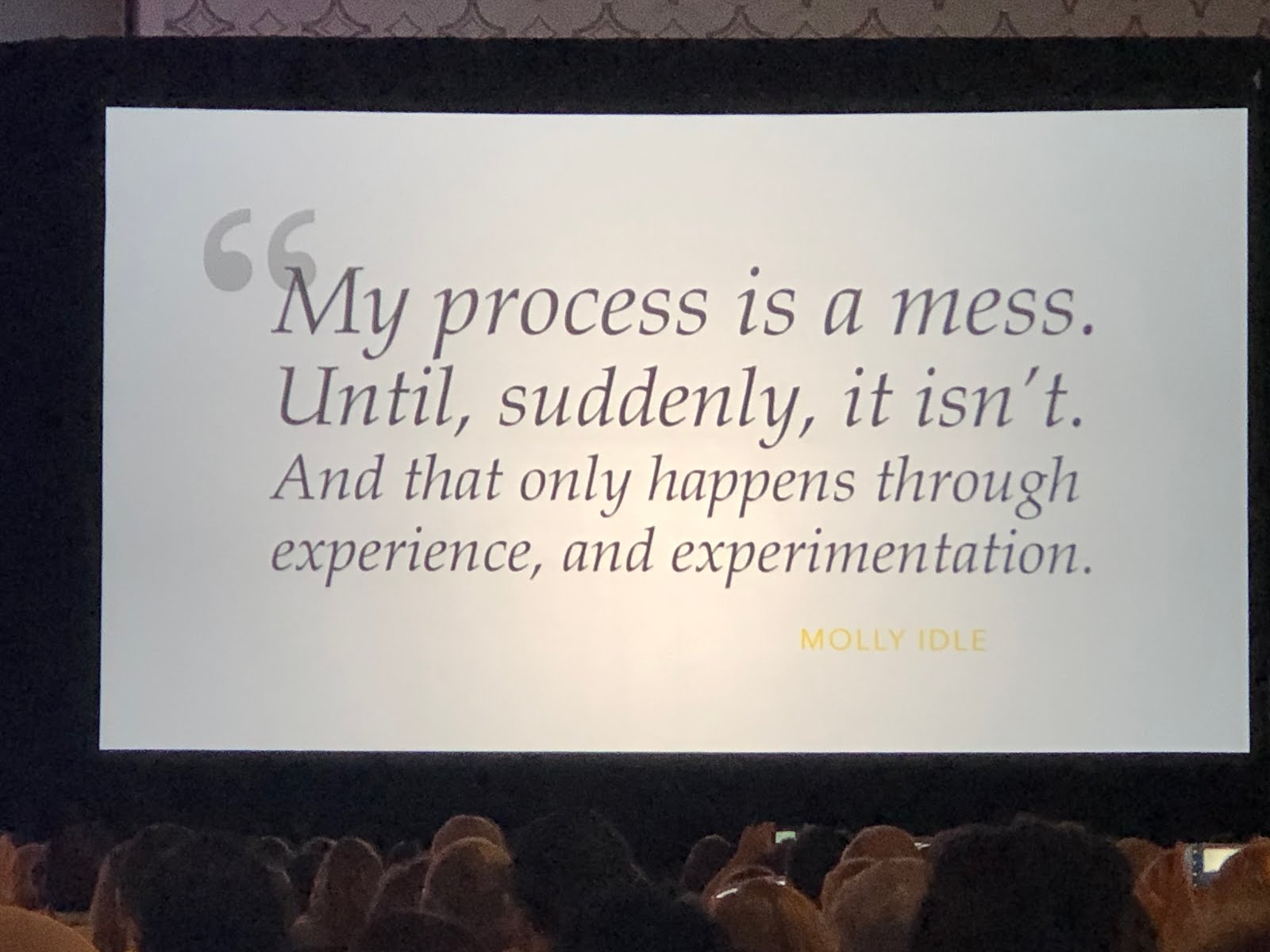
In her own space, she gets to make a mess. "Also," she said, "my process is messy."

She calls it a process of making mistakes, and of using improvisation and experimentation to move her work forward. "This is how I arrive at solutions."

In Adrian Simcox Does Not Have a Horse, the story is about a child who may or may not have a horse. So she had to figure out a way to convey that. She used negative space (you can see it on the book cover, pictured on the right--the horse continues to the back of the jacket).

Adrian Simcox Does
NOT Have a Horse
Her process involves making many dummies (at least 12 for The Book of Mistakes). And it can be emotionally hard ... her family reports that she gets grumpy when her experimentation isn't going well.

All of her books begin with emptiness ... she needs to get out of her own way, a concept that Kate DiCamillo expressed well. And then there is attention. Books exist between that sweet spot of emptiness and attention.

She also balances fear and love.

"You can make a choice. Which one are you going to allow to guide you? Fear is a very real part of the process ... All we can hope is that we will not succumb to that.... I do try to remember that every day, the job of the artist is to be sharpened and honed by this uncertainty."

What questions do you ask yourself during the work of book making? 


My Heart
"I try to have a conversation with the story and ask it what the heart of the story is, the feeling, the most important thing I'm trying to convey." That can inform Corinna's decisions.

How do you choose touches that are unique to the book that you are working on? 

You have to be interested and excited by the world of each new book. Corinna changes up materials when she starts a new book. "What does this world feel like? What art materials need to be used? what's speaking to me?"

She's used brown Kraft paper, a red, white, and blue color palette. She wanted white to be a character in a book with a little white dog. And there have been moments of doubt during the process—"what was I thinking?" But she gets to a point where she's invested, where the materials have spoken to her, and how their limits help guide and constrain the work in a helpful way.

The Book of Mistakes
Sometimes she's drawing away, and then she gets this charged feeling that lets her know it's important, even if it might not be visible to other people. She doesn't keep her finished art around, but she does keep those pieces that feel like "seeds" that got her going.


Author Panel: The Birth of a Picture Book: Juana Martinez-Neal


Juana Martinez-Neal is the recipient of the 2018 Pura Belpré Medal for Illustration for La Princesa and the Pea and the Caldecott Honor for Alma and How She Got Her Name, among others.

"A line is dot that went for a walk" - Paul Klee

This is how Juana's sees her process. Or more like a squiggly line with lots of starts and stops. She says no one wants to follow it because it's chaos.

By the time ALMA was published it had been 8 years since she had the idea. The essence remained the same, inspired by her own name. "How your name changes you and makes you who you are stayed with me."

Juana started with character sketches, these changed many times over the years. Until one day she drew "this" while working on something else.


"Fear is my best friend in my creative process. There's fear and the only thing you can do is act. Only with action you can face your fear. You keep working and working and working."

A quote from Juana's good friend Molly Idle

"All you can control is the action."


Author Panel - Alice Faye Duncan

Alice Faye Duncan
Alice Faye Duncan
Alice Faye Duncan is the author of (among others) Honey Baby Sugar Child, A Song for Gwendolyn Brooks, and Memphis, Martin, and the Mountaintop, which was awarded a 2019 Coretta Scott King Honor Medal and voted a Best Picture Book in 2018 by Booklist, Kirkus Review, School Library Journal, and the Chicago Public Library.

Alice Faye Duncan, who won the hearts of the entire room as soon as she started speaking, is emphatically from Memphis, and grew up fully immersed in the people and places of the Civil Rights Movement. Her childhood photographer was Ernest Withers, who chronicled the era (including the last days of Dr. Martin Luther King, Jr.), and a chance encounter with him at a funeral in 2006 planted the seed for a book about the assassination of MLK and the concurrent Memphis sanitation strike.

Memphis, Martin, and the Mountaintop was published in 2017 after an 11-year gestation period, and in 2019 the book received a Coretta Scott King honor medal. She believes she was destined to tell this story, because she is wholeheartedly from and of Memphis, and the people involved in the events of that time were and are her people. She urges us all to do the same for wherever we're from; she calls on us to mine the stories in our cities and our towns.

Follow Alice on Instagram, or visit her website at www.alicefayeduncan.com.

Friday, August 9, 2019

Author Panel - Lesléa Newman

Lesléa Newman is the author of more than 70 books, including Heather Has Two Mommies, and October Mourning: A Song for Matthew Shepherd.

Do you ever feel like you have stories in you that are lying dormant until some sort of event or news trigger you into awaking that idea? 

Lesléa wrote Gittel's Journey on purpose and in light of current events in America. As the granddaughter of immigrants who were fortunate enough to be able to come to America during WW2 fleeing a country that would have murdered them had they stayed, Lesléa felt it was an important story to share now.

"That's Gittel's Journey for me, all the family history that is for me."


Share a story about one of your young readers:

In Kentucky, after sharing her Matthew Shepherd book at an evening event, a teen male student in attendance ran across the street from the auditorium to talk to a fellow student who was working at the gas station across the street. He wanted to apologize for calling him names, for calling him "fag". The other student said, "I forgive you," and they hugged.

What's a book that matters to you? 

The Day You Begin because it's a book about feeling different and then being honest and sharing your truth, and that takes a lot of courage.

Author Panel: Adib Khorram

Adib Khorram is the author the critically acclaimed and award-winning DARIUS THE GREAT IS NOT OKAY.

Adib set out to write a book that would have mattered to him growing up, and then let the chips fall where they may.

Because Adib had done a lot of work with his agent it was in pretty good shape by the time it reached his editor. With those revisions they went deep, but every time they'd fix something, another thing would shift out of place. It would create ripples.

Adib says it was a joyful experience, but a lot like an editorial game of whack-a-mole. He felt that his editor also brought the best out of him.

Each of the authors is sharing a personal story of an experience they've had with a reader. The interactions are real and emotional, and very specifics. But Adib reminds the room of the bridge writers create with their readers and even to the adult in their lives.

Books-that-matter recommendations from the panel: Adib recommends TRISTAN STRONG PUNCHES A HOLE IN THE SKY by Kwame Mbalia.

Lightning round (I'll let you guess the question):
dogs
chocolate
unicorns
pants-er
revision
Schitt's Creek
Iran
Thai

What are you working on now?
Another YA contemporary

A final thought:

Adib shares that there's so much to being a writer that's out of your control. But the two things that that are: first, the words or art you put on a page; and second, your personal behavior.


Author Panel: Renée Watson

Author and activist Renée Watson
Renée Watson
Renée Watson is a New York Times best-selling author, educator, and activist. Her young adult novel, Piecing Me Together (Bloomsbury, 2017) received a Coretta Scott King Award and Newbery Honor. Her children’s picture books and novels have received several awards and international recognition. Her poetry and fiction often center around the lived experiences of black girls and women, and explore themes of home, identity, and the intersections of race, class, and gender.

Renée Watson, who names Portland, OR as her home SCBWI region, says every time she writes she's thinking about how that story matters, because she believes words matter, especially in the context of what kind of stories Black kids get to read. She puts that belief into practice in more than her own books, too—the creation of the I, Too Arts Collective brings the value of the written word directly to the Harlem community.


Her editorial experiences have been much more focused on the content of her books than her mastery of craft, and very much highlight the need for more stories about and for Black kids. For example, an editor said "this doesn't feel believable" about one of her books because the Black kids and families in it weren't traumatized enough.

On an uplifting note, she first and foremost writes for Black girls, but at one author event a white boy who had just read WATCH US RISE asked her how he can be better to his sisters and friends who are girls. So many times books like hers are put into the hands of Black girls, but she was so moved that a teacher put that book into that boy's hands. It's a memory she'll carry forever.

Follow Renee Watson on Twitter and Instagram, or get more info at her website.

Author Panel: Elizabeth Partridge

Elizabeth Partridge
Elizabeth Partridge is the author of seventeen books, including Boots on the Ground: America's War in Vietnam, and Marching to Freedom: Walk Together, Children, and Don’t You Grow Weary. She's also written biographies on Dorothea Lange, Woody Guthrie, and John Lennon.

Her books have received many honors, including National Book Award Finalist, Boston Globe-Horn Book Award, Los Angeles Times Book Prize, Michael L. Printz Honor, SCBWI Golden Kite Award, School Library Journal's Battle of the Books, and the Jane Addams Children's Book Award.

She spoke on the author panel moderated by Linda Sue Park.

Did you set out to write a book that mattered? Tell us about the original idea of your book:
Boots on the Ground:
One of Partridge's many
 books for young readers

"I was a young protestor during the Vietnam War. I knew nothing about the guys who went to fight... I wanted to write about them."

Elizabeth interviewed veterans, a nurse, and refugees and wove together their stories, and she wanted kids to hear those stories before the primary sources died.

Share a story about the editorial process for one of your books. What's it like to work with an editor?

Elizabeth wrote some material for an editor, who then arranged for a phone call. She was excited about what she'd done. But then her editor asked, "Um, where do we go now?"

Elizabeth was laughing because she didn't want to cry. She knew big changes were coming—it turned into eight months worth of work. But it was so worth it, basically having someone say, 'I'm in your court. Let's go to work.'"

Share a story about one of your young readers:

She has asked students to interview grandparents who might have been soldiers or refugees in Vietnam, and the most touching story for her: A Vietnam veteran came to one of her events, and then he came back to another reading two weeks later.

He told his wife he was going to read the book. He went into the bedroom and read fast and furious, and he came to her and said, "It's going to be OK. I didn't know it happened like this to other people. I can forgive myself now."


Follow Elizabeth on Twitter
Visit Elizabeth's website

Saturday, August 4, 2018

Panel: Culture, Identity, and Writing, Where Do They Intersect? - Ibi Zoboi

Ibi Zoboi is the author of National Book Award finalist AMERICAN STREET for young adults with more YA and middle grade books on the way. Arthur Levine asks: Where does Ibi's life and character's life intersect, and if that's a joyful spot?

Ibi says, "My story is about a Haitian immigrant teen, I'm a Haitian immigrant, of course there's going to be an intersection. The joy came when I could include writing about spirituality. I'm not talking about the bastardization/corrupted version of voodoo, I was able to talk about the whole, true, original Haitian practice of spirituality in my book...

For me it's reclaiming a narrative that hasn't been truthful at all. Taking back the power, which was empowering for me and for the narrative."

What are the talismans of power you have for your writing?

The first thing Ibi thought of was a poem by Paul Laurence Dunbar:

We wear the mask that grins and lies,
It hides our cheeks and shades our eyes,—
This debt we pay to human guile;
With torn and bleeding hearts we smile,
And mouth with myriad subtleties.

Why should the world be over-wise,
In counting all our tears and sighs?
Nay, let them only see us, while
       We wear the mask.

We smile, but, O great Christ, our cries
To thee from tortured souls arise.
We sing, but oh the clay is vile
Beneath our feet, and long the mile;
But let the world dream otherwise,
       We wear the mask!

Ibi also mentions W.E.B. Dubois's double-consciousness theory, being a black person in your body, being a black person in the world and how other people are responding to you and your presence, thinking about how others are seeing you in the world.

The panel talks about self-censoring their subjects as if something could be 'too diverse.' Ibi thinks about if there are points of views that people are too afraid to read but that she may want to explore:

"We've heard the term anti-blackness in this political environment. There are also instances of small black communities in history that practiced anti-whiteness. If anybody has read Tara Westover's memoir EDUCATED, Ibi knows there are similarly survivalist/anti-establishment families that exist in black communities. Who will be afraid to read about these families and how they treat their children?

Arthur asks about writing outside of your identity:

"We are in the world with other people, if we are drawn to storytelling, there's a level of empathy there." What we bring to those characters is based on our perspectives and the internal work that we do for ourselves, that work that isn't on the page but is deep self-reflection.

Our observation and perception and reflection on the world and the people in it should be on our minds all the time, and continuously questioned.

Writers Ibi loves:

Nnedi Okorafor
Renée Watson
Jacqueline Woodson
Rita Garcia Williams
Jayson Reynolds

What books would you love to see?

Ibi says, "I would love to see a book that delves deep into whiteness, I think A.S. King has a book coming out touching on this... How did whiteness get so much power? What would a white kid who understands that power structure do with it once they figure it out?"

Friday, August 3, 2018

Panel: Truth vs Innocence in Children's Books - Linda Sue Park

Linda Sue Park, the Newbery Award-winning, New York Times bestselling author of so many wonderful books for young readers moderated a panel featuring four extraordinary authors: Elana K. Arnold, Brandy Colbert, Erin Estrada Kelly, and Carolyn Mackler.

We normally don't do a special blog post for the moderator, but Linda Sue is such a consistent source of insight and wisdom that we couldn't resist capturing what she said too.

The started by listing topics included in the books written by the authors on the panel:

Mental health problems. Body shaming. Racism. Bullying. Date rape. Unwanted pregnancy.

"These writers boldly go where parents fear to tread," Linda Sue said.

She told an anecdote about a librarian who gets many requests for sad books—there is an audience for heartbreak. It's worth keeping in mind as we write. For whatever reason, young readers often crave encountering pain on the page.

Linda asked the authors what the sources for the deeply sad scenes in their books were, which made me wonder what inspired the crushingly low moment in A Single Shard, which, if you haven't read it, is an extraordinary work. The panelists spoke about how real-life moments of heartbreak often informed their work, showing them how to find a way into darkness (that they could then leave behind).

She also asked how the authors responded to people who said their work was too dark. It's never teens who say this, apparently—it's adults. And the honesty of the books has served readers, the panelist said. They write to tell the authors this.

"Reading is the best place to practice life," Linda Sue said. This is what she thinks about resistant parents. "You don't want them to practice life?"