Showing posts with label panel. Show all posts

Friday, July 31, 2026

Industry Panel: The AI Debate - Ginee Seo


Ginee Seo is VP and Editorial Director of Ten Speed Young Readers, the children's book imprint at Ten Speed/Crown. She has worked in children's book publishing for over 35 years and has held a number of positions, including Executive Publishing Director of Children’s Books at Chronicle Books; VP, Associate Publisher at Atheneum Books for Young Readers, where she also had her own eponymous imprint; and VP, Editorial Director at Harper Trophy. 


A note on this conversation, as AI is quite broad. In this conversation, the panelist are speaking to generative AI technology. Keeping in mind that generative AI has been built on copyrighted material (without compensation for that work). 

Martha asks about AI clauses in contracts.

Ginee shares that PRH doesn’t have a specific AI clause as of now, but they do already have a a clause that expresses that the work is solely created by the author. That said, they (PRH) very much believe in protecting copyright. On the copyright page of each book, there is a statement that any use of generative AI using the book is not allowed (protecting the person/people behind the book). 

She also shares that at Ten Speed, they have core principles:

• Human authorship is essential

• Originality and IP integrity is nonnegotiable

• Transparency and early communication are key

She says it all comes down to protecting you. 

Ginee wanted to be on this panel to share this message: Protect your text. Do not run your text through AI. If you do, you are giving away your material. People are not aware how invasive and intrusive AI is. 

Ginee is not seeing any request from agents or authors to not put their work through AI, but she thinks that’s likely to change

She is asked if any publishers are taking their IP work and putting it into AI to generate more work like it. Ginee hopes not, but she could see a possibility of that happening. 

On the question of using AI to research, Ginee says to consider the information are you giving it. Know it can be wrong. That it is only just a starting place.

Final advice: Ginee fears that maybe the conversation has created a bit of fear. She just wants you all, as book creators, to know: Do not make it easy for these companies to take your IP. Don't take the shortcuts. And, if you were to write something to share with publishing gatekeepers you might say, "All work done by an imperfect human." Imperfection is what makes us beautiful. It's what makes art. 

What an informative conversation about this important topic. If you want to listen, you can still register for the conference at scbwi.org and watch the replay. 


Saturday, January 17, 2026

PANEL: Banned But Not Silenced: Authors Tell Their Stories: Jason Reynolds & Tiffany Jackson

PANEL: Banned But Not Silenced: Authors Tell Their Stories:
Jason Reynolds & Tiffany Jackson

Sarah Baker: "We all know censorship is affecting children's right to information and to live freely. It's the biggest challenge creators are facing today." But we were joined by a fantastic panel who were here to "speak to the power of resistance."

"The function of freedom is to free someone else."-Toni Morrison

Lesa: What role did libraries/librarians have on you as you were becoming into a reader?

Jason: To be honest, he didn't go to the library. He grew up as an "outside kid" where you could be yourself or whoever you were for that day and only went to his local library when it rained.  It was the only building that would be open but when they were there, they'd tell them to be quiet so they would leave! Ah, well! He admits that he "wasn't a reader" but had an Auntie who would gift him books for Christmas. Mostly the classics— Treasure Island, Little Women, Little Men, Little Engine That Could. Jason found them recently and saw that she inscribed them. Mind you, he still didn't' crack them open, but heard a lot about them (LOL). Though he never read them, to have the objects in his room meant a lot. To have a home library. 

Tiffany: Growing up in Brooklyn, Tiffany had a few library homes. She visited the library near Atlantic Terminal, and the big one at Grand Army Plaza. She loved visiting her school's, small, yet mighty library, that hosted the Scholastic Book Fair. That's where she found she could be a writer. Though she didn't have a specific librarian she connected to growing up, now having children (they visit the library 3 times a week), they are a part of her village.

Lesa: Book bans stem from fear, what are people really afraid of?

Jason: My theory is that they only take what they don't have. "People usually steal what they don't have." In this case, it is intellectual freedom. 
Why? The fear lies in that, because you weren't give intellectual freedom, you want to take it away. You're afraid that you don't have the capacity to engage, and instead humbling yourself, you shut it all down. "I feel really bad for them, because I know what they don't have. There's no way you can have it and do this."
He continued to talk about those who have no idea they are a part of the machine. They are inheriting order given to them through a specific narrative and they are carrying out those orders, not knowing what the orders are for. They build this "thing" but don't know why. That's the danger.

Tiffany: They can't control kids in the way they think they can. Kids are incredibly intune. They have a high B.S. meter! They don't like that their kids are learning outside of their "bubble," and they hate that they can't control that. Things are taken out of context and we are in the middle of a terrible, childish game of "Telephone."
They try to get rid of books, internet— any contact to the outside world but Kids are creating their own safe bubbles and they're holding these adults accountable. We couldn't correct adult in the past, but these kids nowadays are making adults sweat. 
A lot of the fear is about power and how to control that power. 

Lesa: Why do you think marginalized stories, specifically stories about Black girls, are labelled disturbing instead of necessary?

Tiffany: Any story with a black girl on cover is flagged. And it's sad. What I write about is based on statistics, but when these stories are banned, you understand that there is something much larger at play here. It's erasure. Banning often is trying to get rid of Black girls—young children— banning it for made up reasons.
She truly didn't have "the words." It get her choked up because it's hard to talk about. Having to live with the fact that her book continues to be one of the top banned books, still shocks, and hurts. "There is no honor in being banned." It has "subverted my dream," a dream she has had since she was 4 years old. She has worked very hard to get here and now has to move very different due to the risks of being banned. 

Lesa: How can conversation about banning be framed as an opportunity for dialogue rather than confrontation?:

Jason: Jason wonder, are there others ways to fight back? He wonders whether or not if we are being agitated enough. Given our countries history, we've seen many models but what it requires is— inconvenience. 
"There are a list of words they use." If they find these words, then the book is pulled. The thing is—most of the words are pedestrian words. What happens when teachers say we can't teach anymore because of all these words being banned. He wonders—what is the big moment that will set things in motion? Just something to consider...maybe it will be a some young teacher who stands up in that way, but not until we are inconvenienced will change begin to come. 

Tiffany: "I don't really have an answer." We are authors—we need to focus on our books. All she wants to do is writes stories about black girls and be left alone to write those books—not deal will all these bans, lawsuits, etc. 

Her favorite thing to do lately is to 'tell adults they are clowns!" Kids will remember this. "Do you want to be put into a nice nursery home nor not?" Think of your legacy. These kids are very aware and it's important to remind that the kids will only be kids for so long. 


Jason Reynolds is the #1 New York Times bestselling author of more than twenty books for children and young adults. A 2024 MacArthur Fellow, Jason is best known for his novels All American Boys (co-written with Brendan Kiely), the Track series, and Long Way Down, which received Newbery, Printz, and Coretta Scott King Honors. Among his many accolades, Jason was named the National Ambassador for Young People’s Literature by the Library of Congress for 2020-2022. He lives in Washington, DC. You can find his ramblings at JasonWritesBooks.com.

www.jasonwritesbooks.com


Tiffany D. Jackson is the author of ALLEGEDLY (HarperCollins/Katherine Tegen Books). TV professional by day, novelist by night, awkward black girl 24/7. She received her Bachelor of Arts in Film from Howard University and her Master of Arts in Media Studies from The New School University. A Brooklyn native, she is a lover of naps, cookie dough, and beaches, currently residing in the borough she loves with her adorable chihuahua Oscar, most likely multitasking.

Saturday, August 2, 2025

The Ins and Outs of Author Publishing - A Self-Publishing Panel: Lee Wind

 The Ins and Outs of Author Publishing - A Self-Publishing Panel: Lee Wind

Lee is an award-winning author, who is an incredibly powerful advocate for inclusive storytelling, championing young people, and people who write and illustrate.

He also ran the official SCBWI blog and the Conference blog for many years, and recently passed the baton on to me, Justin Campbell and I am so glad to be covering him in this post!

 Lee serves as Chief Content Officer at Independent Book Publishers Association (IBPA), which is one of SCBWI's valued partner organizations.

"I think that the term self-publishing tricks people into thinking that they can just "download the software to their computer", and design the cover of their own book. If you want to publish something that you created, you're now the publisher. You have to hire a team of professionals to help you make your book indistinguishable in quality."

So that's why, at IBPA, the Independent Book Publishers Association, they've begun to use the language of author publishers. "I think it's a really good mental model shift. That's why it's called the Ins and Outs of Author Publishing."

Lee currently has seven books out; his first book being crowdfunded and author-published and the other six being published by independent publishers. 


His most recent is Like That Eleanor, from Cardinal Rule Press, about a little girl who is named after Eleanor Roosevelt by her two dads. Eleanor sees some unfair things happening in her school, and when she talks to her dads about it, they tell her about the real-life Eleanor Roosevelt, her namesake, who inspires young Eleanor to stand up and be an ally to make her corner of the world a little more fair.


His picture book that came out last year, Love of the Half-Eaten Peach, illustrated by Jieting Chen was just named a finalist for the Lambda Literary Award for Picture Books. Congratulations, Lee! 

"The decision about whether to publish a book yourself, or to have it traditionally published is about a particular project, it is not about you as a creator."

That decision has a lot to do with your journey and what you want out of your journey.

Check out the panel posts by Jolie Stekly and Jaime Temairik for the in depth Q&A session. Panel recordings available through September 14th, 2025! 

Lee Wind writes the books that would have changed his life as a young Gay Jewish kid. His latest nonfiction book for readers 11 and up is “The Gender Binary is a Big Lie.” Kirkus’s starred review cheered it as “an accessible, thorough, curiosity-provoking introduction to gender.” Lee is also the author of YA novels including his gay teen homage and critique of James Bond movies, "A Different Kind of Brave," that Foreword Reviews' starred review called “A gem for young adults.” His picture books include "Red and Green and Blue and White"(art by Paul O. Zelinsky) that the New York Times celebrated as “beautiful.” His June 2025 "Like THAT Eleanor" (art by Kelly Mangan) received a starred Kirkus review that praised it as “An ideal guide for readers of any age to learn how to be an ally.”

www.leewind.org/

Friday, August 1, 2025

Writing from the Immigrant Experience Author Panel: Paula Yoo (moderator) / Zahra Marwan


Paul Yoo is an accomplished writer. RISING FROM THE ASHES: LOS ANGELES, 1992. EDWARD JAE SONG LEE, LATASHA HARLINS, RODNEY KING, AND A CITY ON FIRE (Norton 2024) won the YALSA Excellence in Nonfiction for Young Adults Award & SCBWI Golden Kite Award/Nonfiction Older Readers. FROM A WHISPER TO A RALLYING CRY: THE KILLING OF VINCENT CHIN AND THE TRIAL THAT GALVANIZED THE ASIAN AMERICAN MOVEMENT (Norton 2021) won the Horn Book Award, longlisted for the 2021 National Book Award and was a Los Angeles Times Book Prize finalist. Other books include the YA novel GOOD ENOUGH (HarperCollins 2008) and nonfiction picture books from Lee & Low Books about Dr. Sammy Lee, Anna May Wong, and Dr. Muhammad Yunus. Paula’s TV credits range from NBC’s THE WEST to The CW’s SUPERGIRL and multiple pilots. She enjoys playing violin & with her 4 cats!

Paula starts by noting how nuanced talking about the immigrant experience is. She holds up all the panelists books and her enthusiasm for all of them is contagious. She even made the potato curry recipe in the back of The Spice Box by Meera Sriram (panelist) and brought it to make us all salivate.

During conversation about language, Paula shares for those who might not know, that there has been a movement in the last 20 years to stop italicizing words written in a foreign language as not to other them. 

Fun fact and connection with panelist Edwidge Danticat: Paula was a huge fan of Edwidge's adult short stories, and when Paula was writing for The West Wing, episode 414, they were sitting around the room, with Aaron Sorkin, pitching ideas for a revolution happening, and Paula had read Edwidge's story Children of the Sea which Paula used as an example and that's what lead to the storyline for that episode. How cool is that!

-----


Working as a traditional artist with watercolor and ink, Zahra Marwan creates work that reflects her cultural roots in Kuwait as well as her life now in Albuquerque, New Mexico. She loves poetry and independent cinema and how quiet and mysterious the night is. She is deeply fond of the sea.

Her debut picture book, Where Butterflies Fill the Sky, was published by Bloomsbury Books and named one of the New York Times / New York Public Library’s 10 Best Illustrated Books as well as NPR’s Best Books of 2022. The week before receiving the Dilys Evans Founders Award from the Society of Illustrators, she was honored with an award by the UN Human Rights Commission for creating art that brings visibility to statelessness, indigenous groups, and minority rights.


Where Butterflies Fill the Sky about not wanting to leave her home as a child and the luck of coming to New Mexico. And Zahra's latest book The Sunflowers relates to the art our ancestors have left us in a way to connect with family. 

In discussing language, Zahra shares that she grew up speaking Arabic. Now living Quebec, she speaks to people in both Arabic and French, and she notes that when she is in public and speak Arabic, she feels more scared than if she was speaking French. Simply introducing herself and saying her name prompts questions from people. For Zahra, the personal is always political, and she is alway navigating how to survive in countries that don't want her. 

Zahra believes that Arabic language is so rich and inspires her art. Her art is stunning, and Paula (our moderator) notes that there are so many easter eggs in the art that Zahra let's us know about in the author's note. Do take a look!


Her book iWhere the Butterflies Fill the Sky received an award from the United Nation Human Rights Commission for brining visibility to statelessness, indigenous, and minority rights. 

Zahra has felt really lucky to work with editors she has. They have taken her, and what she wants to do, seriously--the stories from her culture and what she understands her culture to be as opposed to constant Ramadan stories.  Zahra says, "There's more to the Middle East."

This panel discussion is deep and personal, and one you'll want to listen to. I hope you will.


If you want to view this session to hear the full content, along with the rest of the conference, register at https://www.scbwi.org/events/virtual-summer-conference-2025. Replays of the conferences will be available until September 14th, 2025.

Saturday, February 1, 2025

Industry Panel: Wendy Loggia


Wendy Loggia is VP and publisher at Delacorte Press for Young Readers where she's worked for over 25 years. She's just moved into the publisher role. Delacorte publishes middle grade and young adult fiction. They see themselves as a boutique imprint, where commercial and literary intersect. 

On trends

For Delacorte, especially in YA they are thinking about book as object as a big trend: books with beautiful sprayed edges, foiled cases, etc.  Books as collectable items. 

On submissions

Delacorte is actively looking and acquiring manuscripts. 

What's the mark of a good agent? 

Wendy thinks a good agent is a person you want to represent you in a room where you are not present. It's a relationship of true collaboration and partnership. Wendy likes to work with an agent who is nice to work with. 

On professionalism

Delacorte wants to have good communication with their authors. They work hard to anticipate any questions they might have a long the way and they have tools they've created to help their authors. 

On teamwork

There are so many people who work on each individual book. THE LAST BOOKSTORE ON EARTH which was written by an author who, at the time, was a senior in high school. Along the way it has had so many internal layers of thumbprints on it--so many people involved. Not all have as many, but so many people are involved in the making of a book. 

On awards

Awards fall under the purview of school and library department. On the editor side, while they would love for one of their books to get any award, it's not what they are focused on. 

In the spirit of fun, if we looked at your social media without book, what would we see?

Cocktails and the beach. If Wendy wasn't working on books, she'd be at the beach. 

With social media, are you finding people there? Specifically illustrators. 

If Wendy is on Instagram and she sees something she likes, she will save it, but the art department is really on top of it. More often she's not the one discovering the talent. 

None of us get to where we are without help. Can you talk about your mentors? Also your mentees?

Wendy's best mentors where her childhood librarians. Recently when her Little Golden Book came out, Wendy's 8th grade librarian emailed her to tell her how proud she was of her.

In publishing Wendy's mentor was Beverly Horowitz, who was the publisher at Delacorte. Right before Beverly retired, she gave a two-hour class for the company on the history of paperback publishing that was incredible. When she finished people were in awe and didn't want her to leave. Wendy has been privy to that wisdom for the last 25 years. Beverly left such a great legacy, the team now is trying to carry on and pass that down that spirit to the newer team members. 

The legacy you want to leave in one word.

A difference

Friday, August 2, 2024

Success Story Panel: Pamela N. Harris


Pamela N. Harris is an award-winning author of young adult novels, which include WHEN YOU LOOK LIKE US and THIS TOWN IS ON FIRE.

Pam's been writing for as long as she can remember. 

As a child when Pam went to the story her parents they would get her a new Lisa Frank notebook that she would immediate fill up with words. And, in second grade she wrote a story called the Troll Princess, and she was selected to read her story to the kindergarteners. In that moment she fell in love with telling stories to others. 

Pam discovered the SCBWI while doing research and seeing that joining the SCWI was recommended by editors and agents. She attended her first conference in LA when Judy Blume was the speaker, and, of course, she cried. 

After getting her first agent, she thought all was going to be great. But it took her subbing three different YAs and a middle grade before she got her first contract. It took nearly 8 years before her break came. Pam stayed focused over that time. She also took a short breather (from writing but not reading) and also stayed connected to the community, listening to the stories of perseverance. 

If you're brand new to the SCBWI, Pam advises taking a break from your writing when you need it, but during that time devour books. - Keep writing. Keep reading. Persevere. Continue to learn. Continue to be eager. And always take care of yourself. 

To those who are already published, Pam recommends doing your best to understand the business side of things. Be aware of all that's going on. Also, continue to follow the journey of those you admire. 

Pam shares that the biggest mistake she made was querying before she was ready. Pam queried when she was only half though a manuscript (to test out the pitch) and when the agent then asked for the full, she wasn't prepared. It meant she didn't share her best work, and it felt like a wasted opportunity. 

One piece of advice that was important for Pam to hear came from Judy Blume at that the first SCBWI she attended. She had been struggling with a beginning, and Judy Blume shared to start a story on the day your character's life changes. That bit of advice has helped her and stayed with her. 

When it comes to Pam's writing routine, it's key for Pam to be intentional. She has a busy life, with a day job, and two young children with special needs. So, when it comes to writing, she schedules it. It is on her calendar. 

Saturday, February 10, 2024

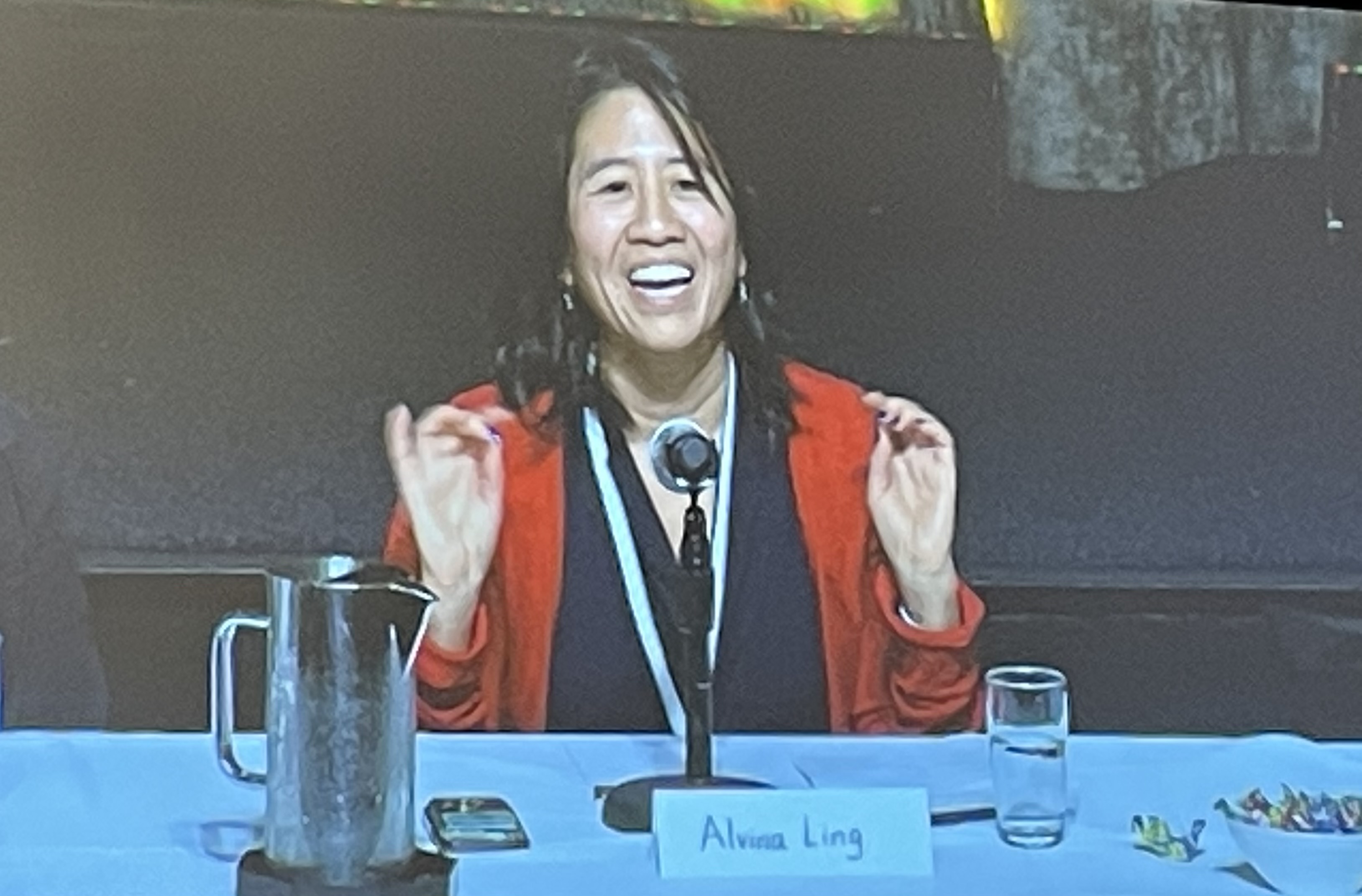
Panel: The Outlook for Children's Publishing 2024 - Alvina Ling & Susan Ven Metre


Alvina Ling is VP and Editor-in-Chief at Little, Brown Books for Young Readers where she has worked since 1999. She edits children's books for all ages, including Where the Mountain Meets the Moon by Grace Lin, The Land of Stories series by Chris Colfer, The Wild Robot by Peter Brown, Ghost Boys by Jewell Parker Rhodes, Troublemaker by John Cho, The Astonishing Color of After by Emily X.R. Pan, and The Cruel Prince by Holly Black. She co-hosts the podcast Book Friends Forever with author Grace Lin. Alvina lives in Brooklyn, NY with her husband and two cats.

Alvina is celebrating her 25th anniversary at Little, Brown. She works on picture books, middle grade, and YA. She has a soft place in her heart for middle grade. Books on the LB list tend to straddle both literary and commercial. 

TeMika :What are you reading?

Alvina: LUNAR NEW YEAR LOVE STORY by Gene Luen Yang and LeUyen Pham 
She just finished reading BIG MAGIC by Elizabeth Gilbert

TeMika: What makes you fall in love to a manuscript? 

Alvina loves books that remind her of the books she loved as a child, books she loves right now, and books she wishes she had as a child. Being drawn in by voice is important, along with feeling like she wants to keep reading even when she's busy. 

TeMika: What is your editorial style? 

Alvina asks a lot of questions. She's not much of a line editor. She loves world building and asking a lot of questions about world building. She says it's collaborative, and more like a conversation. 

TeMika: Are there any things you consider when working with an author/illustrator rather than an author only?

If Alvina can picture what the book would look like from the text, that's important for a writer only. For an author illustrator it's a question of: Do I like the art style? 

TeMika: How do you find illustrators? 

Alvina echoes what the others have said about the importance of social media and websites. Little, Brown also has something they call picture book breakfast where the picture book editors and designers get together and share illustrators they've discovered

TeMika: Trends in picture books?
Alvina has a wish to shift back to more storytelling. 


***


Susan Van Metre is the Executive Editorial Director of Walker Books, a new division of Candlewick Press. Previously she was at Abrams, where she founded the Amulet imprint and edited EL DEAFO by Cece Bell, the Origami Yoda series by Tom Angleberger, the Internet Girls series by Lauren Myracle, THEY SAY BLUE by Jillian Tamaki, and the Questioneers series by Andrea Beaty and David Roberts. She lives in Brooklyn with her husband, Pete Fornatale, and their daughter and the ghost of their Lab mix.

Susan works on mostly fiction and graphic novels. She's also in love with those books for kids aged 8 to 12. Susan is CeCe Bell's editor, who just had a wonderful conversation with Sarah Baker on the stage. 

TeMika: What are you reading? 

Susan: Ever Since by Alena Bruzas

TeMika: What makes you fall in love to a manuscript? 

Susan: The recognition that there are high stakes for kids in the ordinary events of their lives, and how big those feel to a child's life. 

TeMika: Are there any things you consider when working with an author/illustrator rather than an author only. 

For Susan, it depends on the type of book. Susan does get excited when she has an author/illustrator for a graphic novel. But, with picture books there's something wonderful about the partnership between author and illustrator, however the timeline can often be longer. 

TeMika: How do you find illustrators? 

Instagram is important way to find illustrators, as well as having a good website. 

On a final note: As the the panel wraps up, all the panelist see SCBWI as an asset to writers and illustrators in terms of learning and growth, to have a better understanding of the business, and for the all-important community. 

Sunday, February 12, 2023

Kate Egan - The Outlook for Children's Publishing 2023

Kate Egan began her career at Scholastic, then veered into the freelance lane when she moved with her family to Maine. As a freelance editor, she worked with authors from Cynthia Lord to Suzanne Collins, and launched a YA imprint, KCP Loft, for Kids Can Press. Now she is an executive editor at Pixel + Ink Books, specializing in IP publishing. Kate is also the author of many books, including the Magic Shop series and Golden Ticket, a middle grade novel. 

Panelist moderator, Martha Brockenbrough, starts by asking the panel why they choice editing book for kids. Kate notes that for her it's not just a business, it's a mission.  The sense of mission in work really appealed to her in children's books. 

Kate went to a high school with a robust tutoring system and as junior or senior it was real honor to be tapped by a mentor teacher to be a writing tutor. When Kate was tapped, her mentor teacher shared that you don't want to tell the student that the work is bad but that her role was to ask questions so that the writer could come to the improvement of the the writing on their own. The teacher underscored the importance of caring for the young writer. Kate felt she was truly helping and loved the experience. She didn't know being an editor was a job early on, but when she did, she knew editing was for her. 

When asked three words that described their taste, Kate shares: accessible, friendly, approachable and she adds a fourth - humor.

Martha moves onto talking about the process and wondering if it's changed at all in the last few years. This opens up a great conversation between the panelists about auctions, with a clear note that while the money is great, it doesn't mean you get the best editor for your book. 

What stands out to these panelists? Kate says it's often emotional connection, work that moves you. 

A way that the pandemic has changed publishing is that much of the publishing staff is working remotely. An editor can be anywhere now and be part of the process. It's opening door for a more people to become editors, allowing folks to come in from many places and backgrounds. 

Saturday, August 4, 2018

Panel: Culture, Identity, and Writing: Where do They Meet? Dashka Slater

Dashka Slater is the award-winning author of books for kids and teens. Her 2017 young adult true crime narrative, The 57 Bus, was a YALSA Excellence in Nonfiction Award Finalist, an LA Times Book Award Finalist and the Northern California Independent Booksellers Association Young Adult Book of the Year.


Panel moderated by Arthur Levine.

Was there a time during the writing that you felt the joyful intersection of culture, identity, and the work at hand?

The 57 Bus is about two people outside of Dashka's identity and it's not a joyful story, but it was connected to her identity as an Oaklander, a place that has been her long-time home. She felt deeply tied to the story because it was about her community which gave her a deep sense of connection. She knew it so well because it was part of her life.


Dashka comments on the feeling of looking in from the outside. Dashka had an oddball schooling without formal instruction so she had a feeling of not being a "real kid" because she didn't have those touch stones that most kids have related to what it means to be a kid. She would study Archie comic books to get a sense of real school and what "normal" people do. That sense of wanting to understand other people is the drive of being a writer. 

Do you ever feel like you need to sensor a part of yourself? 

The question of authenticity resonates with Dashka being a part of a very assimilated Jewish family. Writing the experience then also became about reclaiming an identity that had been shed in order to survive.

How do the non-visible aspects of culture and identity interact with the more visible ones? 

Having just written a story outside her idenity, Dashka found the struggle in separating what she knew from what she thought she know. She created many layers of checking to be sure she was seeing clearly, or at least as clearly as she could.

As we move forward, what do you want to see? What book do you want? 

Dashka says it's weird, but she's craving more utopian-esque fiction. "I know what I don't want. I want someone to show me the new ways."

Sunday, February 12, 2017

Panel: The Current Landscape for Children's Books - Eileen Kreit

Eileen Kreit is the President and Publisher of Puffin Books, a division of Penguin Young Readers Group, Penguin Random House. Eileen has been at Puffin her entire career.

"I have the best job in the business."

The backlist is their frontlist. 70% of publication are their backlist titles, while 30% is frontlist. The books are republished, not reprinted, and Puffin is always looking for levers to pull to keep those backlist titles part of the current conversation.

How would you characterize 2016 and what do you anticipate in 2017?
There was a change in the New York Times bestseller list very recently. They've removed lists, without giving publishers notice. NYT reallocated staff to Washington DC. Discoverability is changing.

"Look at your brand and how you can grow that."

"The themes of middle grade always keep it relevant."

A benefit of being a bigger house with smaller boutiques within is that they have a great deal of flexibility. They can publish many different kinds of books by a particular author, with an eye toward publishing authors longterm and building careers.

Kids need empathy today and books that provide empathy.


Saturday, February 11, 2017

Panel: Four Types of Picture Books - Andrea Beaty

Four Types of Picture Books: A Closer Look
Panel

Andrea Beaty is the author of thirteen books for kids including the New York Times bestsellers Ada Twist, Scientist and Rosie Revere, Engineer.

After writing Iggy Peck, Architect, Andrea, along with illustrator David Roberts, had created a wonderful class of characters in the book. Creating another Iggy book that would feature that class of wonderful kids didn't work, so they took a closer look at the other wonderful kids in Iggy's class. Those kids had stories too. And so readers now get to enjoy Ada and Rosie's stories.

Andrea tells the room, "If you find something that inspires you, dig into that a little deeper." She encourages us to get to the truth about character. She sees these books as ones that explore character more than the occupations that are featured.


Andrea is not thinking about kids when she's writing a book, but she does think about the kid she's writing about (like Ada). It's more important. "When people say, 'I think a kid would like this,' kids can smell it a mile away."

On rhyme:
"A book tells me if it's a rhyme or if it's not...the book needs to demand rhyme."


Saturday, July 30, 2016

Ingredients of a Successful Picture Book: Barney Saltzberg

Barney Saltzberg is a writer/illustrator and musician. He has written and illustrated close to fifty books for children, including the best-selling Feel and Touch series, which has over one million copies in print.

What is a successful picture book (professionally and personally)?

Barney believes the rhythm of a page turn is so important. It's like music. Also the element of surprise. He wants to write a book that resonates every time.

Picture books are often placed in different categories whether more commercial sales or school and library. What considerations do you make when writing your books?

Barney says he doesn't think about that when he writes the books that I write and the marketing department and schools find where it fits.

On ways you get feedback on your work:

You have to be careful of who you share your work to and at which stage. While Barney did have a critiques earlier in his career, he now has authors/illustrators that he turns to for feedback when needed.

Barney tries not to go into the book store a lot. There are times he see another book and thinks, Wow, I wish I wrote that. As writers, we're trying to find our voice but if we compare ourselves with others, it's going to be a problem.


People like to classify picture books (boy books/girl books). How do you feel about that?

"We live in a world where Toys R Us has a girl aisle and a boy aisle and it drives me nuts."

Barney's next book is called WOULD YOU RATHER BE A PRINCESS OR A DRAGON? Barney's answer is that you can be both. Barney thinks parents will have some issues with this one.


Hey, all...can't wait for this one!

Favorite picture book childhood:


ARE YOU MY MOTHER? by P.D. Eastman

"I remember thinking it was hilarious when I was a kid."

Barney says there's a sense of humor and a sense of angst in the story, and the book works on so many levels. As a kid it appealed to his elevated sense of humor, that he as a kid got this inside joke. Having been lost as a child, there's a sense of wanting to find out what happens.

Final thought:

When getting feedback that Barney doesn't think works for him, he always takes the opportunity to sleep on it first before reacting and making a decision about it.

Don't wait for inspiration, make yourself go to work every day.


Ingredients of a Successful Picture Book: Jessixa Bagley and Don Tate


Jessixa Bagley and Don Tate took part in our panel on picture books. Jessixa is the Golden Kite winner for picture book texts, and Don has won numerous awards for his critically acclaimed texts and illustrations.

What makes a picture book successful? 

There's a sense of completion to it, Jessixa said. It doesn't assume that the reader has knowledge about the subject. There's nothing left hanging. It's like an amuse bouche, a perfect bite. She's also drawn to books with a really deep meaning—a meaning that can be joyful too.

Don loves it when people can flip through his book and know the story by the pictures. He loves making emotional connection with readers. We connect with our readers through emotions. Page turns help guide readers from left to right through the story. "I like it when the illustrator has really done their job ... and you want to linger and live in that space for a while."

When it comes to developing stories for markets 
Don doesn't illustrate books differently on whether they're commercial or more for libraries. Don loves to illustrate books about little-known historical figures, which typically puts his books into the school/library market. This lets him do more school visits.

Jessixa also doesn't think about making books directly for markets, and thinks that books with emotional content can be really useful in school markets.

What collaborations help? 
Don is in several critique groups. They help him make his manuscripts stronger for agents.

Jessixa says you should treat your work like a baby egg. Nurture it until it gets a little more solid, and then you can share it. You won't be as hurt by the feedback. It won't be as bruising. It will be able to hatch. "We've all had the experience where you work on something really hard and you show it to someone and they don't respond to it, and you're gutted."

Advice: 
Don: Be sure to keep your stories child-focused. It's important to engage a child by beginning in childhood. Children like to see themselves represented on the first page of a book. He's not a fan of labeling books by gender. Sometimes, books appeal more to boy than to girls. But you don't need to labels. "Let the readers find them where they will."

Jessixa wasn't a girly girl. She wasn't a tomboy. She was just herself, so she gravitated toward identity-neutral things. There is universality to her work that she wants to extend. "I have a hard time with the fact that there are pink LEGOs and those are the girl LEGOs."

"Allowing the space to have things appeal to more people, whether it's gender or diversity, is going to make us all a lot stronger."


Ingredients of a Successful Picture Book: Jessixa Bagley and Don Tate


Jessixa Bagley and Don Tate took part in our panel on picture books. Jessixa is the Golden Kite winner for picture book texts, and Don has won numerous awards for his critically acclaimed texts and illustrations.

What makes a picture book successful? 

There's a sense of completion to it, Jessixa said. It doesn't assume that the reader has knowledge about the subject. There's nothing left hanging. It's like an amuse bouche, a perfect bite. She's also drawn to books with a really deep meaning—a meaning that can be joyful too.

Don loves it when people can flip through his book and know the story by the pictures. He loves making emotional connection with readers. We connect with our readers through emotions. Page turns help guide readers from left to right through the story. "I like it when the illustrator has really done their job ... and you want to linger and live in that space for a while."

When it comes to developing stories for markets 
Don doesn't illustrate books differently on whether they're commercial or more for libraries. Don loves to illustrate books about little-known historical figures, which typically puts his books into the school/library market. This lets him do more school visits.

Jessixa also doesn't think about making books directly for markets, and thinks that books with emotional content can be really useful in school markets.

What collaborations help? 
Don is in several critique groups. They help him make his manuscripts stronger for agents.

Jessixa says you should treat your work like a baby egg. Nurture it until it gets a little more solid, and then you can share it. You won't be as hurt by the feedback. It won't be as bruising. It will be able to hatch. "We've all had the experience where you work on something really hard and you show it to someone and they don't respond to it, and you're gutted."

Advice: 
Don: Be sure to keep your stories child-focused. It's important to engage a child by beginning in childhood. Children like to see themselves represented on the first page of a book. He's not a fan of labeling books by gender. Sometimes, books appeal more to boy than to girls. But you don't need to labels. "Let the readers find them where they will."

Jessixa wasn't a girly girl. She wasn't a tomboy. She was just herself, so she gravitated toward identity-neutral things. There is universality to her work that she wants to extend. "I have a hard time with the fact that there are pink LEGOs and those are the girl LEGOs."

"Allowing the space to have things appeal to more people, whether it's gender or diversity, is going to make us all a lot stronger."