Showing posts with label Wendy Loggia. Show all posts

Saturday, February 1, 2025

Industry Panel: Wendy Loggia


Wendy Loggia is VP and publisher at Delacorte Press for Young Readers where she's worked for over 25 years. She's just moved into the publisher role. Delacorte publishes middle grade and young adult fiction. They see themselves as a boutique imprint, where commercial and literary intersect. 

On trends

For Delacorte, especially in YA they are thinking about book as object as a big trend: books with beautiful sprayed edges, foiled cases, etc.  Books as collectable items. 

On submissions

Delacorte is actively looking and acquiring manuscripts. 

What's the mark of a good agent? 

Wendy thinks a good agent is a person you want to represent you in a room where you are not present. It's a relationship of true collaboration and partnership. Wendy likes to work with an agent who is nice to work with. 

On professionalism

Delacorte wants to have good communication with their authors. They work hard to anticipate any questions they might have a long the way and they have tools they've created to help their authors. 

On teamwork

There are so many people who work on each individual book. THE LAST BOOKSTORE ON EARTH which was written by an author who, at the time, was a senior in high school. Along the way it has had so many internal layers of thumbprints on it--so many people involved. Not all have as many, but so many people are involved in the making of a book. 

On awards

Awards fall under the purview of school and library department. On the editor side, while they would love for one of their books to get any award, it's not what they are focused on. 

In the spirit of fun, if we looked at your social media without book, what would we see?

Cocktails and the beach. If Wendy wasn't working on books, she'd be at the beach. 

With social media, are you finding people there? Specifically illustrators. 

If Wendy is on Instagram and she sees something she likes, she will save it, but the art department is really on top of it. More often she's not the one discovering the talent. 

None of us get to where we are without help. Can you talk about your mentors? Also your mentees?

Wendy's best mentors where her childhood librarians. Recently when her Little Golden Book came out, Wendy's 8th grade librarian emailed her to tell her how proud she was of her.

In publishing Wendy's mentor was Beverly Horowitz, who was the publisher at Delacorte. Right before Beverly retired, she gave a two-hour class for the company on the history of paperback publishing that was incredible. When she finished people were in awe and didn't want her to leave. Wendy has been privy to that wisdom for the last 25 years. Beverly left such a great legacy, the team now is trying to carry on and pass that down that spirit to the newer team members. 

The legacy you want to leave in one word.

A difference

The Industry Panel begins!

 The Outlook on Children's Publishing in 2025


Our panelists, from left to right: TeMika Grooms (moderator), Andrea Pinkney, Wendi Gu, Wendy Loggia, and Francesco Sedita

Friday, July 31, 2015

The Editors' Panel Begins!

#LA15SCBWI Editors' Panel underway


From Right to Left:

Moderator Wendy Loggia, executive editor at Delacorte Press/Random House Children's Books (primarily MG and YA)

Jordan Brown, executive editor with Walden Pond Press and Balzer + Bray at HarperCollins Children's Books

Allyn Johnston, vice president and publisher of Beach Lane Books, an imprint of Simon & Schuster

Rotem Moscovich, senior editor at Disney-Hyperion

Sara Sargent, executive editor at HarperCollins Children's Books

Julie Strauss-Gabel, vice president and publisher of Dutton Children's Books, an imprint of Penguin Young Readers

Alison Weiss, editor at Sky Pony Press

Friday, August 1, 2014

Editors' Panel: Wendy Loggia

Wendy Loggia is executive editor at Delacorte Press/Random House Children's Books.

The theme for this panel is: 3 + 3: Three things your book should include and three things to avoid.

The importance of voice is top on the list for all of the editors on the panel.

For Wendy, when looking back on particular books she's worked on, a one or two sentence description might not sound all that exciting, but it's the voice of the book that draws in the reader and makes it interesting.

What should writers avoid?

Wendy shares a simple tip: make sure you have page numbers on your manuscript. If you'd like her preference, put page numbers in the bottom, right corner.

Avoid telling an editor that your kids or grandkids love your manuscript. They hear this often.

"It's wonderful when I'm partnering with someone who has a clear imagining of how they want their book to look and feel."

The Editors' Panel!

It's starting!

Lin moderating the editors' panel!

And some close-ups!

Left to Right: Alessandra Balzer, Mary Lee Donovan, and Allyn Johnson


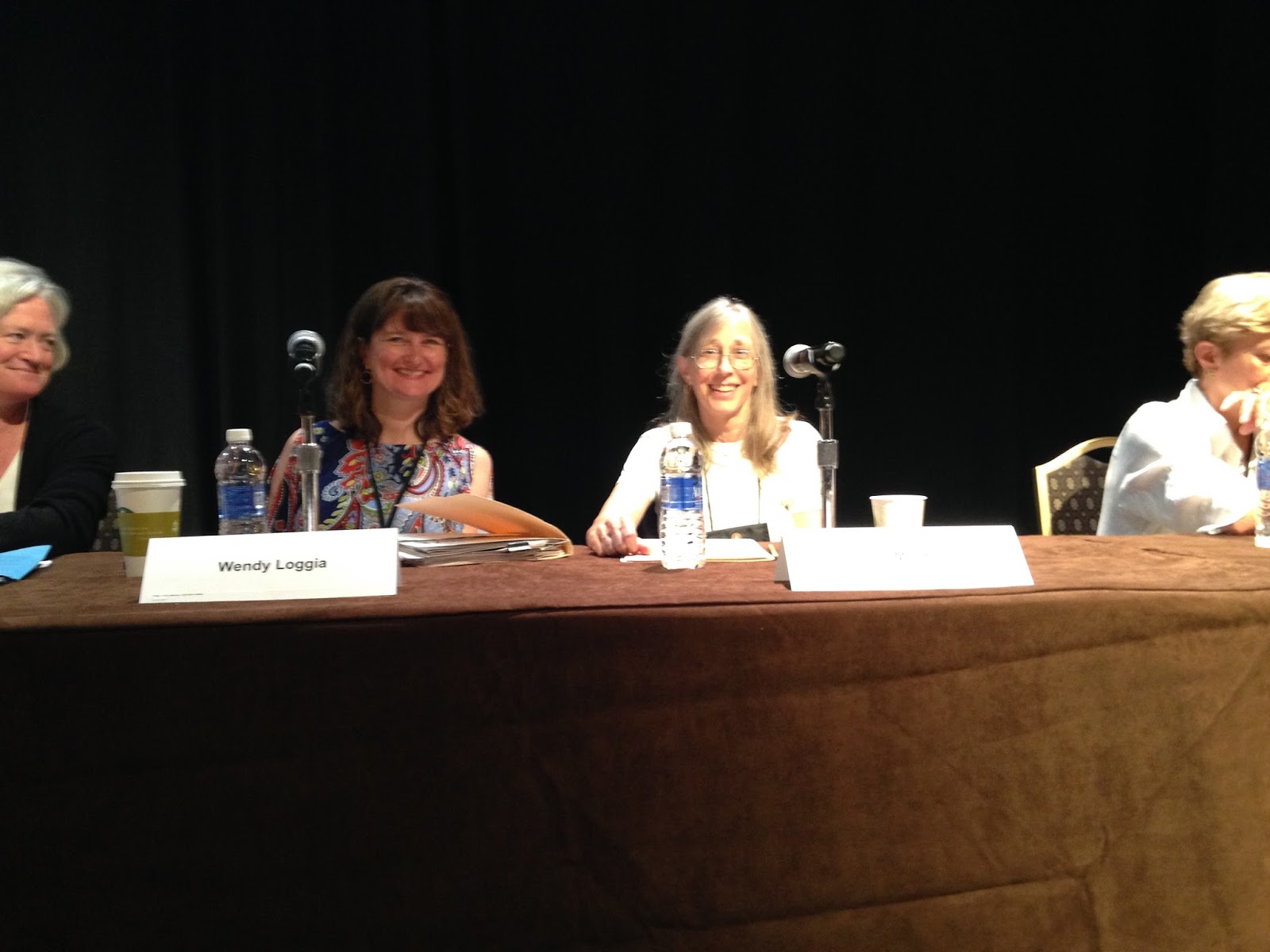
Left to Right: Allyn Johnson, Wendy Loggia, Lucia Monfried, and just a bit of Dinah Stevenson


Left to Right: Dinah Stevenson and Julie Strauss-Gabel


Friday, January 29, 2010

Wendy Loggia On Why SCBWINY10 Critique Day is like American Idol


--Posted by Lee Wind

The Next Step: what to do after a critique

Lin: Do writers need to start on the day that's different?

Ari: Starting on the day that's different is OK. Starting on the moment that's different can be tough because readers don't know enough about the story.

Wendy: Every book is different. It should be organic to the story. And it boils down to the writing, (I can help you with the plot, but I can't help you reshape your writing--it all comes down to that.)

Allyn: The problems I see with beginnings when it comes to picture books, is that they are not the beginnings of picture books, they're the beginning of chapter books. What I'm looking for is one sentence that make me interested, that's a clear beginning. Another common problem--manuscripts written in sing-songy rhyme with lots of alliteration and no narrative arc.

--POSTED BY ALICE

Friday Afternoon Panel: You've Had Your Critique, Now What?


Lin Oliver moderates a panel of (left to right) Wenday Loggia, Ari Lewin, and Allyn Johnston.


Here's a taste:


Allyn: the manuscript that you brought might not be the first manuscript you sell.

Ari: Saw 4 things she'd want to see more of. A lot of action starts but needed to be grounded in world and who character is.

Wendy: The points given to you about your manuscript are not a checklist, but for you to consider - it's your story. See what resonates.


Lots of great advice - and all to a packed house!


-- Posted by Lee Wind

The Next Step: what to do after a critique

Lin: What mistakes did you see.

Allyn: First-person narratives in picture books, and rhyme that's off. Picture books that are on themes that have been done so many times that they wouldn't be salable. (Read books, buy books, go to bookstores, she advises.)

Ari: Manuscripts that started in the middle of a scene.

Wendy: Pages that seemed crammed with information in the beginning. A lack of awareness of the marketplace and what's working

--POSTED BY ALICE

The Next Step: what to do after a critique

Lin: What did you see today?

Allyn:
I didn't ask to buy anything today. I did ask everyone who sat at my table to send me something, but that thing might not be the thing we talked about today. Everyone should go home and think about that.

Ari: I got a lot out of being in a critique group and hearing the comments of the writers who brought up things I didn't think of. It just goes to show that every editor is going to thing a little differently about your work.

Lin: What advice would you offer writers on using the comments they got today?

Wendy: Go home and think about the comments you got today and decide what resonates with you. If you're consistently getting the same feedback, those may be the things you should concentrate on.

Ari: There's always a lot of negotiating between and editor and a writer. Think about the comments you got and if you don't think they'll work for your story, think of another way to solve them.

--POSTED BY ALICE

The Next Step: what to do after a critique

Lin Oliver is moderating the post-intensives panel on what to do post-critique.

Panelists include:

  • Allyn Johnston, Beach Lane Books
  • Wendy Loggia, Random House
  • Ari Lewin, Hyperion

Stay tuned...

--POSTED BY ALICE

Saturday, August 8, 2009

WENDY LOGGIA, "I Wanted to Love This: 7 Reasons Why Your Manuscript Gets Declined"


WENDY LOGGIA, "I Wanted to Love This: 7 Reasons Why Your Manuscript Gets Declined"


Delacorte editor Wendy Loggia's panel focused on the manuscripts that ALMOST were accepted but were not quite ready for primetime. (She was not focusing on manuscripts that were obviously not ready at all, she was focusing on the manuscripts that are ALMOST ready to go.) She felt these 7 tips would help SCBWI members and aspiring writers as they revised their manuscripts.


WENDY LOGGIA BIO: Executive editor of Delacorte Press, an imprint of Random House Children's books; the focus at Delacorte is almost exclusively on middle grade and YA novels. She is the editor of THE SISTERHOOD OF THE TRAVELING PANTS series by Ann Brashares, the GEMMA DOYLE trilogy by Libba Bray, as well as several debut novels by SCBWI members including Kristin O'Donnell Tubb's AUTUMN WINIFRED OLIVER DOES THINGS DIFFERENT and Georgia Bragg's MATISSE ON THE LOOSE.


Wendy looks for a strong narrative voice, great stories, and for writers that display a clear authorial hand. She joked about spending "nine years crushing people's dreams" but then discussed the real reasons as to why she will pass on book submissions.


Some highlights from Wendy Loggia's panel:


-- She tells aspiring writers always to think about WHY someone will want to buy your book. They are going to pull out their wallet and spend 18 dollars or more, so make your book worth it.


-- She will pass on a manuscript that is "too similar to other novels I've worked on." Examples included writers who love THE SISTERHOOD OF THE TRAVELING PANTS series which she had edited, so they submit a novel just like it. She also says she will pass on books that are too similar to other books already in the marketplace. She says they have received a flood of similar Twilight vampire books, books about werewolves, etc.. "Instead of jumping on a trend, write what feels true to you."


-- Voice, voice voice. "I may love the concept, but I can't connect to the voice. The voice wasn't special enough, I don't see teens/tweens connecting to the voice, I think the voice is meant for adult readers. It may have great moments but if there's too much telling or not a compelling voice, I will pass on it."


-- Sometimes she will pass on a book if the author seems to be too much trouble to work with. "Working on a book is like a marriage," she says. "Editors and authors spend a lot of time together sharing ideas. It's not all fun and games. If person feels like trouble before process has even started, I don't want to get involved." She will google people who have submitted their work and read their blogs as part of her research to make her decision. She said "it's like a job interview."


These are just some of the tips she offered. All of Wendy's seven tips were all very helpful and telling to the standing-room only crowd at the main ballroom for both aspiring writers and published veteran writers. Again, another reason why this conference is so great - you get exclusive information that can really help you improve your writing and help you on your journey towards publication. 


Posted by Paula Yoo