Showing posts with label #SCBWISummerSpec. Show all posts

Tuesday, August 4, 2020

Meme Contest Winners!

So at past physical conferences, there was a joke contest... This year, with #SCBWISummerSpec gone digital, there was a MEME contest.

And here (drumroll - yeah, that's virtual, too)... are the winners!

@jmillspaints

@authormamanda

Congratulations to @jmillspaints and @authormamanda - your memes are funny, true, and winners!

#SCBWISummerSpec Agent Panel: Regina Brooks Agent's Panel

    Regina Brooks, CEO of Serendipity Literary Agency and former aerospace engineer, starts off this panel assuring folks that you "don't necessarily need to have an English major" to be successful in the publishing field.  She's says she's "definitively an editorial agent" and enjoys bringing folks from other industries into publishing as she has done. Looking through the authors in her lineup, Brooks believes what makes a book successful is collaboration. Authors and Illustrators collaborating throughout the "entire life cycle of a book" is incredibly important. This collaboration does not only help the story expand itself but also extends "better storytelling about the book after the book is published." 

    She cites examples such as I am Every Good Thing team Derrick Barnes and Gordon C. James, Lubaya's Quiet Roar team Marilyn Nelson and Philemona Williamson who all would meet in their respective illustrators studios to collaborate. Another important thing for Brooks is the trans-media potential of manuscripts. She is always looking for "what other experiences" can be expanded in work. She's working closely with YouTube, other social media professionals, the Calm app, and even orchestras to further share her clients' stories. She tells about a new book coming out soon about the sculptor Augusta Savage and how it will also become a traveling art exhibit! This comes back to the collaboration that Brooks spoke about before, she also values this relationship between agents.
    
    Brooks believes it is critical to look at a book across mediums. The industry right now is very tied to cultural moments and how books are acquired are driven by the need in the market. A couple years ago narrative histories or graphic novels weren't heavily acquired but now the market is wanting more. For illustrators, Brooks suggests looking at their work through a historical lens. Here she cites Crown An Ode to the Fresh Cut illustrator Gordon C. James who structured the style used in the book after 3 distinct pieces to break down stroke, tone, and palette. She also recommends making your work "fresh." Whether that be through merging several formal formats or shifting lengths, these changes have made for successful stories.

    Once asked on accessibility initiatives within her agency, Brooks responds that her agents participate in Twitter campaigns as well as leading their own Twitter campaign on NaNoWriMo. She is more focused on the execution of material rather than the similarity of themes in her roster and doesn't mind having the same themes as long as the execution is done well. On illustrators struggle to find agents she agrees with Linda Camacho that websites are critical as well as reminding that "Instagram is always being sourced for artists." To replace the previously in person tours for this years published books she finds that "mini commercials" through streaming services and social media have been great additions to virtual events. Brooks reminds folks to work with their community to "allow them to help the discover-ability of your books." She states that authors who are a good fit for her usually follow "the three C's;" chemistry, similar communication styles, and be willing to build connections to collaborate.  She smiles and reminds folks,"to be successful, you have to be willing to not have fear or work with your fear."

The Agents Panel Begins!

The Agents Panel at #SCBWISummerSpec
A screen shot of Lin Oliver (top left, moderating) and the panelists Regina Brooks (top right), Linda Camacho (center left), Brooks Sherman (center right), Rosemary Stimola (lower left), and interpreter Jennye Kamin (lower right.)

Jeff Kinney in Conversation with Henry Winkler and Lin Oliver

Jeff Kinney is the author of the wildly successful Diary of a Wimpy Kid series and lives in Massachusetts, where he owns a bookstore, An Unlikely Story. Twitter: @wimpykid

Lin Oliver is the co-founder and executive director of SCBWI. She is also the author of over forty children’s books. With Henry Winkler, she writes the New York Times bestselling series Hank Zipzer: World’s Best Underachiever, which has sold over four million copies. Their chapter book series, Here’s Hank, is also a New York Times best seller. This year marks the launch of their new comedy series, Alien Superstar, from Abrams Books, which debuted at #5 on the New York Times best seller list. Lin’s collection of poetry, illustrated by Tomie dePaola, the highly praised Little Poems for Tiny Ears is a perennial for babies and toddlers. The fifth and final volume of her Fantastic Frame chapter book adventure series from Penguin Workshop is a Christmas, 2019, release. A much-credited film and television writer- producer, Lin is also the recipient of the prestigious Christopher Award and the Eric Carle Mentor Award. Learn more at www.linoliver.com or follow Lin on Twitter @linoliver, or on Instagram @linoliver22.

Henry Winkler is an Emmy Award–winning actor, writer, director, and producer who has created some of the most iconic TV roles, including the Fonz in Happy Days and Gene Cousineau in Barry. In partnership with Lin Oliver, they have written over thirty books for children, including the HANK ZIPZER and HERE’S HANK series, which has sold over four million copies. Their newest collaboration is the ALIEN SUPERSTAR trilogy from Abrams. Twitter: @hwinkler4real


A screen shot of the conversation between Henry Winkler (top left), Lin Oliver (top right), Jeff Kinney (lower left), interpreted by Brian Truitt


Jeff is speaking from a hotel, on his physically distanced book tour. Here's a picture of the long trident he uses to pass books to young readers!


Henry puts it so profoundly, Jeff's selling over 200 million books is amazing: "From your imagination to the page to the kids' imagination."

Jeff shares that kids in China think of the characters in his books “as friends of theirs.” He's focused on stories about teachers, bullies, pets, homework.

Lin follow up with a question about creating characters that are so lovable, and Jeff explains that he originally thought he was writing the books for adults. It was the publisher who decided it was a children's book series. "The humor needed to stand on its own." There didn't need to be a 'lesson'. And so, it wasn't watered-down. The character, "warts-and-all" is what makes it so relatable to kids.

Jeff considers that there's a "bit of an edge" to his Diary of a Wimpy Kid books. "Kids recognize edge." They want to get away from the 'lesson' books and so, when his character Greg does something that gets another kid in trouble, and Greg's mother tells him to do the right thing, and the right thing for Greg is to let the other kid take the fall, that subverts expectations. (and that's funny.) And then Greg's mom takes him out for ice cream. That's causing kids dissonance. (and that's funny, too.) And then, eventually, Greg does the actual right thing.

Jeff says that he's always walking that line, wanting to avoid putting out stories that are bad for the world with the need, as he puts it: "I want to be truthful."

After 20 years of writing, Jeff finished mining his own childhood memories, and tells us that now he has to "create memories." He uses a system called "systematic inventive thinking."
Step 1: take an object, and list its components.
Step 2: use tools on each component: Subtraction, Task Unification, Multiplication, Division, and Attribute Dependency.
He uses it for humor.

An example: They fly by plane. Jeff lists the components of a plane. wings, pilot. Then he uses the tools. Take away wings. take away pilot. How do you get humor? Jeff made his character Greg a pilot in a fantasy sequence, the plane hit turbulence and since Greg didn't know how to solve the problem, he parachutes out of the plane.

Jeff tells us that for each book he writes hundreds of pages, 300-700 jokes. Then he gets it down to best 200 and starts writing.

There's so much more discussed - here's just few more gems from the conversation:

"Humor is my craft. Sometimes I hit, sometimes I miss, but I always try." –Jeff Kinney

"Truth is always funniest." –Henry Winkler

"For Henry and me, if we're laughing, the kids will be laughing." –Lin Oliver

Thanks, Jeff, Henry, and Lin!


A conversation with Laurie Halse Anderson and Meg Medina

We haven't even begun and Laurie and Meg are already tweeting about the energy and passion they're going to bring to the SCBWI Summer Spectacular this morning, our last morning of this amazing event. I have no doubt these two forces in our industry are about to deliver.

Lin Oliver introduces this last day, our dessert day. YUM! My favorite. Let's dig in. (And be sure to shop at the online bookstore and browse the Portfolio Showcase.)

Both Laurie and Meg are prolific and award-winning authors of many books for young readers. 

This session begins as the east coast is being hit by severe weather. Thankfully we've caught Meg at point she's having a break in the weather. "For now, it's all sunshine for our conversation," Meg says.


Meg tell us that they're going to ask each other the things no one ever asks them. Exciting!

Laurie says she came into writing through dumb luck and a lot of mistakes. She hated writing in college. But she was reader, and she was first a journalist. That helped her to communicate effectively in few words. She joined SCBWI and she says she never would have been published if it weren't for that. And Laurie says she even wrote very bad novels. 

Meg points out that it's hard to believe that Laurie wrote bad novels, but we all do. We all write very bad books. 

They both agree to be wary of the term "break out" author. Those breakouts usually have years and years of work before success comes. 

Meg started late, according to her. She started with food reviews and silly articles. Even though she had a lovely life, she felt something was missing. "I wasn't doing the thing I was meant to do." Upon that realization Meg wrote a mission statement for herself. When she did she was ashamed, thinking "who was she" to think that she could want the things she wanted, which was to write books. She still has that mission statement, and looking back, almost all of it has come true. Amazing! (Get to writing those mission statements, friends!)

Meg asks Laurie: How have you changed the most as a writer?

Laurie has learned that she's not as shy as she thought she was. She's grown to know she loves to talking to kindred spirits. Laurie says that she's still learning how to write. She still gets nervous.

Meg agrees, and says she's super cautious as a teacher that students feels like she has all the answers when she doesn't. 

Both Laurie and Meg have written across the many formats: picture book, middle grade, young adult. 

Meg says, "When I began I knew nothing and when I say nothing I mean nada, nada, nada, nada...in the beginning you grab any advice, but you have to be very cautious of that."

Laurie asks Meg: Do you think your craft has changed?

"Yes," she says. "I'm very character driven...I love people...I find people endlessly fascinating. But I have learned to honor plot more."

In discussing writing historical fiction, Meg and Laurie light up, getting excited about the gems they find, like the phases of the moon and what SNL episode was airing at the time of their stories. 

Meg asks Laurie: If you could do something over in your career, what would it be?

When Laurie was an emerging author and SPEAK came out (which she sold un-agented) she had no idea what she was doing. Laurie didn't speak up and ask the hard questions. She didn't share that she didn't think her second novel CATALYST was done. She didn't recognize her power and responsibility. Laurie wishes she would have spoken up. She wishes she could do that one again. 

Meg shares she often wishes she had started earlier. That she had been braver. That she hadn't tried every other career under the sun. But then she thinks she writes to make sense of what she's lived. What would her perspective have been at a different age? So now she thinks of it as coming to it when she was ready. 

Meg asks: Can we talk about legacy? 

This was a deeper conversation here, but to share a bit, Laurie says the concept of legacy is bewildering, but she feels a great responsibility to use it for good. She says to Meg,  "I've spoken to some Latinx authors that see you as a real "auntie."

Meg feels so honored when they say that. Meg tells us, "I want to have made room for the Latinx authors coming behind me. So they are not the only one. Or one of six... " Meg says. "I can't write all the books. I can't write all the perspectives." Meg only has her stories. She wants to encourage more. More!


Authors/books that excite Meg and Laurie now!


First, recs from Meg:


Recs from Laurie:


The LGBTQIA+ And Allies Social

Community.

With special guests Laurent Linn, Lesléa Newman, Bruce Coville, Heidi E.Y. Stemple, Emma Dryden, Marietta Zacker, Jane Yolen, April Powers, and Lin Oliver, over 150 of us gathered in community.

We opened the circle. Screen after screen of live video, seeing each other, acknowledging each other, even those whose cameras were off, knowing we were all there supporting each other,

We introduced our special guests.

We zoomed into breakout groups (rooms) for 5-6 people introductions

We came back for questions and answers with our special guests, talking about safe space between a book's covers and in the world for LGBTQAI+ authors and illustrators, about including diversity in respectful ways and career guidance for those of us writing Queer stories, and more.

Then we zoomed into small breakout groups again, this time organized by what folks wanted to talk about:
PB - those who wanted to talk about picture books and works for children
MG - those who wanted to talk about middle grade books and works for middle grade readers
YA - those who wanted to talk about young adult books and works for teen readers

We gathered back as a large community for a final closing moment, and then over 100 of us stayed and shared for another twenty minutes.

It was powerful. Joyful. And in this moment of physical distancing, socially connected.

As community.

Monday, August 3, 2020

#SCBWISummerSpec: A Conversation with Grace Lin and Alvina Ling


Alvina Ling and Grace Lin smiling into the camera while seated on opposite sides of a table with a recording device between them and their names on placards on table's edge
There are quite a few pictures of Alvina Ling and Grace Lin together on the internet, but this is the one I chose
You're probably thinking "oh for crying out loud, guest blogger Mike Jung, how about not coughing up your personal anecdotes about the faculty for a change," to which my answer is BUT I WANNA. In fact, Alvina Ling and Grace Lin are both lovely, gracious, engaging people who were supremely kind and welcoming to me, as I know they'd be to you too, if we were actually gathering in person. And, AND, I met them both at SCBWI conferences, which is, of course, the type of cool thing that can happen when attending SCBWI conferences.

Photo of Alvina Ling.
Hey it's Alvina Ling!
They're also both dedicated advocates for equitable representation of historically marginalized voices in children's publishing, with long histories of doing that work before it entered the mainstream discourse, and long-time BFFs who co-host a podcast called Book Friends Forever. But that's not all, of course. 

Alvina Ling is VP and Editor-in-Chief at Little, Brown Books for Young Readers where she oversees Little, Brown’s picture book, middle grade, and young adult lists, and edits books on all of those lists too. She's worked with creators such as Peter Brown, Bryan Collier, Ed Young, Wendy Mass, Justina Chen, Chris Colfer, Laini Taylor, Libba Bray, Holly Black, Matthew Quick, and of course, the aforementioned Grace Lin. She's kind of a big deal.

Grace Lin, wearing a blue top and standing in front of the bookshelves in her home office.
The one and only Grace Lin!
Grace Lin is, simply put, one of the most accomplished and influential children's book creators of her generation. She's a Newbery Honor medalist, Caldecott Honor medalist, Theodore Geisel Honor medalist, National Book Award finalist, Today Show Kid's Book Club honoree, Champion of Change for Asian American and Pacific Islander Art and Storytelling (as named by the office of President Barack Obama), New York Times bestseller, New England Public Radio commentator, NYT book reviewer, and TEDx speaker. Her art has hung in the White House. The woman is legit

Alvina and Grace really are best friends forever - they met in fifth grade, wrote endless letters to each other when Alvina's family moved to California, shared an apartment in Boston when Grace blanketing the earth with postcards of her artwork and Alvina was interning at Charlesbridge and The Horn Book, and years later, after Grace had established herself as a respected, working author/illustrator and Alvina had climbed the ladder at Little, Brown for Young Readers, finally worked on their first book together, THE YEAR OF THE DOG, which just so happened to be about their childhood friendship. I mean, seriously, how preposterously sweet is that whole story? You can't make this stuff up, am I right?

Cover image for THE YEAR OF THE DOG by Grace LinThey went on to collaborate on a bunch of books, including Geisel Honor recipient LING & TING: NOT EXACTLY THE SAME, and the middle-grade novel that took hard-working, deeply respected storyteller Grace Lin and elevated her into the kidlit pantheon, WHERE THE MOUNTAIN MEETS THE MOON, for which Grace received the Newbery Honor medal. 

They had yet to work on a picture book together, however, and in fact Grace hadn't done any PBs at all for a number of years. The birth of her daughter proved the catalyst for The Rebirth of Picture Book Queen Grace Lin, however, as well as the onset of the Lin & Ling BFF Era of PB Dominance. Their first picture book together was A BIG MOONCAKE FOR LITTLE STAR, which was subsequently named a Caldecott Honor book. I mean, of course it was, right? It was their first-ever picture book together! That is bananas!

There was too much useful, superbly defined advice to comprehensively note here, but one that struck me was the intersection of Grace's perception of herself - a storyteller, that is, instead of an author, illustrator, or author/illustrator - and her approach to deciding whether she's writing a picture book, easy reader, or MG novel. In a nutshell, she doesn't really decide at all, because as a storyteller, she approaches each story with the tools at her disposal, which are words and pictures. and the story itself will reveal which format it fits into eventually. PBs are good for stories that focus on small, intimate moments - a family ordering food in DIM SUM FOR EVERYONE!, for example - while novels are much more enveloping and engrossing. And of course, novels don't rely on illustrations the way PBs do. Grace's family apparently tells her she's always in a bad mood when she's writing a novel, which I suspect is not an experience exclusive to her family. *cough*

One of the most interesting parts of the conversation to me personally was Grace's very open and easy admission that she's always been and will probably always be harried by imposter syndrome. Her honesty is refreshing - stature of the kind she possesses is too often accompanied by arrogance, after all - and she followed up with what I think is a very important point. Her insecurity and doubts are parts of her, and they might stop her from feeling like the world needs her to make art, but they don't stop her from knowing she needs to make her art, for her own sake. And honestly, it's useful to know that someone as skilled and deservedly feted as Grace Lin still grapples with imposter syndrome, because it's so clear that the imposter syndrome is wrong. Super wrong. Sooooooo wrong. 


A Conversation with Mac Barnett and Jon Klassen

Mac Barnett and Jon Klassen, a kidlit power couple more enjoyable to listen to surely than any Branjelina or Bennifers 1.0 or 2.0.

They've done SIX amazing books together and Jon jokes that they started out as friends but are no longer. Jon is teasing, of course, it's rare authors and illustrators are in touch at all during the picturebook-making process! But these two working closely together equals Caldecott Honors and Horn Book and E.B. White award stickers slapped deservedly on some of our absolutely most favorite picture books of the 21st century. Mac says their working relationship is an 'anabolized' version of the way words and art should work together in a picture book: Two simple organisms (Mac and Jon) combine to be one much stronger, better entity (like the Decepticons combining into The Devastator).

For example:

Mac reads us their book, SAM AND DAVE DIG A HOLE.

88% sure Mac and Jon would not eat this
A book idea that sprang from a lighthearted discussion over heavy breakfast foods on the design puzzle of book trim sizes.

Jon had been talking to Mac about how his I WANT MY HAT BACK series was often difficult to shelve at bookstores and libraries because the books are so wide. So for fun Jon and Mac started spitballing ideas that would lend themselves well to a very tallll book. To Mac and Jon the sky is boring, thus digging down was the answer.

And the art you brainstorm when digging down leads itself very well to being a sequential image series which is another good checkmark to check on the well-made picture book checklist.

Exercise: Try taking advantage of the form or treating something like trim size as a constraint/puzzle to solve even before you pick the plot in a picture book. 

Jon and Mac never start with theme or message, they always start with the characters or a visual joke, and how you push that joke beyond the joke into a deeper meaning is one way you can get to your picture book's message. Most funny ideas, says Jon, if you dig deeper on them have a sincere or sad internal, universal truth.

Another benefit of authors and illustrators working together directly, the ability of the art to change or inform the story. Their initial idea of Sam and Dave moving around and missing the diamonds was much, much more complicated visually and had an entire subplot only in the dirt of sparring skeletons and dinosaurs besides the bigger and bigger diamonds. Mac and Jon scrubbed that big, complicated side plot because not only did the diamonds by themselves get great laughs, just having the large diamonds as the art focus on a page meant the images were readable across a crowded room, which Mac says is an important thing to think about when making a picture book.

He mentions the three levels of connection in the world as they apply to reading picture books:

  1. Only to yourself (kid reading alone)
  2. One to one connection (kid being read to by a caregiver)
  3. One to many (kid being read to in a large classroom setting where it's hard to see tiny picture details so some big compositions will shine)

If your book can hit all three of these levels, bonus points to you.

Questions about authors and illustrators working together:

Even if you aren't in touch, authors and illustrators should still consider themselves as equal parts of a team. Mac says authors shouldn't say "So-and-so is illustrating my book," because a picture book is NOT your book yet, it's not even a BOOK without the pictures, so you need to think of the illustrator as having an authorial seat in the picture book making process, too.


Sunday, August 2, 2020

#SCBWISummerSpec A Conversation With Jacqueline Woodson Hosted By Nancy Paulsen

    Jacqueline Woodson a New York Times bestseller and winner of awards"too numerous to mention" talked this Sunday morning with her editor Nancy Paulsen an "editor of unheralded reputation." After introducing them Lin Oliver, co-founder of SCBWI, explained how excited SCBWI was to be a virtual fly on the wall for their collaborative conversations. Being able to watch just how these two women were so enthusiastic about their work and  joyful to share their canon was an honor.
    Paulsen began the conversation by setting the scene. She painted a picture of life in the 90s, "listening to Micheal Jackson and dancing off the wall." Paulsen met Woodson after winning the Coretta Scot King award, Woodson had several books published in several publishing houses and had "never thought" of the "canon" of her work. Her agent suggested her book to be auctioned and it was the first auction of a children's book in history. Many publishing houses wanted to simply pay her the low rate they had been paying and sent her to "kick rocks." This is where Paulsen comes in; she was "blown away by the lyrical quality [of Woodson's books] and [loved that] they were short too!
     The shop talk started here, with Woodson speaking about how she struggled with Point of View while writing If You Come Softly. She decided to have Ellie's POV be first person while Jeremiah's POV be third person because he is no longer alive to share his story. Woodson explained that since social media wasn't necessarily a thing at the time, there wasn't any widespread videos or other documentation of the police brutality that Black communities face. 
It was surprising for Woodson to hear many people didn't believe that a Black boy would be killed by police in the book. Unfortunately, these occurrences were normal in Black and brown communities. Woodson continued, talking abut editors roles in the writing process. Editors are "putting these slits through your page to let your light come through," she explained. Paulsen chimed in regarding the bending of restrictions around Young Adult and Middle Grade labels saying, "we worked around that." She explained the shift from previous publishing houses, and how middle grade wasn't so clearly defined when Woodson's books were first being published so even now they flip between middle-grade and YA labels. Paulsen talked about Woodsons dedication to reading her work aloud to work through any problems and how Paulsen herself is now doing the same with any book shes working on.
   
     Woodson spoke about the loss of her grandmother 4 months before she was pregnant with her daughter and how this spurred Show Way, her first picture book, and it's focus on matriarchal lineages. They described the process of finding an illustrator for picture books, Woodson expressing that she did get to pick her illustrator though "not a lot of people get to do that." The process for them is simple, consisting of Paulsen sending over illustrators for Woodson to choose from. Woodson explains that when she first wrote The Other Side it was a story about present day segregation but when E.B Lewis finished the illustrations they were all set in the past. She loved the work but recalls she felt like "this wasn't my book." She laughs about it with Paulsen asking, "remember I was so cranky?" She had to tweak the writing of the book adding quick lines such as, "that's my blouse on the line," to further place the book in the time the illustrations showed. Sp many folks were impacted by the book she calls it the illustrations a blessing in disguise. They both believe having it be set in the past helped its' marketability so to speak. Paulsen explaining that setting in the past makes folks more comfortable imagining segregation as an issue of days gone by. Woodson agrees, explaining that she can use the book in classrooms as an entry to speaking about the segregation that still occurs today. Later, Laurie Halse Anderson, another New York Times best seller with her own panel on Tuesday and friend of the pair, asks "is it possible that the time has come to reissue The Other Side with the illustrations Jackie was first thinking about?" "That's interesting!" Paulsen nods. Lin Oliver, moderating the Q and A section, laughs, "I think she wants an answer." Paulsen laughs along and says, "I've learned not to give an answer on the spot."

    Brown Girl Dreaming is the next book they tackle and echo a sentiment from yesterdays conversation with Kwame Alexander and Raul the Third; being an overnight best seller is years of hard work. Woodson set out to write this book to figure out how she became a "not so great student by any means to Jacqueline Woodson." As she wrote she felt as if the book was "so specific to me that I felt it was irrelevant in a way it simply was not." She rewrote the book over 30 times, and with it's success she was surprised with just how many people connected with her work. She laughs as she remembers that some white men had called her and told her of their experience being coached by her grandfather and their love for him and the book. She says she "learned we are part of something bigger." She reads the first poem of her multi-award winner as well, and here one can hear the lyrical quality Paulsen was speaking about. The music of Woodson's words beautifully burst through. Speaking of music, Woodson and Paulson both agree that there is an art in listening. Woodson believes "you can't be a writer if you're not listening- engaging with the world." For Woodson that listening comes with an almost scary accuracy to see precisely where her stories were coming from, she doesn't want to mess with that process too much so she tries not to pinpoint them often.
    The conversation pivots to Woodson's '98 Horn Book essay, "Who Tells My Story" which is as important today as it was when first published. Paulsen believes that "you can write about people you know." Multicultural children's books, as they used to be called, started off with white authors using a "color by numbers" rubric on their books. They would make the best friend of the main character Black and then wonder why kids of color wouldn't read the books. Woodson explains that kids can see right through these types of books. Paulsen agrees and says that her imprint at Penguin is dedicated to books that can be read aloud in classrooms, books that let readers be in "someones else's shoes." She looks for "the kinds of books that win states awards, the ones kids vote on." They both recall the anger of some folks at Each Kindness, specifically its' ending. Woodson laughs, stating "it made them feel some type of way!" She believes it's the loss of a chance to change bad behavior that upset people. She continues, explaining that she was very deliberate writing Maya as a strong character rather than "beaten down." She wanted to pay homage to those kids in the world who felt the same as Maya and center them. 
    
    To close the conversation, Woodson reads her most recent picture book The Day You Begin, and dear reader I'm not afraid to admit I teared up. Once again the musicality of Woodson's words beautifully bursts through and the story is only more lovely. Inspired by her poem "it'll be scary" in Brown Girl Dreaming, it assures readers that there will be folks out there who share your stories. Once in the Q&A section, Woodson was asked what the most rewarding part of writing was. "All of it," was her response. The ever present question of writing for an audience or for yourself was asked. Woodson explained that she writes for herself first and foremost, "I don't think folks should worry about audience too much." She asks herself how she will mold her writing, whether it'll be middle grade, young adult, or otherwise.
She writes responsibly and kindly, making sure that the kids she writes for will be cared for in the worlds she writes. She answers that her writing is always character driven, asking herself "what does a character wants and how will they get there?" Paulsen offers some generative questions that inspire deeper insight into a manuscript; they include "Who're their people?" and "I want to know more."  When Woodson is asked if she has different processes for different genres, she laughs and answers, "Long time ago I would've said yes but now no." She explains that her writing has gotten more poetic across the board citing intentional behind line breaks as an example. For folks eager to know which book she wrote that had taken 4 days, she laughs again and says she misspoke; the shortest one she had written was about two weeks. She smiles, "don't aspire to a 4 day book y'all, it won't be any good!" 

A Conversation with Jane Yolen, Hosted by Heidi E.Y. Stemple

Jane Yolen is the author of over 385 books and at least half of those are picture books. (She’s also written two cookbooks, six graphic novels, well over eighty novels, ten music books, lots of nonfiction, plenty of poetry collections, and has edited anthologies of short stories and poetry.) Along the way her work has garnered a Caldecott, Caldecott Honor, three SCBWI Golden Kite Awards, three Mythopoetic Awards, two World Fantasy Awards, and many state awards. She has been given six honorary doctorates for her body of work from colleges and universities, as well as the Kerlan Award, the De Grummond Medal, Smith College Medal, the Catholic Library Regina Medal, the Jewish Book Award, and an award from the Massachusetts Senate. She was the first writer to win the New England Public Radio’s Arts & Humanities Award, and the first woman to give the Andrew Lang lecture at the University of St. Andrews since the series began in 1927. http://janeyolen.com/

Heidi E.Y. Stemple didn’t want to be a writer when she grew up. In fact, after she graduated from college, she became a probation officer in Florida. It wasn’t until she was twenty-eight years old that she gave in and joined the family business, publishing her first short story in a book called Famous Writers and Their Kids Write Spooky Stories. The famous writer was her mom, author Jane Yolen. Since then, she has published about twenty-five books, including Counting Birds, Fly With Me, You Nest Here With Me, Not All Princesses Dress In Pink, and two Fairy Tale Feasts cookbooks, as well as numerous short stories and poems, mostly for children. Her website is www.HeidiEYStemple.com


Jane and Heidi are in the (virtual) house!

Jane Yolen (top left), Heidi E.Y. Stemple (top right), and interpreter Jennye Kamin (lower)


Jane starts us with a poem (wow!) Here are highlights of the rest:

Heidi's first question: "Why picture books?"

"Because picture books are the closest to poetry as you can get." – Jane Yolen

Picture books are a way, Jane says, that "I'm able to get poetry up. A book that lifts children up, as well."

On process: Jane starts every day with writing a poem. If she "primes the pump" with a poem, she tells us, the rest of the day, her words can flow.

On compression: "Every word has to count. Most words have to move backwards and forwards. They have to resonate throughout the entire book.... Every time you revise, you'll find more words to take out. (Of course, you also sometimes find more words to put in.)"

Jane's tip: Sometimes, if you write a picture book down as if it's a poem... you'll suddenly see all the words that don't belong.

"It's very important to read it out loud. Even more important, have someone else read it out loud to you... The eye and the ear are different listeners."

They discuss three more elements great picture books need:

Lyricism: "a picture book can almost be sung."

Arc: "you need to go from one place to another."

Visuality: "Picture books are meant to be illustrated." Even if you're not an illustrator, "you still have to think visually."

We also get to hear the story behind Jane writing Owl Moon.


They discuss the difference between "the real, the true, and the actual." Jane advises us that sometimes an actual story from life is just an incident. For Owl Moon, she needed an individual child having an emotional experience. It's not a memoir. It's not point for point real, but it is point for point true.

There's so much more discussed, including revision as "re-visioning," the different kinds of books, Jane's productivity secret ("Butt In Chair - BIC."), and the best advice she's received.

Two more inspirational thoughts from Jane to share here...

About the work Jane puts into her picture book manuscripts:

“Sometimes it takes me longer to write a great picture book than a full novel.” 
And about writing in hard times:
“Pick up what is bothering you and turn it into a little piece of beauty.” That’s what writers (picture book writers especially) can do. 
They transition to the Q&A by reading a new picture book they co-wrote, I AM THE STORM, to us. It's beautiful (and beautifully illustrated by Kristen Howdeshell and Kevin Howdeshell.)


Thank you, Jane and Heidi!


#SCBWISummerSpec Editors Panel: Neal Porter

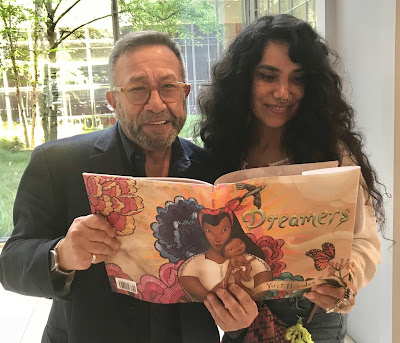
Editor and publisher Neal Porter with author illustrator Yuyi Morales, holding a copy of DREAMERS
Neal Porter, founder and publisher of Neal Porter Books, with Yuyi Morales, author/illustrator of the award-winning picture book DREAMERS

Neal Porter is VP and publisher of Neal Porter Books, an imprint at Holiday House, and is also the founder of Roaring Brook Press, an imprint of Macmillan. His books have won a plethora of awards, including the Caldecott Medal, four Caldecott Honors, Geisel Honors, Sibert Honors, the Coretta Scott King Award and Honor for illustration, Pura Belpré Awards, and the Boston Globe-Horn Book Award, and in 2015 he himself was awarded an Eric Carle Honor in the category of Mentor.

I had the pleasure of meeting and having more than one conversation with Neal at an SCBWI conference at Asilomar a few years ago, and I made a point of introducing myself and expressing my respect because ye gods, the man is having a CAREER, you know what I’m saying? He’s been in the children’s publishing industry for 43 years, with positions at too many publishing houses to even try to list, and works with some of the most heralded authors and illustrators in the field, including my personal choice for The Best Picture Book Author/Illustrator On the Planet Earth Right Now, Yuyi Morales.

A photo of Neal Porter, standing with arms folded in front of a bookshelf
The man himself, Neal Porter.

Neal exclusively publishes picture books - 24 picture books spread across 3 seasons per year, to be exact - and some of the books he’s especially proud of are DREAMERS by Yuyi Morales, NINE MONTHS by Miranda Paul and Jason Chin, HEY WATER! by Antoinette Portis, and A PLACE TO LAND by Barry Wittenstein. In fact, he met Miranda, Antoinette, and Barry at SCBWI events, so, you know, SCBWI has served up a few bottles of that particular flavor of lightning.

Neal’s also done the publishing equivalent of finding a movie star working at the local soda fountain - in his case, the soda fountain being an indie bookstore, and the movie star being future Caldecott medalist Erin Stead - but he mostly hears about new talent from agents. He entertainingly describes the three-person staff of Neal Porter as a “vast empire,” but one which doesn’t accept unsolicited material because, you know, three people. Dude is good with irony.

He was not shy about acknowledging the changes and challenges forced upon the publishing industry by the Covid-19 pandemic. He misses the easy spontaneity of strolling down the hall to chat with colleagues, which is a more formal and ritualized process via Zoom. His list is full through 2022, and looking to 2023 means looking toward a reality we can’t yet predict the shape of. At the end of the day the publishing industry is still a personal, intuitive, and selfish (in the sense of only publishing books he truly loves) one for him, but he second guesses his choices more these days because of pandemic-induced uncertainty.

Neal acknowledges that as a 66 year old white guy, he carries an immense amount of privilege that he sometimes struggles to check at the door, but he finds much inspiration and learning from the examples set by his younger colleagues, and is eager to keep finding new work that prioritizes underrepresented voices, confronts racism, and empowers individuals and communities to rise up. Publishing has proven infinitely adaptable, and he believes a good book will always find its audience, no matter the circumstances.

A screen capture of the #SCBWISummerSpec editor panel on Zoom, with Lin Oliver, Neal Porter, Arthur Levine, Namrata Tripathi, Stacey Barney, Julia Strauss-Gabel, and Jill Santopolo
Lin Oliver, Neal Porter, Arthur Levine, Namrata Tripathi, Julia Strauss-Gabel, Stacey Barney, Jill Santopolo, and Brian Truitt during the #SCBWISummerSpec editor panel.

#SCBWISummerSpec Editors' Panel: Namrata Tripathi

Namrata Tripathi is VP & Publisher of Kokila, an imprint of Penguin Random House, where she focuses on "centering stories from the margins" and expanding the vision of our narrative landscape, endeavoring to "add nuance and depth to the way children and young adults see the world and their place in it."

Tripathi, whose 20-year career in publishing included stints at Atheneum/Simon & Schuster, Hyperion, and HarperCollins, publishes picture books through young adult, fiction and nonfiction projects--all are welcome at Kokila. Of particular interest are children's book creators who have a singular point of view, who reflect on their sense of self and its manifestation in their stories.  Tripathi shared insights on some of Kokila's early and forthcoming titles:

Tripathi is an "agitator" who appreciates stories with multiple layers, like the seemingly simple My Papi Has A Motorcycle, by Isabel Quintero and Zeke Peña, which is about a loving father/daughter ride through the neighborhood on the surface, but also explores themes of gentrification, immigration in U.S. cities, and changing communities. Hair Love, by Matthew Cherry and Vashti Harrison, is also about a loving father/daughter relationship. It includes a celebration of Black hair and Blackness, and it is a vivid portrait of a young Black father just being a nurturing, fun-loving, engaged daddy, a decidedly non-dominant image in today's children's media landscape. "All of our books are creative...but also destructive," Tripathi said about Kokila's work to turn away from harmful narratives that are often considered the "norm". Hair Love went on to become an Oscar-winning short film.

When she sees a need in the world, Tripathi works to bring that vision to life through story. Such was the case with the board book Anti-Racist Baby, by Dr. Ibram X. Kendi and Ashley Lukashevsky. Personal experiences and dialogue with others about "when to discuss race" with young children prompted the development of the bestseller that belied the idea that there was an age "too young" for those conversations.

There are some books, like Veera Hiranandani's Newbery Honor award-winning The Night Diary, that are an immediate straight-to-the heart. match for Tripathi, the ones "that you know that nobody else can do." Her intimate knowledge of the history that grounded that story, and her understanding of what it means to move within and across borders enriched the process of acquiring and editing the book. Additional and forthcoming titles include Randy Ribay's National Book Award finalist young adult novel Patron Saints of Nothing, Traci Sorrell and Weshoyot Alvitre's At The Mountain's Base, Jessica Kim's Stand Up, Yumi Chung!,  and Keah Brown and Sharee Miller's Sam's Super Seats.

The small, but mighty team at Kokila accepts unagented submissions from September 1-December 1 every year. For more about the imprint, its people, and its vision, visit Kokila online,
on Instagram, and on Twitter.

#SCBWISummerSpec Editors Panel: Arthur A. Levine

After a wonderful conversation with Sir Phillip Pullman on Friday afternoon to start off the Summer Spectacular in the best possible way, Arthur A. Levine is back to take part in the Editors’ Panel: Discovering New Talent and Publishing New Books: The Challenges, The Decisions, The Criteria. Arthur has well over 30 years of experience in children’s book publishing. He first worked his way up to Editor in Chief at Knopf Books for Young Readers, and then founded the imprint Arthur A. Levine Books at Scholastic, and after 23 years as its President and Publisher, he founded Levine Querido in April 2019, where he is determined to showcase a diverse range of voices, delivering “The Best of the World’s Literature for Young People” to readers.


Arthur is joined on the panel by Namrata Tripathi (VP & Publisher of Kokila, an imprint of Penguin Young Readers), Julie Straus-Gabel (President and Publisher of Dutton Books for Young Readers at Penguin Random House), Stacey Barney (Executive Editor at G.P. Putnam’s Books for Young Readers), Neal Porter (Founder Neal Porter Books, an imprint of Holiday House), and Jill Santopolo (Editorial Director of Philomel Books, a Penguin Young Readers).  


When thinking about the criteria he uses to find new talent, Arthur speaks of his company’s motto: “Beloved books, beautifully made, giving voice to a world of talent”


And “beloved” is a central consideration when thinking about the kind of books Levine Querido is interested in publishing. 

“We are looking for books that not only do we love reading now,” Arthur says, “but that you could imagine being a beloved book . . . One that stands out for a reader in that special shelf of books they treasure forever.” 

He spoke of the concept of books having an essential truth.
“A book having an essential truth—that there’s some essential truth in that book that you carry away with you and it stays with you maybe for the rest of your life.”

A few examples he gave of books his worked on over his career are:

 
Officer Buckle & Gloria by Peggy Rathmann
Essential truth—Always stick with your buddy
“If you carry that through in the rest of your life, you’ll have something good.”


Mirette on the High Wire by Emily Arnold McCully
Essential truth—Think only of the wire and of crossing to the end
“Truly it’s everything, the project you’re working on. A challenge that you’re facing. If you can break it down, if you can only think of the wire, the path that you’re on and of crossing to the end, you’ll be okay.”


Everything Sad Is Untrue (a true story) by Daniel Nayeri
Essential truth— Your truth, your deep truth is untouchable

Arthur says you need to grab the book August 25th to know the full meaning of its essential truth. J


Levine Querido is all about “beloved books, beautiful made,” which also speaks to the fact that their books will have an “exceptional quality” and lasting appeal.