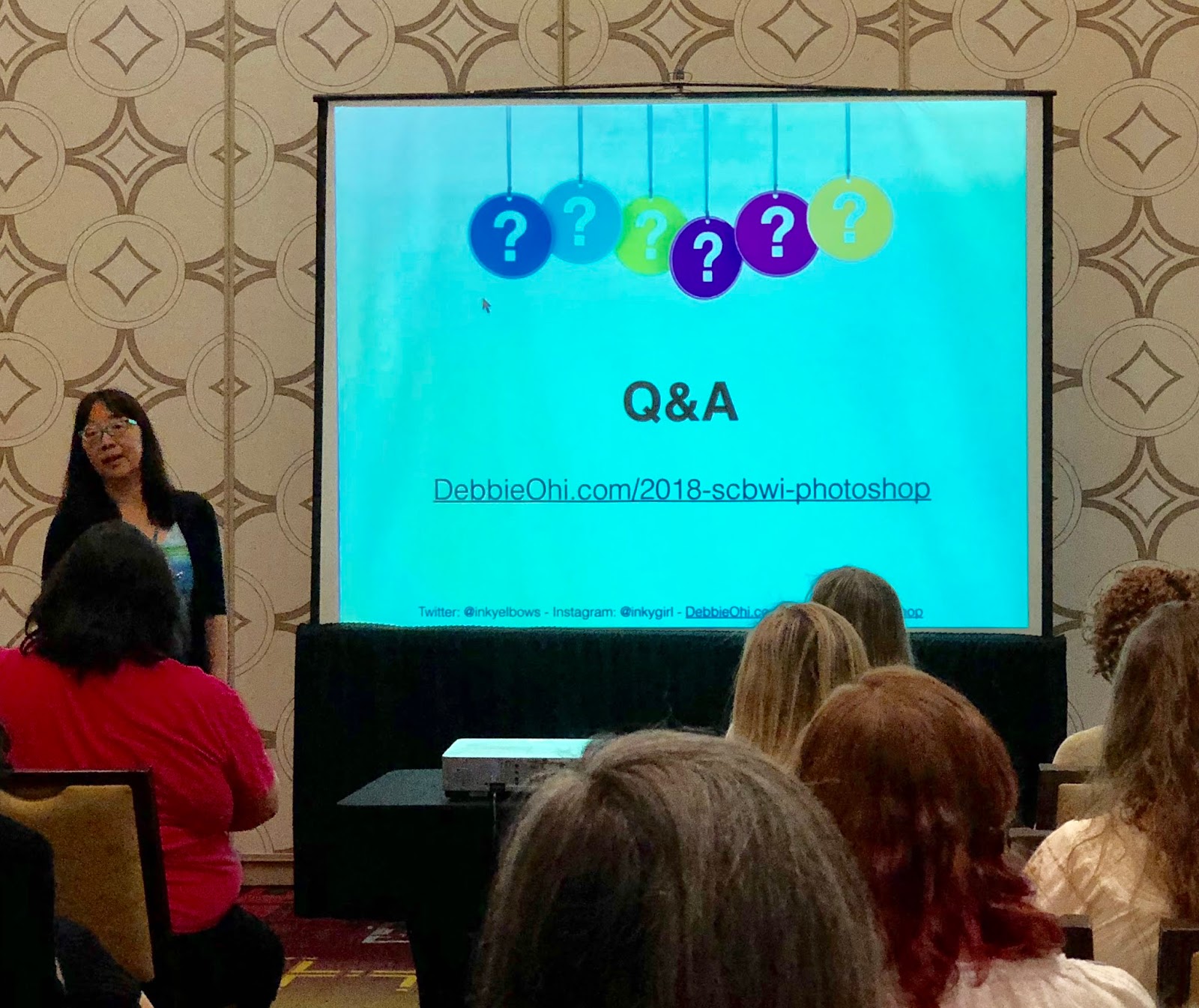
Oh, boy!—what an abundance of information Debbie Ridpath Ohi offered to illustrators. Debbie is a social media guru, but she's also a successful illustrator and an SCBWI success story. She won the portfolio showcase at the 2010 SCBWI LA Conference, and has gone on to illustrate several books, including Sam & Eva and Where Are My Books? (Simon & Schuster), more.
Fortunately, most of what Debbie offered in her workshop is also available on her website, including BONUS MATERIALS!
Showing posts with label business. Show all posts
Sunday, August 5, 2018
Sunday, July 9, 2017
Kwame Alexander: Business Tips for Writers
Newbery winning author Kwame Alexander answered business questions along with his agent Arielle Eckstut.
Some generated tips
- Build relationships with your local independent bookstore even before you sell a book.
- Have a plan that has reach.
- Know what you don't know and surround yourself with people who know.
- When you are searching for an agent, you need to identify all that you want in an agent.
- You've got to make the hard decisions that are going to impact your career positively.
- With his books, Kwame never mentions poetry.
- Consider putting some money aside from an advance for promotion or travel to help promote your book.
- Make connections with librarians and booksellers.
- Marketing energy should all depend on your book, and you know your book better than anyone else.
- Figure out a desired mechanism to engage with your audience when presenting your book. Do it in a way that is you.
- To get love, you have to give love. To give love you have to have it.
- If you don't have the passion driving you, it makes the challenges harder to sustain.
Labels:
#LA17SCBWI,
Arielle Eckstut,
business,
Kwame Alexander
Saturday, August 2, 2014
Justin Chanda: The State of the State of the Industry
Justin Chanda is vice president, publisher of three flagship children's imprints at Simon & Schuster: S&S Books for Young Readers, McElderry Books and Atheneum. He oversees the publication of two hundred and fifty titles per year ranging from the youngest picture book to the edgiest YA.Justin feels he needs to begin by telling us: the e-book has not engulfed our universe; printed things on paper have not been eradicated; self publishing has not taken over; drones are not delivering our books--yet.
The good news is: children still need books.
Get ready! Justin tells us there's a new trend! It's going to change the face of publishing forever. It's contemporary YA. This has been the reaction lately, as if contemporary YA hasn't been done. Tell that to Judy Blume and Laurie Halse Anderson.
This business in cyclical.
Trends are undeniable and influenced by many factors. They are not predictable. You can't write to a trend. If you do, that trend will already be over by the time you're done writing your book. You have to write the book that you are meant to write. "Your voice is the biggest capital you have in this business."
While there are still what is considered girl books and boy books, there's a great rise in gender-neutral books in middle grade. This is great.
Picture books continue their rise back to life. Yes! Successful picture books now tend to have an identifiable character, humor, adult and child appeal, and they are leaning younger (targeting about 5 too 6 year old).
Justin is a huge fan of e-books. They have done a lot help and sustain the reading growth.
There was a belief that ebooks would kill the picture book, but that is not true. The wonderful printed books that you read with a child in your lap are selling more and more.
The adoption of the Common Core standards across the country is now a key focus. People have said it will kill fiction in the classroom. Common Core is far from perfect and we don't even know if it will be around in a few years. Consider that Locomotion by Brian Floca has found great success and is being used in classrooms as part of the Common Core, but it was written well before Common Core was in place.
Our job as writers is to create good books, not to write toward a trend or the Common Core. Just like trends there will be different educational waves that will come and go.
On diversity: It's the responsibly of publishers and publishing houses to publish books that are as diverse as the world we live in. However, the responsibility is not solely in the hands of the publishers, it's also in the hands of those of us writing the books, the agents representing them, the store selling books. We are all in it together.
Our main focus as writers and illustrators should be story. Write books. Illustrate books.
Friday, August 1, 2014
Sarah Davies: Writing and Selling for a Global Marketplace
Sarah Davies is a literary agent at The Greenhouse Literary Agency.
She has deep experience in this business, both as an editor and an agent. For more than 25 years, she was a publisher in London, working with the likes of Judy Blume, Meg Cabot, and Karen Cushman. Her agency, launched in 2008, is based in both the U.S. and London. She considers both the U.S. and U.K. her domestic market, and represents writers in both places, although most clients live in the United States.
Greenhouse's affiliate Rights People is the top seller of international rights in the business. Being international is part of the agency's DNA.
She gave us a detailed talk about the international aspects of publishing, which she finds "quite exciting." She also walked us through the anatomy of a complicated deal simultaneously struck on both sides of the Atlantic.
Some excerpts from her remarks:
Why care about foreign sales?
These sales mean more income for writers. The biggest contenders are Brazil, France, and Germany. Your advance can equal or exceed a U.S. advance. They can also lend prestige and profile.
"Success breeds more success," she said.
Territory is where all negotiations begin, she said. Publishers want as much exclusive territory as they can get for as little money as possible. Her agenda as an agent is different, but there are three types of territorial contracts she can make:
In terms of book publishing, all sales play into making your brand and your book bigger, she said. Buzz goes on internationally and nationally. And the book business is a small, interconnected world.
A book called HALF BAD by Sally Green holds the record for foreign sales: 40 countries before it was even published.
On how books get buzz (a few of her observations):
She told us about some "shadowy figures" known as book scouts who live in NYC and London network with agents to find the hottest upcoming properties. They usually represent foreign publishers and film clients. "They are desperate for early information and hot tips," she said.
Book fairs also spread buzz—Bologna and Frankfurt (which is all books, not just children's books).
Publishers Weekly lists deals. There's a free newsletter you can subscribe. Publishers Marketplace also has a subscription service.
Follow Sarah on Twitter.
Learn more about The Greenhouse Literary Agency
She has deep experience in this business, both as an editor and an agent. For more than 25 years, she was a publisher in London, working with the likes of Judy Blume, Meg Cabot, and Karen Cushman. Her agency, launched in 2008, is based in both the U.S. and London. She considers both the U.S. and U.K. her domestic market, and represents writers in both places, although most clients live in the United States.
Greenhouse's affiliate Rights People is the top seller of international rights in the business. Being international is part of the agency's DNA.
She gave us a detailed talk about the international aspects of publishing, which she finds "quite exciting." She also walked us through the anatomy of a complicated deal simultaneously struck on both sides of the Atlantic.
Some excerpts from her remarks:
Why care about foreign sales?
These sales mean more income for writers. The biggest contenders are Brazil, France, and Germany. Your advance can equal or exceed a U.S. advance. They can also lend prestige and profile.
"Success breeds more success," she said.
Territory is where all negotiations begin, she said. Publishers want as much exclusive territory as they can get for as little money as possible. Her agenda as an agent is different, but there are three types of territorial contracts she can make:
- One for North American rights (usually U.S. and Canada) - the publisher can publish in English in those two places, their dependents, and the Philippines.
- World English language - the publisher can sell your book anywhere in the world in the English language.
- World rights in all languages. Subsidiary rights are potentially very valuable. There are good reasons for your agent to sell them to your publisher, e.g. if your publisher has a good track record of selling your rights. These count to erode your American advance, which is good for the writer. There are also good reasons to retain those rights, and Greenhouse tries to do just this.
In terms of book publishing, all sales play into making your brand and your book bigger, she said. Buzz goes on internationally and nationally. And the book business is a small, interconnected world.
A book called HALF BAD by Sally Green holds the record for foreign sales: 40 countries before it was even published.
On how books get buzz (a few of her observations):
She told us about some "shadowy figures" known as book scouts who live in NYC and London network with agents to find the hottest upcoming properties. They usually represent foreign publishers and film clients. "They are desperate for early information and hot tips," she said.
Book fairs also spread buzz—Bologna and Frankfurt (which is all books, not just children's books).
Publishers Weekly lists deals. There's a free newsletter you can subscribe. Publishers Marketplace also has a subscription service.
Follow Sarah on Twitter.
Learn more about The Greenhouse Literary Agency
Labels:
agents,
business,
international,
Sarah Davies
Saturday, August 4, 2012
Deborah Halverson Keynote: An Up To The Minute Survey Of Market Needs and Trends
| Deborah - on the big screen! |
Deborah Halverson is the source of one of the most valuable gems in the conference packets, "The 2012 SCBWI Market Survey: Publishers of Books for Young Readers."
She's giving us the behind-the-scenes info on the 16 page report, with the goal to enlighten us on what's going on behind the numbers - which might help us decide which projects to work on, and who to submit them to.
Some headlines...
Picture Books - the market is improving.
There's a trend of shorter, character-driven stories.
Middle Grade seems to be doing stronger than YA.
There's paranormal and dystopian fatigue.
She's sharing about ebooks, answers the question: are editors looking to acquire self-published works?, shares how most editors are acquiring from agent-submitted works, and how most agents are finding their clients through referrals and conferences.
It's honest, upbeat, and valuable, and now everyone is going to study and bookmark and dog-ear their copy of the "2012 SCBWI Market Survey."
Thanks, Deborah!
Labels:
#LA12SCBWI,
business,
Deborah Halverson,
Lee Wind
Subscribe to:
Posts (Atom)


