Showing posts with label Illustration. Show all posts

Friday, August 1, 2025

Creating Winning Picture Book Biographies with Don Tate

 Don Tate is an award-winning author and/or illustrator of numerous critically acclaimed nonfiction biographies for kids including (this is a partial list!) Carter Reads The Newspaper, No Small Potatoes: Junius G. Groves and his Kingdom in Kansas, Whoosh! Lonnie Johnson’s Super-Soaking Stream of Inventions, The Amazing Age of John Roy Lynch, Poet: The Remarkable Story of George Moses Horton, It Jes’ Happened: When Bill Traylor Started To Draw, Strong As Sandow: How Eugen Sandow Became The Strongest Man on Earth, William Still and his Freedom Stories: Father of the Underground Railroad, Jerry Changed The Game! How Engineer Jerry Lawson Revolutionized Video Games Forever, and Swish! The Slam-Dunking, Alley-Ooping, High-Flying Harlem Globetrotters.


In today's fantastic session on crafting picture book biographies Don demonstrates the power of finding your next nonfiction story by looking for what was missing from your own childhood library and shining a light on the role models you wish you'd been able to read about when you were growing up. 

Little Don!

Don, growing up in Iowa, did not see black men as heroes in the books of his school or public libraries—in highschool he was assigned to read European folktales, Edgar Allan Poe, Thoreau, Steinbeck, Hemingway. Don felt like these books weren't for him, but for his white friends. And that didn't change after college when Don's new job as a book designer for an educational publisher had him designing guides for, you guessed it, European folktales and books by Edgar Allan Poe, Thoreau, Steinbeck and Hemingway.  But that publisher also had him designing a guide for a book he'd never seen before, Black Boy by Richard Wright.


It was the first time Don had seen a black male centered in a book, the first book he could really relate to. Don says that Wright's autobiography saved his life and is what made him a reader. Don went on to read the biographies of Frederick Douglass, Malcolm X, Claude Brown, Nathan McCall, and many more. Don saw himself in these black men in America who faced obstacles, most often racism, and how they overcame these obstacles to contribute greatly to the American story. All of which was so inspiring to Don that when he entered publishing he knew he wanted to create books that were missing from his childhood library with subjects such as these inspiring men. 


And that's just the first bit! The rest of Don's session takes us deeper into how to find your next biography inspiration (including thinking of heroes in our news today, not just of the past), he shares tips on research (we all bow down to the amazing resource that is librarians!!), and ways for artists to develop their written voice (super cool tips from Don and how he uses 'mentor texts').


Friday, August 4, 2023

Making A Living as an Illustrator: Balancing Career, Values, Income, & Play with Susie Ghahremani

Susie Ghahremani is an award-winning artist whose work is licensed, exhibited and sold internationally under the brand boygirlparty. She's also a RISD alum whose children's books include STACK THE CATS, SHE WANTED TO BE HAUNTED, as well as many others. 

In Susie's session she shared examples of the many streams of income she's set up and how they do or do not fulfill her personally, professionally, financially and creatively. This was such a helpful way to think about prioritizing and assessing one's own potential income streams. Susie shared a ton of great, personal career information while walking us through how and what she works on. 

Besides making children's books Susie also makes her own products, takes part in art shows, does editorial illustration, takes commissions, runs an Etsy shop, licenses her art, teaches, and on top of all that makes things just for the fun of it! Susie has a Patreon where she's graciously set up a blog post answering all the Q&A audience questions from her SCBWI conference session. (I've already asked (demanded) she consider hosting a class series expanding on this session, so whenever that happens I will update this post with that link here 😗). 

Susie's books

A sample of Susie's latest products

Susie broke down how each income stream positively or negatively impacted her career, values, income, or opportunity for play and creativity giving attendees an excellent framework to use for themselves. 

Here Susie shows how personal work and public events align for her:


Susie gives some tips on working on your own products vs. working with a team/publisher/collaborators. There are a lot of risks with making your own products and work, but it's also full of really big joys and unexpected wins. Making books with a publisher lets them take on more upfront risk and can also be full of big joys and unexpected wins, but most books do eventually go out of print and that's sadly not in your control.

Self care for long-term career and physical longevity (Ott lights!), taxes, and so many great tips in general are touched on!! Susie has had to battle copyright infringement (she was interviewed on NPR!) and does an amazing job in the session of helping attendees understand how to protect their work and themselves (this could be a standalone class all on its own).

Susie touched on overwhelm with juggling so many different income streams. She has found a balance that energizes her, but doesn't expect anyone else to follow that. She recommends knowing yourself and accepting where you are at—everyone has different physical, emotional, and mental capacities to consider when figuring out life and career goals.

Susie’s next release will be the picture book MEMORY GARDEN written by Zohreh Ghahremani (her mom!), publishing in 2024 with Godwin Books / Macmillan. 


Friday, February 11, 2022

Brian Selznick's Opening Keynote: Everything Changes, Nothing Ends: Telling Stories

Brian Selznick broke open the novel form with his innovative and genre-breaking books creating an entirely new reading experience. He is the Caldecott Medal-winning creator of the #1 New York Times best sellers The Invention of Hugo Cabret, adapted into Martin Scorsese’s Oscar-winning movie Hugo; and Wonderstruck, adapted into the eponymous movie by celebrated filmmaker Todd Haynes, with a screenplay by Selznick; as well as the New York Times best sellers The Marvels and Baby Monkey, Private Eye, co-written by David Serlin. Most recently, he illustrated the 20th anniversary paperback edition covers of J.K. Rowling’s Harry Potter series. His books have garnered countless accolades worldwide, and have been translated into more than 35 languages. Selznick's latest novel is Kaleidoscope, a multi-layered story about love and loss told over the course of twenty-four chapters, each featuring an iconic black and white graphite illustration.

What an exciting way to start off the 2022 Winter Conference - with Brian Selznick!

screenshot of, on left, a photograph of a red apple with a green leaf attached to its stem. On right is (at bottom) Brian Selznick speaking, with (at top) ASL interpreter Brian Truitt
What is this? Brian tells us it's not an apple. It's a picture of an apple.
(Brian Selznick at bottom right, ASL Interpreter Brian Truitt top right.)

Do you write the word "apple" or do you illustrate it? Citing wisdom from one of Chip Kidd's TED talks, Brian tells us "don't do both." (Doing both means you don't trust your audience.)

Brian shares that the title of this talk, "Everything Changes, Nothing Ends" is from Ovid's Metamorphosis, and is the epigram of his book Kaleidoscope.

Just a few resonant quotes from Brian's talk:

"As story makers, as book makers, we are always talking to the future." —Brian Selznick

and

"The act of turning the page makes a book a machine." —Brian Selznick

and

"Figuring out what to draw is important. Equally import is figuring out what not to draw." —Brian Selznick

and on writing a book about silent French cinema (The Invention of Hugo Cabret), whose success was a "wondrous" surprise:

"I know it's important to pursue what it is you love...what you feel is important." –Brian Selznick


Among the amazing photos and illustrations shared is this interior view of Brian's studio when finishing one of his books!

screen shot from Brian Selznick's presentation, at left a photo of his studio with one wall completely covered with black and white illustrations, at bottom right is Brian Selznick, and at top right is the ASL interpreter Brian Truitt

And this illustration from Kaleidoscope:

screen shot from Brian Selznick's keynote, at left, a Kaleidoscopic image from Brian's latest book, Kaleidoscope, and at right top Brian Selznick, and at right lower ASL interpreter Jennye Kamin

Brian discusses the evolution of his creative process during the pandemic, inspiration he pulled from books including Fortunately by Remy Charlip, and Where the Wild Things Are by Maurice Sendak, and so much more...

What a storyteller!

Thursday, May 7, 2020

#SCBWIdigital workshop: Laurent Linn and Cecilia Yung present "Two Art Directors Talking: The Theater of Picture Books"

Today's full workshop title is "Two Art Directors Talking: The Theater of Picture Books - The Art of Bringing Visual Elements Together For Storytelling."

Our experts are Laurent Linn (Art Director, Simon and Schuster Books for Young Readers)
and
Cecilia Yung (Art Director and Vice President, Penguin Books for Young Readers).

Both Laurent and Cecilia are also on the SCBWI Board - so giving back to this community (including the 1,200+ of us watching live) is something they do with heart and passion.

Lin introduces them, saying that they both create picture books that are "as much works of art as they are books."

Clockwise, from top left: Lin Oliver, Laurent Linn, and Cecilia Yung

Laurent opens by speaking of how it's not just one thing, "It's everything coming together to tell a good story."

In reference to our current global pandemic, he says,

"Stories and art have survived through every catastrophe of civilization... Now is the time, not just the world needs your stories, but we - I'm a writer and illustrator also - we need to tell our stories."

Cecilia begins by discussing the inner life of the character or story, which transforms how we the reader see ourselves, and/or the world.

She suggests questions we should ask ourselves:
The most important question is "why?"
Who is your reader?
What is the take-away?
What is your difference - that unique something that only YOU can do to distinguish this book from all the other picture books that have been published?

They dedicate today's workshop to Tomie de Paola - calling him a master who "used the book as a stage."

Read Lin Oliver's remembrance of Tomie dePaola here.
Walking us through visual examples from books they've art directed, they teach us different principles.

From Misty Copeland's nonfiction picture book "Bunheads," illustrated by Setor Fiadzigbey, Cecilia shows us the drama and theater of the illustrations.


Notice the top left page, where Misty is so dedicated she shows up early to practice but her friend is already there in the studio! Cecilia speaks more of how the illustrations in the book show that friendship, and the competition between them that drove each dancer to excel.

From the fiction picture book "Sulwe" by Lupita Nyong', illustrated by Vashti Harrison, Laurent points out how even the sky is a character:


"Nothing should be generic," He advises us, adding, “Often the more specific makes it universal.”

They speak and show examples from many more picture books, discussing character design, costume design, controlling the direction of a reader's eye, getting to the heart of the emotion, narrative, and so much more.

There's a Q&A that ranges from white space to compositional tools (line composition, color composition, and light/shadow), to the selection of an illustrator.

It's a master class in how two brilliant art directors look at and think about picture books and the illustration of picture books.

Thank you, Laurent and Cecilia!

Stay safe, all.
Lee

p.s. - Did you miss it? The video is available for 30 days to SCBWI members here.

Saturday, August 10, 2019

Ben Clanton - InterPLAY: The FUNdamentals of Pairing Pictures and Words

Ben Clanton is the Eisner award-winning author and illustrator of books like the Narwhal and Jelly series and Rot: The Cutest in the World. He's also an editor for Little Bigfoot in Seattle.

Just going to share a tiny tiny bit from his presentation! Sorry!

Here are some questions to ask to see if your picture book will be wonderfully interactive:

Is it relatable?

Does it have some unique or interesting angle to it?
I remember meeting Ben a million years ago and he has ALWAYS loved and talked up Viviane Schwarz's There Are Cats in This Book. It remains an excellent example of interactivity in a standard paper book.

Strong central characters that come alive?
Ben says he can probably name more fictional characters than he can real people, and that he may have more fictional friends than real ones. Which he says may sound sad but trust him, he's happy with it that way!

Does it invite the reader to participate?

Does it have enough negative space/white space to let the reader's imagination have space to play?

Is there a subversive element?
Ben loves to use No, David! as a great example for this.


Author Panel: Birth of a Picture Book - Suzanne Kaufman

Suzanne Kaufman
Suzanne Kaufman is an author-illustrator of Confiscated. She has also illustrated several other picture books, including the New York Times bestselling picture book, All Are Welcome and the recently released Take Your Pet to School Day.

She shared that her creation process is complete and utter failure and displays a slide with a stack of sketchbooks several feet high, which she would "rather call play." Suzanne also considers her work to be therapy. When she's sad about the world, she creates art.

Working on nonfiction picture books gives her so much freedom, citing her work on 100 Bugs: A Counting Book. She also shared that she looks for real people—that unique, authentic self—to portray.

Her most recent release
How do you choose touches that are unique to the book you are working on?
When asked what touches are unique to books you work on, Suzanne shared, "It's subversive. The librarian in All Are Welcome is Maya Angelou. I put as much as I can in each illustration. Basquiat is my biggest inspiration."

For more information about Suzanne and her work, visit her website or follow her on Twitter.

Sunday, August 5, 2018

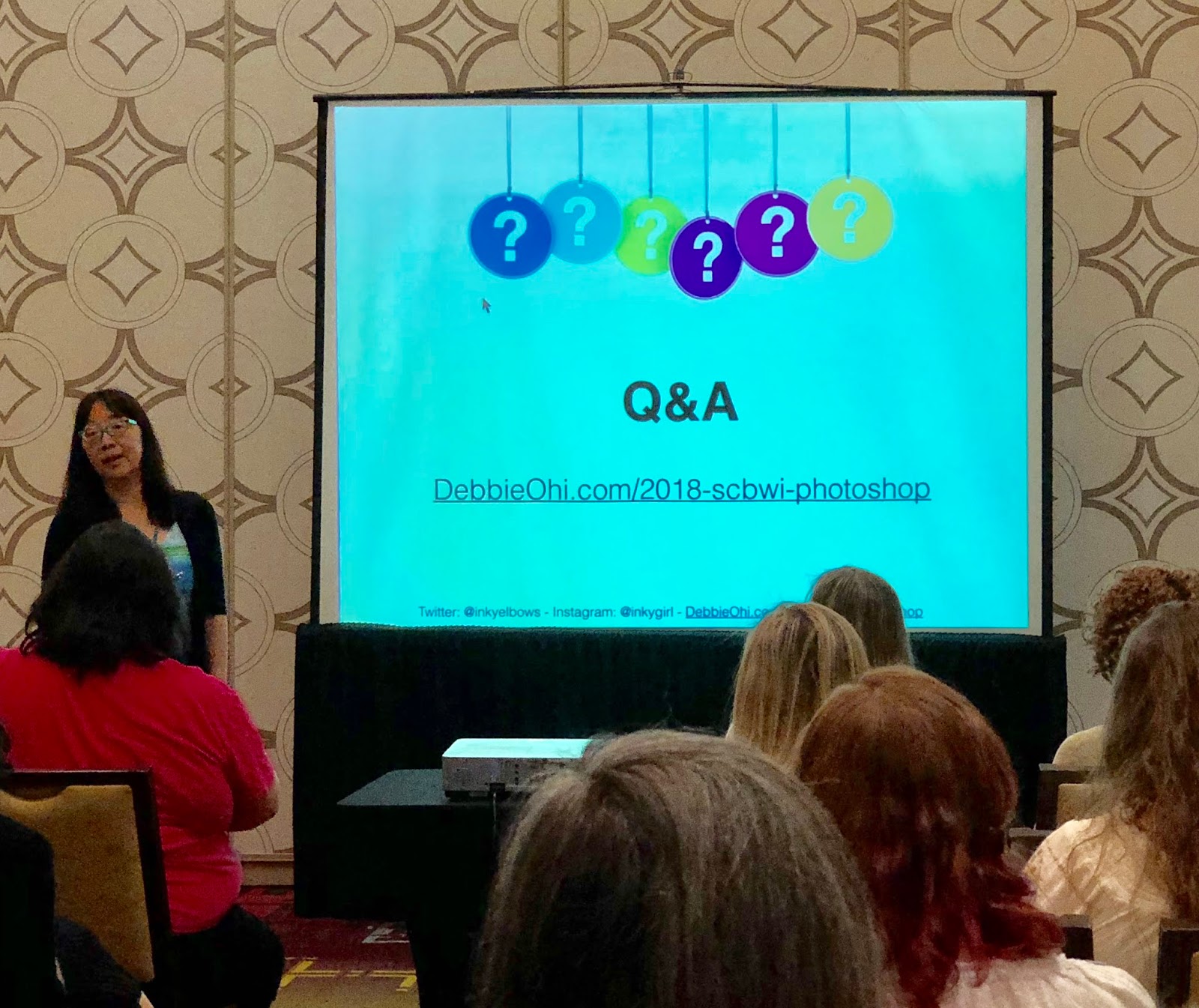
Photoshop Tips for Illustrators: Debbie Ridpath Ohi

Oh, boy!—what an abundance of information Debbie Ridpath Ohi offered to illustrators. Debbie is a social media guru, but she's also a successful illustrator and an SCBWI success story. She won the portfolio showcase at the 2010 SCBWI LA Conference, and has gone on to illustrate several books, including Sam & Eva and Where Are My Books? (Simon & Schuster), more.

Fortunately, most of what Debbie offered in her workshop is also available on her website, including BONUS MATERIALS!

Lily Malcom: Conveying Emotion: Breathing Life into Your Characters

Lily Malcom is Vice President and executive art director of Dial Books for Young Readers. She's art directed many great books and talented illustrators including Corinna Luyken, Judy Schachner, David Small, Zach O'Hora, Erin Stead, Jerry Pinkney, and Jon Agee.

Lily shares a number of awesome tips to make your characters unique and bursting with... character.

Here are a few:

Main characters can convey emotion through their eyes, yes! But be sure that emotion spreads to their eyebrows, too. And what other accessories can be emotive? Think of Ladybug Girl's wings for a start.

The size and placement of your characters on the page are hugely important. You can use that space that they take up on the page and the way it changes page to page to make a huge impact. A big change in size or placement of a character page to page results in a powerful page turn that shocks the reader. You can also speed up the action this way, or slow down the action with spots and vignettes.


Visual narrative, Lily explains, is what is shown on the page, it’s separate from the text, and should bring something new to the text. Visual subplots of characters not even mentioned in the text are fantastic as long as they aren’t scene stealing from the main plot and main characters. Think of Judy Schachner's elephant in SARABELLA'S THINKING CAP.


Lily shares with us some of the AMAZING spreads full of supporting character action from Jon Agee's forthcoming THE WALL IN THE MIDDLE OF THE BOOK. Go preorder it now.

To get to your most powerful page turns, Lily recommends you sketch it all out in dummy format on cheap paper, even if it’s over 32 pages that you end up sketching, get all your ideas out. She says you can then go back and kill your darlings.


Lily always prints out and tapes together dummy books to go through with the editor to see pages turns so there’s drama and cliff hangers on as many pages as possible.

Sunday, July 9, 2017

Vanessa Brantley Newton: Digital Art, Best Practices.

This session is so much more than best digital art tips!

Vanessa talks a bit about how she started to learn how to illustrate. She followed every possible illustrator and animator blog, did all of the Illustration Friday prompts. She copied her favorite artists like Sasek and Blair, but then adding her Vanessa interpretation. She works both traditionally and digitally, and is a perennial student in both. Vanessa stalks Youtube and still enrolls in things like Lilla Rogers classes. She tells us to make a lab for yourself, take a day to learn how to do something on Youtube and improve all your illustration weaknesses in this customized fashion. Paint your own textures and papers so you have your flavor in those textures and also so you don't need to rely on stock sites or worry about copyright.

To Vanessa, the ideal is: You want to get to that point where people can't tell, even art directors, if it's digital or traditional.

Dyslexia made Photoshop and Illustrator's complicated workspaces too difficult for her to work in, but Vanessa found that Corel Painter had a simpler tool panel that she was able to master quickly. One of Corel's drawbacks is the inability to add texture to those digital drawings, so after all of the drawing and flat color is done in Corel, Vanessa brings that art into Photoshop to add her texture and collage elements.

She uses Photoshop to put together her sketch dummies, too.

She collects all kinds of fabric, paper, she makes her own paper, too. You can buy textures, but Vanessa recommends taking your camera outside and taking photos of textures and building your own digital library. You can add photographs to your work to add dimension, too. Photos from flea markets!

MARY HAD A LITTLE GLAM was hand drawn first, scanned, and then colored digitally.

For her Hallmark work, she used the Corel Draw airbrush tool.

She shares art made just a few weeks ago, it's made with a scanned piece of linen fabric with multiple layers of color overlayed over the linen layer and then she uses the Photoshop scissor tool to cut out shapes on that color layer. Amazing! Here is my terrible screenshot of it, I'm sorry I can't do it justice here.


Vanessa asks us to all bring diversity into your art, we are all different colors, we have all different hairstyles, don't go for stereotypes.

Javaka Steptoe: Picture Book Panel

Javaka Steptoe is an award author/illustrator whose most recent book Radiant Child, a beautiful biography of Jean-Michel Basquiat, was this year's Caldecott recipient. Other notable titles include What's Special About Me, Mama? and Jimi: Sounds Like a Rainbow.

Javaka uses everyday object in his art.

"I come from a place of trying to not just create an illustration but to create an experience." Javaka remembers as a child he didn't sit and draw quietly, he made noises and felt emotions. "I don't want to draw you a map, I want you to be immersed in whatever I'm creating for you."

The materials Javaka uses to illustrate are ones that will help bring readers into the world he's creating. For kids it's amazing because they feel like the materials might be something they also have access to. The materials act as a bridge.

Javaka says that when writing you have to find an idea that sustains you throughout the project. Ideas can come from anywhere. Life is where you get your ideas from. Once Javaka has that idea, he does the research and tries to experience the idea in every way possible. "You shouldn't force a story," he says. "Let it be something that happens in a comfortable way...in a way that feels fluid." Once Javaka finishes the writing he considers what the materials should be to create the art.

Javaka makes all of his books personal to him.


Congratulations to the 2017 SCBWI Portfolio Honorees! #LA17SCBWI

Bologna Members' Choice Award


Billy Goats Gruff
Future Bologna opportunities at bologna.scbwi.org


Each year, the SCBWI sponsors four conference scholarships for full-time graduate or undergraduate students studying illustration. (Two for the New York conference, two for the Los Angeles conference)

Many of our SIS winners have gone on to be represented by agents, get illustration work, publish books and win awards.


Julie Kwon and Irena Freitas pictured here with Director of Illustration and Artist Programs, Sarah Baker


2017 Illustrator Mentorship


The goal of the mentorship award is to identify, develop, and nurture illustrators whose work shows potential and may benefit from mentorship.


Portfolio Showcase Honors


Grand Prize


Many, many thanks to the incredible Priscilla Burris and Sarah Baker who work so hard on these incredible opportunities for illustrators, and to the Illustration Committee and judges.