The SCBWI puts a call out to undergraduate and graduate schools across the country every year to find the most talented student writers and illustrators they can find.
This year the writer's scholarship went to Mercer Black, a graduate student at Vermont College of Fine Arts
Oscar Vargas from Hunter College in New York won the undergraduate scholarship.
The Student Illustrator Scholarships go to two full-time illustration students. Competition is steep.
This year, Margo Huang and Aura Lewis received scholarships to the conference and intensives.

Your SCBWI 2026 Virtual Summer Conference "TEAM BLOG" is Jolie Stekly, Justin Campbell, and Jaime Temairik. Check in here and on socials at #scbwiSummer26 for updates, countdowns, and LIVE BLOGGING from the conference!
Sunday, February 12, 2017


Saturday, February 11, 2017
The LGBTQ + Allies Q&A Social
With an expanding circle as more and more people arrived, and with special guests that included Ellen Hopkins, Heidi Stemple, Laurent Linn, Ellen Wittlinger, Matthew Winner, and Arthur Levine, the social opened with a conversation about the responsibilities and challenges of speaking up about diversity, equality, human rights, and politics as people who create content for children.
Then each person around the circle introduced themselves, sharing what they're working on.
And then, for another hour +, people mingled and chatted and exchanged cards with their new tribe-within-a-tribe friends.
Two moments that are still resonating for me:
The evening was brave and beautiful.
Then each person around the circle introduced themselves, sharing what they're working on.
And then, for another hour +, people mingled and chatted and exchanged cards with their new tribe-within-a-tribe friends.
Two moments that are still resonating for me:
On an Ally author's reluctance to make a fantasy character queer:
"I want to give you permission that you know as much about a two-headed dragon as anyone." - Arthur A. Levine.
"Don't let anyone shut you up. You have a story to tell. Tell it. ...Somewhere along the way, children will hear it and they will be saved." - Jane Yolen
The evening was brave and beautiful.
Illustrator Social — Now with Cash Bar!
Thanks to fearless and generous social media-er / author/illustrator Debbie Ohi for capturing our great group of socializing illustrators!


Shout outs to the Regional Advisor Teams and SCBWI Staff
Lin and the crowd of 1,000+ of us cheer on…


Find out more about SCBWI's regional chapters here
and the SCBWI Staff here.
The Amazing Regional Advisor Teams

The SCBWI Staff

Find out more about SCBWI's regional chapters here
and the SCBWI Staff here.
Children's Books and the Social Media World Panel - Travis Jonker
 |
| Travis photo stolen from the Horn Book. |
Martha asks: What drew you to social media in the first place?
"Curiosity more than anything, I started my blog in 2007, and wanted to share my blog posts, that's what drew me to social media, and then I realized there were a lot of people there."
For Travis, a way to drive traffic to his blog became a way to engage in a larger, world-size community of people interested in children's books.
Who should or shouldn't do social media?
Travis says, "One big thing to remember is social media is best when you have an honest, hardworking creative life. When you're working hard and writing/illustrating, it can help boost what you're doing. It's not a shortcut to becoming more popular, the work comes first."
Don't feel like you have to jump in with both feet. Travis joined Twitter in 2009, but didn't really use it or converse on it, but got the lay of the land first.
How can authors and illustrators use it well to connect with people like you?
We fall in love with a book because of its voice, so if your voice can come through in your social media, a good example is the hilarious Bob Shea, his Twitterfeed is as funny as his author/illustrator voice in his books.
A simple guideline from Travis is:
Have a generous spirit online.
It's okay to try out a social media platform for a time, and then decide it is not for you, for Travis, he tried Snapchat for a few weeks, and then determined it wasn't really for him.
 |
| The apex of Travis's SnapChat career. |
How did you determine your audience or direct your content towards an audience?
"When I first started with my blog, trying to decide who the audience was was tricky. Was it for kids? Adults? I finally decided on an audience of 1, me. What I think is interesting and funny... I think people doing the same kind of job I'm doing will find my blog interesting."
Favorite post?
 |
| The barcode of Troll Two... Three... Four... |
Cynthia Leitich Smith: The Social Media Panel

Cynthia Leitich Smith is the New York Times and Publishers Weekly best-selling, award-winning YA author of the Tantalize series, the Feral trilogy and several acclaimed children’s books. She was named a Writer of the Year by Wordcraft Circle of Native Writers and Storytellers in recognition of Rain Is Not My Indian Name. Cynthia is on the faculty of the VCFA MFA program in Writing for Children and Young Adults. She also serves on the advisory board of We Need Diverse Books. The Austin chapter of SCBWI has instituted the Cynthia Leitich Smith Mentor Award in her honor. Visit www.cynthialeitichsmith.com and www.cynthialeitichsmith.blogspot.com
Cynthia speaks of starting to do social media, and how her web presence in the early days (1999!) was a response to a larger cultural misperception of native people not being modern -- her being cutting edge helped reshape that to prove native people like her are "people of now."
She shouts out to Debbie Ridpath Ohi (http://inkygirl.com, @inkyelbows) as an author/illustrator who's doing a great job with social media -- offering both a tremendous resource for others and examples of her illustrations.
She also shares the example of YA authors Cori McCarthy and Amy Rose Capetta starting the Rainbow Boxes project to donate books with LGBTQIA characters to one community library and one homeless shelter in every state in the USA. We too can start a project related to a larger conversation, with a positive tangible end, and be involved in social media in that way.
Cynthia asks us to consider:
What do we have to offer, what's our unique point of view to share, and how can we share it in a way that's enjoyable?
The panel also covers platforms (you don't have to be on everything), time on social media (and tips for limiting it), not obsessing about the numbers, the professional/personal line, how social media can help you find community, how having a social media presence involves a lot of listening, and so much more!
One last powerful moment to share:
Cynthia tells us about losing followers when she's featured certain subjects on her blog. And how that's okay. One example: she featured -- in 2016 -- a series on LGBTQ YA, she signal-boosted it with an ad on Facebook, and she noticed that 35 people stopped following her within a half-hour of the post going up. Her response? A strong "I. Don't. Care."
Her space. Her rules.
Awesome!
Similarly, social media can be your space.
Panel: Children's Books and the Social Media World: Matthew Winner

What drew you to social media?
I started in 2010 witht a blog called The Busy Librarian. I spent most of my day alone doing busy work, which drove me to the internet. I found community and collaboration there. After that, I started doing more projects, including podcasting.
Is social media necessary? Who should and who should not?
Depends upon your goals. Community and resource sharing is important. I like posting and getting an immediate response from my readers.
What are some standout things authors and illustrators are doing to engage online? How can authors use social media well?
I love connecting with people on social networks. Josh Funk is an example of someone using social media right. He's a picture book author, a good person online. He not only talks about his own books, but he helps to promote other people. Being a good person goes a long way. I like talking about books and knowing that there are good people behind them.
What do you think of individual social media platforms?
Don't be afraid to try out new platforms, even though they may go away (Vine, MySpace). Personally, however, I like to stick to one platform and do it well. Occasionally, I do use Instagram, and I lurk on Twitter. Think about what it is you are creating online. There are places where your readers exist. Find them where ever they are . . . whatever the platform.
Who is your audience? How are you reaching out?
With my social networking, I intend to recreate experiences between friends, and then share those conversations with others. At All The Wonders, we want to engage parents to be as enthusiastic about books as we are in class. I connect with those parents on Facebook, because that's where they are.
How do authors with new books to promote begin to interact with you?
My six-year-old son has a T-shirt that reads: "Being Nice Makes Me Cool." I receive a lot of promotional things from publishers. But I pay more attention to people online who are nice and have something to share with the world, without wanting something back.
Who are people to follow on social networking?
I love following hashtags, I discover a lot of good people that way. #kidlitart is a good one.
The Children's Books and Social Media Panel Begins!

From left to right: SCBWI Team Blogger and moderator Martha Brockenbrough, blogger/librarian Travis Jonker, author/blogger Cynthia Leitich Smith, and librarian/podcast host/blogger Matthew Winner.
Tahereh Mafi Keynote

Lin Oliver introduces our next keynote speaker, Tahereh Mafi, saying she has captivated the imagination and the love of her readers, and that her readers are vast. Tahereh's Shatter Me series has just been sold as a television series. Her new venture is in middle grade fiction with Furthermore.
There are vast amounts of information about writing to be found, but what about the moments in between the dreaming, the moment of the pause? The moments you aren't writing are the ones that Tahereh plans to talk about. Those moments that can be hard to push through.
Heartbreak is unavoidable. Rejection inevitable.
The books we love most come from a place of truth. So when our work is rejected, we feel rejected.
A thick skin will not help you to survive the pain, it will only insulate you from the feeling, and what good is a writer who can not feel?
"Being a more compassionate person allows me to a more compassionate writer."
"Your voice is there waiting to be harnessed. Harness it. And there is no such thing as overnight success."
Tahereh wrote and queried five books before the one that sold.
"If you do not give up, you will not fail."

Emily Easton: Writing Nonfiction for Children and Young People

Emily opens her session with a vision of what she hopes nonfiction will do: teach young people to think for themselves, encourage them to be curious about our world, and to have a reverence for the facts because people need to know what's true and what's not true.
Emily has her finger on the pulse of children's nonfiction, and she share its stats and vital signs. She runs down the nuances of Random House's seven children's imprints, and tells us what distinguishes Crown, including how being social active and looking for diversity is part of their mandate.
She tells us the story behind Lost And Found Cat: The True Story of Kunkush's Incredible Journey, about a refugee family who lost and then were reunited with their cat. It's a book they published as a way to make the refugee crisis accessible to children.

Emily breaks down the four different markets for nonfiction (Trade, School & Library, Mass Market, and Gift/Special Markets) and then shares about the different publishers in each category.
She runs down lots of great places to find ideas, including:
exploring common core state standards,
next generation science standards, and
national curriculum standards for social studies
What's scholastic book club offering?
what's junior library guild choosing?
What's B&N promoting?
What's face out in the nonfiction sections of Indie bookstores (talk to their staff!)
It's a session packed with much more -- tips, insights, and advice.
One takeaway that's still resonating:
"Your passion is what's going to set your book apart."
Breakout workshop: The Artist-Led Picture Book
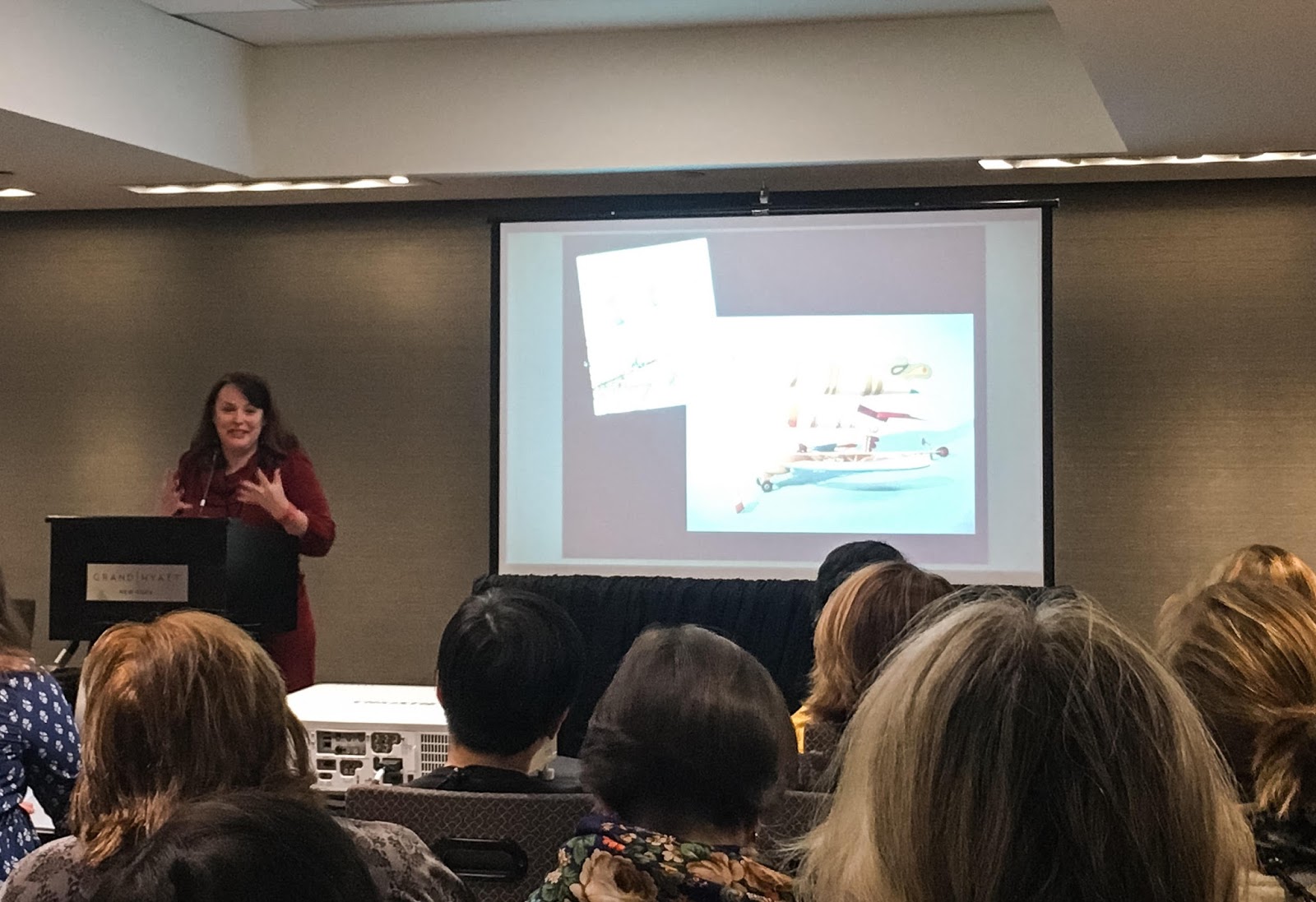
In her workshop, she spoke to a crowd of mostly illustrators, offering tips on how to make the jump from illustrator to author-illustrator. Here are a few tips she offered:
Be true to you. Keep a sketchbook, record a visual response to your day. Create your own characters, imagining their back stories. She highlighted the work of author-illustrator Steve Light, who has done just that. Steve keeps copious visual notes, always drawing in a sketchbook. A drawing that he created of a detailed flying machine inspired his book, ZEPHR TAKES FLIGHT.

Take inspiration from stories that are around you--newspapers, social media, biographies of people and places. Artist Asley Yazdani had an interest in gardening, which led her to write and illustrate an upcoming book about Frederick Law Olmsted, the landscape architect behind the design of Central Park in New York City.
Research the competition. Know the market. Be distinctive. Fill the holes. The best way to research? Join critique groups, study writer websites and blogs. Connect with your community.
Andrew Harwell: Writing Middle Grade Fiction

Andrew Harwell is a Senior Editor at HarperCollins Children's Books.
What is middle grade?
The fiction that is aimed at readers from 8 to 12 years old, about 2nd to 6th grade.
Key elements of middle grade:
Character, POV, Perspective
Middle grade readers are incredibly sophisticated and you can trust them to read and understand point-of-views that are a bit more sophisticated. You never want to talk down to your reader.
Voice, Style
We want to hit the ground running on page one with your character, seeing what they see, thinking what they think.
3 things that Andrew often see in middle grade in terms of voice:
1. gross-out humor
2. precious cleverness
3. arch narrators
Plot
Middle graders can handle the sophisticated.
Hooking your reader on page one doesn't have to be active or big. What makes a moment exciting is that it matters to the character.
Theme or Concept
Be sure when you're plotting that you are trying to tap into something bigger and more universal.
Setting
Paying attention to setting and making your setting unique is important to your story.
Diversity, #OwnVoices, Representation:
More and more editors and writers are using sensitivity readers to get the representation right. There is a lot that writers might not even know they don't know. Editors are also trying to find representations from marginalized voices.
Andrea Davis Pinkney: Beginning Chapters
Andrea Davis Pinkney is an award-winning, NYT bestselling author and editor-at-large for Scholastic. In short, an all-around genius.
 She started by telling us how she begins her day. At 4 AM. (At which point everyone realized they are not going to become Andrea Davis Pinkney because regular humans are not made of steel.)
As this wee hour, Andrea puts her iPhone on her knee and sets a timer. Then she closes her eyes and thinks of happy things. It's a way for her to get her feet on the floor. Then she picks up a notebook--she showed us hers. Slim and elegant, just like Andrea. Every one of her books begins in a notebook like those.
After that, she hastens to the swimming pool and does her workout. She returns home, writes a bit more, and goes to her day job at Scholastic.
"Writers write daily. Every day." On their birthdays. When they don't feel like writing. When their houses are messy. When the children aren't feeling well. "Writers write every day under all circumstances and conditions."
Whatever you want to do, you have to be actively engaged in the pursuit of doing it. It doesn't mean everything is publishable.
First chapters are the hardest ones, and she talked to us about this from the perspective of a writer and editor.
Andrea is a theater buff. She sees everything she can. She loves the moment before the curtain rises. It's a moment of great anticipation, a moment before potential greatness.
"I have to lift that curtain and dazzle instantly."
There's something she likes to call the Chapter 1 Pact. Or the Page 1 Pact. The promises is that the writer reaches out a hand, invites a reader on a journey, and pulls the reader along. A book called The Crystal Ribbon by Celeste Lim is a recent title that does this beautifully.
Andrea urged us to kill "the committee"—those voices in your head that say can't, won't, and other things that get in the way. You can't get to Chapter 1 if you're engaged with negativity. (Or, if you're a pacifist, kiss the committee goodbye.)
She also takes care to turn off her editor switch when she's writing. "Do not edit yourself. It's like doing dental work on yourself, or being your own psychotherapist."
Another piece of advice: "Bring your twinkle." What you bring to the party. The unique thing everyone has. The gift God gave you. "You can't bring your twinkle if you bring the committee with you."
Chapter 1 has to have this twinkle too. You don't have a lot of time, and there are a lot of elements to pack in, including:
 She started by telling us how she begins her day. At 4 AM. (At which point everyone realized they are not going to become Andrea Davis Pinkney because regular humans are not made of steel.)
As this wee hour, Andrea puts her iPhone on her knee and sets a timer. Then she closes her eyes and thinks of happy things. It's a way for her to get her feet on the floor. Then she picks up a notebook--she showed us hers. Slim and elegant, just like Andrea. Every one of her books begins in a notebook like those.
After that, she hastens to the swimming pool and does her workout. She returns home, writes a bit more, and goes to her day job at Scholastic.
"Writers write daily. Every day." On their birthdays. When they don't feel like writing. When their houses are messy. When the children aren't feeling well. "Writers write every day under all circumstances and conditions."
Whatever you want to do, you have to be actively engaged in the pursuit of doing it. It doesn't mean everything is publishable.
First chapters are the hardest ones, and she talked to us about this from the perspective of a writer and editor.
Andrea is a theater buff. She sees everything she can. She loves the moment before the curtain rises. It's a moment of great anticipation, a moment before potential greatness.
"I have to lift that curtain and dazzle instantly."
There's something she likes to call the Chapter 1 Pact. Or the Page 1 Pact. The promises is that the writer reaches out a hand, invites a reader on a journey, and pulls the reader along. A book called The Crystal Ribbon by Celeste Lim is a recent title that does this beautifully.
Andrea urged us to kill "the committee"—those voices in your head that say can't, won't, and other things that get in the way. You can't get to Chapter 1 if you're engaged with negativity. (Or, if you're a pacifist, kiss the committee goodbye.)
She also takes care to turn off her editor switch when she's writing. "Do not edit yourself. It's like doing dental work on yourself, or being your own psychotherapist."
Another piece of advice: "Bring your twinkle." What you bring to the party. The unique thing everyone has. The gift God gave you. "You can't bring your twinkle if you bring the committee with you."
Chapter 1 has to have this twinkle too. You don't have a lot of time, and there are a lot of elements to pack in, including:
- voice
- emotion
- texture/color
- psychic condition
Travis Jonker: Creating Unusual Books Outside The Boundaries
Travis Jonker is a K-4 elementary school librarian in Michigan. In 2007 he started the kid lit blog, 100 scope notes (hosted on School Library Journal). He co-founded "The Yarn" podcast with his friend Colby Sharp, where they interview creators of children's books. (The Jason Reynolds, Mo Willems and Gary Schmidt episodes are among his favorite.) He's also part of The Creativity Project, a book of writing prompts (and responses) from about 40 children's book authors. He writes reviews (and the occasional article or two) for School Library Journal, and was a member of the 2014 Caldecott committee.

Travis is our guide to books that push boundaries, with the hope that it will spark something for everyone attending.
He recommends 100 Great Children's Picture Books by Martin Salisbury, about the history of picture books. Why? Travis quotes Martin,
Travis shares his "six most experimental Caldecott winners of all time":
The Little House: Her Story by Virginia Lee Burton - dares to just show the one scene for much of the book, and how over time the countryside changes.
Where the Wild Things Are by Maurice Sendak - dared to show child protagonist with faults, changed perceptions of how
Tuesday by David Wiesner - surrealness, wordless,
The Invention of Hugo Cabret - hundred of pages long, meshing illustration and text in new way
The Three Pigs by David Wiesner - laid groundwork for lot of meta works that came after
Black and White by David Macaulay - so complex - telling four stories that intertwine
He breaks down the three main ways books break boundaries (Format, Subject Matter, and Convention), and shares many examples of each, talking about each and what make them unique. A few examples from his presentation:
Robo Sauce by Adam Rubin, illustrated by Daniel Salmieri
The Onion's Great Escape by Sara Fanelli
Open This Little Book by Jesse Klausmeier
Samira and the Skeleton by Camilla Kuhn (a little girl who's freaked out that we all have skeletons inside us)
Baa Baa Smart Sheep : Warning! Contains Mischief by Mark and Rowan Sommerset (a sheep tricks a turkey into eating… wait for it… poop.)
The Unofficial Holy Bible for Minecrafters: A Children's Guide to the Old and New Testament by Garrett Romines and Christopher Miko (The Bible for kids. Pixelated. Minecraft-style.
Press Here by Hervé Tullet - groundbreaking
Du Iz Tak? by Carson Ellis - invented language
Battle Bunny by Jon Scieszka and Mac Barnett, pictures by Matthew Myers
Travis challenges each us to take elements of three books that were outside the boundaries to come up with something new.
The session is inspiring -- Travis not only loves these unusual books, he's able to convey his excitement to us all!

Travis is our guide to books that push boundaries, with the hope that it will spark something for everyone attending.
He recommends 100 Great Children's Picture Books by Martin Salisbury, about the history of picture books. Why? Travis quotes Martin,
"The very best work comes from a mixture of respect for history and a healthy disrespect for convention."
Travis shares his "six most experimental Caldecott winners of all time":
The Little House: Her Story by Virginia Lee Burton - dares to just show the one scene for much of the book, and how over time the countryside changes.
Where the Wild Things Are by Maurice Sendak - dared to show child protagonist with faults, changed perceptions of how
Tuesday by David Wiesner - surrealness, wordless,
The Invention of Hugo Cabret - hundred of pages long, meshing illustration and text in new way
The Three Pigs by David Wiesner - laid groundwork for lot of meta works that came after
Black and White by David Macaulay - so complex - telling four stories that intertwine
He breaks down the three main ways books break boundaries (Format, Subject Matter, and Convention), and shares many examples of each, talking about each and what make them unique. A few examples from his presentation:
Format (physical nature)
Robo Sauce by Adam Rubin, illustrated by Daniel Salmieri
The Onion's Great Escape by Sara Fanelli
Open This Little Book by Jesse Klausmeier
Subject Matter (what it's about)
Samira and the Skeleton by Camilla Kuhn (a little girl who's freaked out that we all have skeletons inside us)
Baa Baa Smart Sheep : Warning! Contains Mischief by Mark and Rowan Sommerset (a sheep tricks a turkey into eating… wait for it… poop.)
The Unofficial Holy Bible for Minecrafters: A Children's Guide to the Old and New Testament by Garrett Romines and Christopher Miko (The Bible for kids. Pixelated. Minecraft-style.
Convention (way things are normally done)
Press Here by Hervé Tullet - groundbreaking
Du Iz Tak? by Carson Ellis - invented language
Battle Bunny by Jon Scieszka and Mac Barnett, pictures by Matthew Myers
Travis challenges each us to take elements of three books that were outside the boundaries to come up with something new.
The session is inspiring -- Travis not only loves these unusual books, he's able to convey his excitement to us all!
 Ari Lewin is Executive Editor at G.P Putnam's Sons, an imprint of Penguin Young Readers Group at Penguin Random House.
Some of her titles include Rick Yancey's bestselling Fifth Wave Series, and she recently published Journey's End, a middle grade novel by Rachel Hawkins.
She gave a workshop on World Building. Creating an immersive world that is seamlessly believable keeps readers turning pages. "The world that you're building is going to create the stakes of your story and force your character arc."
She's come across a lot of worksheets for world building, but she thinks those are more useful to look at later in the game. She started us off with a sheet to jumpstart our brainstorming. Spoiler alert: animate teacups were an option (hooray!).
Some questions to ask ourselves when we are constructing worlds: Is this believable? Why does it matter? If the topic is familiar, how will I break it out and make it different?"
We chose elements and--working with a partner--created worlds with stakes, and thought about how make these things believable. This is where she pulled the rug out from under us, after having given us things like talking teacups and astronauts to work with.
Premises can't be 20 kinds of wacky, because we need readers to believe these things our wheel. when you take on elements that are too difficult to work with, "you can spin your wheels to infinity."
Humans are wired to pick up information at locations. Let's say you're at a bar. What are people wearing? What's being served? What drinks are on the menu? These things build atmosphere. This gives context for your reader and lets them slide in without having too many questions. The atmosphere is revealed as a reader watches what a character says and does. When the author steps out from behind a curtain, this turns into a book report—which isn't as exciting as a movie.
She gave us a story scenario and walked us through the process for creating a world that works using fairies, trolls, and a pair of purloined wings by considering a number of dynamics: power structures, the economy, the presence, rules, and limits of magic.
Generally, showing a character in a world is far more interesting to read than explaining and summarizing a world.
Follow her on Twitter: @ariannelewin https://twitter.com/ArianneLewin
Sara Pennypacker: Making Your Work Memorable
 Sara Pennypacker is the author of seventeen children's books, including the New York Times bestselling Clementine series, Summer of the Gypsy Moths, Pierre in Love, Sparrow Girl, and The Amazing World of Stuart, and most recently Pax.
Kids can read an extraordinary number of books, but you want yours to be the one they share with friends, and the one they go back and buy again when they are adults.
Pay attention to what you connect to in books. For Sara, it is children and people in need. People often place a book with some significant event in their own life (something we have no control over). But this speaks to the idea of connection.
"A books connects a reader to the rest of his tribe through time and space."
A reader is connecting because he or she is going through something.
As writers we want to expand the emotion so readers connect in the way they've experienced that emotion.
This is easier to do with realistic fiction, but this is still important in fantasy. Find something universal.
 What makes a book memorable:
Character: Start with a name. Create multi-dimensional character, but those characters must be paired with the right plot.
Omission: Leave room for the reader. When the brain sees a pattern, it shuts off. Add something a bit irregular.
Voice: A great voice grab you by the throat.
Show, Don't tell: This happens in scenes, and scenes must be vivid. Discomfort is extremely powerful (fear, anger, danger, embarrassment, physical pain).
Honest Emotion: If you don't have honest emotion about that "thing" then find something else to write about.
Kat Brzozowski: Writing YA Romance

Kat Brzozowski is an editor at
Swoon Reads/Feiwel & Friends. She acquires YA for Feiwel & Friends and edits crowdsourced YA manuscripts for Swoon Reads. Previously, she
was an editor at Thomas Dunne Books, a division of St. Martin’s Press. She has
worked on a wide range of young adult fiction, including Anna-Marie
McLemore's When the Moon was Ours, which was longlisted for a
National Book Award, and the new Fear Street books in R.L. Stine’s best-selling
series, which has sold over eighty million copies worldwide.
Kat starts her talk by sharing some
romance writing basics:
You need tension between your
characters, things can't just be easy, and you can't throw in an easy obstacle.
Odds are if a character sees somebody cute on the first page, they are going to
fall for each other, and we do love that familiar beginning, but you still need
to insert real obstacles.

Examples of good obstacles include:
Families at odds; different social or economic classes; past heart breaks
that are impeding current relationships; different priorities and goals or
values (college bound or not for example). What hangs in the balance if they do
or don't get together? The whole world ending or just their relationship?
You can't just have romantic longing
in a story, Kat says, there needs to be actions that unfold in the book that
the romance is tied up in. What sacrifices or changes are they going to make to
stay or begin that relationship?
The emotional states of the
characters will also need to change from beginning to end, and you'll need to
be able to describe physical attraction appropriate to your audience's age.
Kat has us read some meet cute scenes
from two books, Kim Karalius's LOVE CHARMS AND OTHER DISASTERS and
Cindy Ansley's LOVE, LIES, AND SPIES.
The group discusses the similarities and differences
between the two scenes, and then Kat invites everyone to take a setting and a
meet cute prompt which she's provided and do some hands on writing.

Subscribe to:
Posts (Atom)