Saturday, August 6, 2022

The Query Cupcake with Kayla Cichello

Kayla Cichello is an agent with Upstart Crow Literary, she's open to picture books through YA and illustrators. Some of her clients include Ana Otaru, author of the upcoming picture book Masquerade for Grandpa (Atheneum/S&S, 2023), as well as author-illustrator Kirbi Fagan, illustrator of Summer of the Tree Army (Sleeping Bear, 2021).

Kayla wants your query to an agent to be as irresistible and delicious as a cupcake is to a toddler. Like a well-made cupcake, a query has a couple of important parts: Intro; Summary; and a Bio.

A quality query starts with the email subject line: For Kayla, please put the title of your story in the subject line, not just "children's book" and include the genre for extra appeal.

The Intro should contain the manuscript's basic info like genre and word count, as well as why you are querying that particular agent. Intros should also include a one or two-sentence pitch summarizing your manuscript (see Eddie Gamarra's session for a whole session on how to craft a pithy pitch), and HOOKS.


Kayla uses Dragons Love Tacos as an example showing what on the surface seems to be just a funny silly book still has deeper themes, something editors are looking for in all picture book manuscripts.

Kayla also covers pitches, bios, and gives examples of excellent summaries for both picture book and MG/YA queries in addition to this handy breakdown of what to include in your summary: 


Biography & Beyond: Carol Hinz

Carol Hinz is Associate Publisher of Millbrook Press and Carolrhoda Books, divisions of Lerner Publishing Group in Minneapolis, Minnesota. She’s passionate about picture books, poetry, and nonfiction for young people, and she enjoys working with authors and illustrators who explore innovative approaches in their storytelling and encourage readers to see the world in new ways. She has worked with authors including Carole Boston Weatherford, Kao Kalia Yang, Irene Latham, Charles Waters, Traci Sorell, Miranda Paul, NoNieqa Ramos, and Patricia Newman.

The big goal of this session: To get authors to think about nonfiction as a malleable category with multiple possibilities. There are so many different ways to write a book and still fall under nonfiction. Hinz certainly met that goal with many samples!

Here are a few:

Informational books: defined as those written and illustrated to present, organize, and interpret documentable, factual material. 

Two key terms to remember: narrative tells a story with characters, story, and a plot. Expository describes, explains, or informs in a clear, accessible way.


5 Kinds of Nonfiction from nonfiction extraordinaire Melissa Stewart's Celebrate Science website: https://www.melissa-stewart.com/


Some types of biographies:

Cradle to grave focuses on one particular element or theme.


Zoom in on a moment


A Place To Land is a story that happens inside of 48 hours.

Tell a story backwards. In Before She Was Harriet, the author tells more of a grave to birth story.


Put your reader in someone else's shoes


Other ways to tell a biography:

--Tell a childhood story

--Focus only on adulthood

--Tell the past in the present tense

--Write to the books subject

--Write from your subjects perspective

--Tell a family story

--Put yourself in the story

--Tell your own story

--Tell a collective story


Other types of nonfiction


Acknowledge what we don't know. Sometimes, all the facts can't be discovered. Acknowledge so in the Afterwards explaining why. 

--Tell the story of a place

--Tell a story we think we know


In the case of All Thirteen, we know what happened and how the story ends,
but the author fills in what we don't know.

A full book list will be available soon


Mining Memories As a Creative Tool with Baptiste Paul


Baptiste Paul is the award-winning author of The Field, To Carnival, I Am Farmer: Growing an Environmental Movement in Cameroon and Climb On. His works have garnered many starred reviews from Kirkus, Booklist, and School Library Journal, and several titles have been translated into multiple languages. He loves writing stories inspired by his childhood in Saint Lucia, and featuring words from his native language, Creole. Baptiste is also a mentor for We Need Diverse Books and the co-author of several works with Miranda Paul, including their newest collaboration, Peace. He lives in Wisconsin with his family. More at baptistepaul.net.

Baptiste mines his memories as a tool for every book he writes. 

Baptiste ask us all to write some of the sounds, the smell, the sight, the feelings that made our life interesting. He says, "Your goal is take your readers on a journey with you. If this is your goal then you have to wow your readers."

The best way to tap into your memories is use your senses (sight, sound, smell, taste, feel).

Baptiste shares the steps of his PROCESS:

SPARK
The first part of his process starts with a SPARK. Take that spark of an idea and ask: Who? What? Why? When? How? What comes to you from your own childhood memories when you ask those questions about a spark. For example: children playing outside. What comes up? What do you think of when you ask yourself those questions? 


REFLECTION
In this step, Baptiste encourages us to go deep here. To ask: Why do I want to tell this particular story? And then, in this step, make lists of all the sensory details. 

"When you are mining your memories, consider your words. Make sure they are colorful. Make sure they are ones that will take your reader on a journey."

CONNECTION
What is the universal element in your story? 
After you dig deep into memory, ask yourself: Is this universal? Is it an experience children can relate to? List the ways it's universal. And why!

WRITING EXERCISE


Baptiste asks us to close our eyes and think of our first day at school. 
Now list three examples of how you used your senses to experience that first day of school. 
    What do I see?
    What do I hear? 
    What do I feel?
    What do I smell? 
    What do I taste? 

And what a treat to listen to Baptiste, as he closes his eyes, to recall each of these for his own first day. 

Baptiste encourage everyone: Each time you go into a memory, go to a place that is quiet, and continue to ask yourself: Who, what, why when, where, and how. And then repeat the process over and over. 


Kayla Miller: Illustrating The Graphic Novel #scbwiSummer22


Kayla Miller is the author and illustrator of the New York Times best-selling Click graphic novel series and co-author of its spin-off series Besties. They studied at the University of the Arts in Philadelphia and graduated with a BFA in Illustration. Kayla currently lives and works in New York state, and when not writing or drawing, they enjoy watching bad movies, trying to cook new recipes, playing board games, and reading other people’s graphic novels.  More info at Kayla-Miller.com, Twitter @Kayke, Instagram at @Kayke.

In this session, Kayla talked about illustrating graphic novels, ably assisted by ASL interpreters: Steve and Jenny.

In school, Kayla said that in school, there weren't many courses that dealt directly with graphic novels. Kayla took some creative writing classes but felt they were missing out on visual narrative, so they also took a Narrative Cinema course. They point out both graphic novels and cinema use many similar techniques.


Graphic novels, however, have a smaller budgets and smaller teams. If you're a graphic novel creator, you need to learn how to be organized, meet deadlines, wear many different hats, working closely with others.


The illustrator needs to decide what the characters look like. You need to design the characters that you can easily draw many, MANY times. Here's Kayla's lineup of characters for some of their books:


Don't count on having room for text. Kayla pointed out that you can convey so much about the character in the illustrations in other ways:


Using film terminology can help with communication. Kayla gave examples such as distance, establishing shot, close up, etc. 

Kayla showed us how varying aspects like just the angle can change the emotional impact, character info, and reader experience. Lighting can show passage of time as well as conveying mood. Decisions about staging the shot can also convey info that is not necessarily known by the character in the story as well as focusing a reader's attention on a particular aspect.

Kayla suggests using a mirror or webcam to try out different emotions as well as body language, to better learn how to "push it" in your illustrations. Kayla says they will watch videos of someone skateboarding if having to draw someone skateboarding, to help get a better sense of the physicality.


You can use panels to control pacing, says Kayla. Having a series of similar small panels will convey the feeling of time passing slowly. Big panels can help convey big emotions or stop time in a single moment. Kayla also discussed how varying the shape of panels can change the mood.

When designing panels, it's important to keep readability in mind, and how alignment can control how a reader will read the page. Kayla showed how grouping and ungrouping panels via gutter placement can help readers (especially young readers) not get confused. Kayla also discussed the importance of word bubble design, and how to be aware of readability over a full spread.


Throughout, Kayla is always aware of reader experience. They even mentioned how they vary the horizontal gutters because in some e-readers, the pages might end up close together and get confusing.

In the Q&A, Kayla said they do all their work on their iPad now. They use Photoshop for easier workflow when working with their team. Kayla keeps spreads organized by name.

When trying to get noticed via webcomics, Kayla advises formatting your webcomics so that they will be easy to translate to print in terms of paging. With support from a colorer and a letterer, Kayla can do a graphic novel in a year.

Wow, what an amazing session! Anyone interested in illustrating graphic novels definitely needs to watch Kayla's session replay.


Feeling Stories with Kelly Starling Lyons

Kelly Starling Lyons is a founding member of The Brown Bookshelf, teaching artist, and award-winning children’s book author. She has written more than 20 books for young readers that span from easy readers to picture books and chapter books. Among her acclaimed titles are My Hands Tell a Story, Caldecott Honor winner, Going Down Home with Daddy, Christopher Award winner, Tiara’s Hat Parade, and Notable Social Studies Trade Book for Young People, Sing a Song: How Lift Every Voice & Sing Inspired Generations. She’s also the author of popular series including Jada Jones, Miles Lewis and Ty’s Travels which won a Geisel Honor Award for Zip, Zoom. Kelly lives in Raleigh and was named to Good Morning America’s 2021 Inspiration List: Who’s Making Black History. Learn more about her at www.kellystarlinglyons.com. 

Kelly Starling Lyons presents her session on Picture Books


The full title of Kelly's breakout session is "Feeling Stories: Creating Picture Books That Pack an Emotional Punch."

Kelly opens with some tips on writing picture books, including:

- There are no absolute rules

- Child main character should solve problem on their own (but elders can be important - they are in Kelly's work)

- Leave room for the art to tell the story, too

- Craft each page turn like a mini-cliffhanger

- It needs to stand up for repeated readings

With mentor text examples and exercises, Kelly walks us through ways to create emotion. Mining our memories and experiences. Keeping a journal or file of ideas. Looking at our life with a "writer's eye."

She suggests that #1, we make a list of:

Best and worst school or family memories (from when you were 4-8 years old)

and/or

Experiences or relationships that inspired you or changed you

An example Kelly gives is girls at school making fun of her outfits.

Next, #2, she asks us to write down, for each item on our memory list, our emotions -- how did we grow or change?

As an example, Kelly tells us about those mean girls at school - and how she experienced embarrassment at first for being picked on, then fear because some of the girls were tough, then anger at being picked on, then relief when she figured out how to deal with them, then finally empowerment in being able to stand proud in the outfits she chose to wear.

Kelly quotes Jacqueline Woodson's inspiring words:

"...when I write, I go back and I remember who I was, and I start crafting my characters from that place. My writing starts with something that I know deeply, and then put it onto and into my characters." –Jacqueline Woodson

Show emotion with Touch, Dialog, Smells, Sounds, Taste  - think about how you can bring emotions to life. "It's really important to use sensory detail..." Keep in mind the illustrator will be focusing on what the character sees, and you can focus on the other senses!

#3, Kelly has a write a scene, 

and then #4 asks us to create a character who is dealing with the emotional truth of our memory. 

Consider: What does our character want? And what is standing in our character's way? "We have to feel that longing." And raise the stakes. Why does it matter so much? How do you make the reader feel how much it means? What's at stake if the character doesn't get it?

There's lots more, with Kelly answering audience questions, talking about self-publishing and how there are no shortcuts, her own publishing journey and being published by multiple publishing houses, and many more examples, from Kelly's own books and other mentor texts, too.

Final gem of advice:

Write from your heart

Creating Memorable Characters That Readers Can Cheer and Celebrate: Ernesto Cisneros


Ernesto Cisneros is the nationally acclaimed author of Efrén Divided. Ernesto shares how to create memorable characters that readers can cheer for and celebrate!
Ernesto begins the presentation with thinking about your circle of your friends. Who are your friends, best friends, acquaintances? What are their positive/negative quirks about them? Do they put ketchup on all their food? Do they never tie their shoe laces? 
 
Ernesto reminds the participants that you can mesh the quirks and characteristics of different people throughout your childhood! You can take something as simple as a name and then develop the personality from other references. 

We all have quirks, these quirks make characters memorable. When you're thinking of a scene, Ernesto shares the importance of making the scene exciting, confusing, or dramatic. For example, when your characters are in the kitchen washing dishes, incorporate a leaky faucet, or something the audience will remember about the character. 

When it comes to creating other characters within the story, Ernesto draws from unfavorable experiences. Think of the people you didn't get along with in school. Why didn't you like them? Brainstorm their traits. Maybe they teased you, maybe they hogged the ball at recess. This can be a character that is disliked in a book. 

Here are three takeaways to creating memorable characters: 

  • Avoid stereotypes 
  • Write from the heart
  • Remember your childhood

Ernesto Cisneros is the nationally acclaimed author of Efrén Divided. He was born and raised in Santa Ana, California, where he still teaches.  As an author, he believes in providing today’s youth with an honest depiction of characters with whom they can identify. Efrén Divided is an Indies Introduce/Next Pick, Amazon Top MG of 2020 So Far list, and is a ProjectLit Selection, and winner of the 2020 Poppy Award in MG, 2 International Latino Book Awards, as well as the prestigious 2021 Pura Belpré Medal and an SCBWI Crystal Kite Award in 2021. 

Instagram: cisne.writes 

Twitter: @Author_Cisneros 

Website: www.ernestocisneros.com

Missed this workshop? Check out the video archives here. https://www.scbwi.org/event-summer-conference-2022/video-archive/


Enjoyed this recap? RT the post on Twitter so others can check it out. 


Live Drawing With TeMika Grooms at #scbwiSummer22

After getting inspired by all the sessions so far at the conference, it was the perfect to do some LIVE DRAWING. ASL interpreters: Genaere and Corinna. 

A longtime SCBWI volunteer with a love for writing and illustrating children’s books, TeMika Grooms also manages graphics and illustrations produced to support the SCBWI.  She provides logistical help with illustration-focused membership benefits and event programming.  TeMika has volunteered for the organization at many levels supporting others with the same passion for developing the craft. Her latest illustrated book by Senator Raphael G. Warnock, Put Your Shoes On And Get Ready, will be released by Philomel Books in November 2022.  Learn more about her work at TeMikaTheArtist.com. 

While we sketched, TeMika told us about her own illustration journey. In 2004, she discovered the SCBWI and started learning how to become a better storyteller. She was delighted to find a community of supportive people who understand and appreciate children's books.

Everyone's journey is different, says TeMika. You need to be patient throughout the process. 

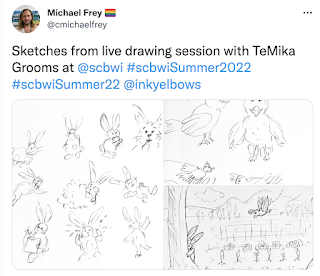
Here are just a few of the sketches people came up with during this fun timed prompt session!


TIPS FOR ALL ILLUSTRATORS:

Don't forget to fill out and/or update your SCBWI Profile. TeMika says that SCBWI is always interested in artists to highlight. She also suggests participating in the monthly Draw This! art prompt.

TeMika also strongly recommends checking out the workshops and courses offered by regional chapters.

Here's what I ended up drawing during TeMika's fun and inspiring session:


Live Writing Session - Play Along At Home!

One of the fun things added to the mix this conference is a live writing session (there's a live drawing session for illustrators, too.)

Eric Elfman sharing the first prompt for the live writing session.


Hosted by Eric Elfman (see bio, below), we start off with a five-minute sprint. The prompt:

Two people are sharing a meal. (You choose who and where). While discussing a life-changing choice.

The second prompt, for a ten-minute writing sprint this time:

Think of a memento or object you've gotten from your parents or grandparents. Take it in whatever direction you want. History of the object. Or a character considering the object, and it's meaning...

Fun to do some writing during the conference!

Eric is the award-winning author of 14 books for Middle Graders and Young Adults, including the popular Accelerati trilogy (Tesla’s Attic, Edison’s Alley, and Hawking’s Hallway) from Little Brown, co-written with NY Times Bestselling author Neal Shusterman. Eric has also written a series of off-beat almanacs for Random House, including Almanac of the Gross, Disgusting & Totally Repulsive (an ALA Recommended Book for Reluctant Readers), and Very Scary Almanac (both went into six printings); as well as three X-FILES novels for HarperCollins.  Eric is also a screenwriter and private writing coach, with a number of award-winning and New York Times bestselling authors among his clients.

One Hour Art School: Daria Peoples

Daria Peoples is an author and illustrator. Her first job was at nine years old in the children’s section of her hometown library in Paso Robles, California. She worked a little, but she mostly read picture books. is the author and illustrator of the picture books This Is It and I Got Next, and the illustrator of Gloria Takes a Stand, by Jessica M. Rinker. She lives with her family in Las Vegas, Nevada.

The main takeaway from this session: Don't let the lack of an art school degree prevent you from reaching your dreams of illustrating children's books. Peoples did not attend an art school, she earned a degree in English and education. For the longest time, she let the lack of an official art school degree hold her back. Good thing for children—because her art is absolutely beautiful—she figured things out. Here are a few lessons she learned along the way: 

Find your artistic voice. Voice is in us from the very beginning, and it expands throughout life's journey. Discovering that voice takes a lot of practice, though, so draw at every opportunity. After college, Peoples worked as a photographer—so she grew from what she knew. As a photographer, she knew composition, value, space. So, she crated art through the lens of a photographer.  Photography informed her artistic voice. While you may not have attended an art school, what is it that you know that you can use to inform your art?

Play—a lot! And don't be afraid to share your experiments along the way. Without an art degree, Peoples didn't know the art rules, so she created like a child, unafraid play. Not worried about getting messy. Sharing her work at conference is how she got feedback and learned to use that feedback to better her art. Sharing, and therefore critique, is how to honestly measure where you are as an artist.  

Seek out mentors. Peoples has been mentored by some of the best, including the late great Floyd Cooper and Marla Frazee.


Pay attention to the world around you in order to create the stories you want to write. For example, People's story THIS IS IT was inspired by her own daughter's desire to become a dancer.

Best Practices.

1. Immerse yourself in art: Mentor texts don't have to be picture books. Watch a lot of movies. Read a lot of books. Listen to a lot of music. Visit museums. 


2. Figure out how the story can function before you put into picture book form--which means boiling down a story to it's visual essence. Make sure the pictures can be read even without words—not worrying abut page count at first. Then figure out how to fit the essence of a story into 32 pages.


3. Practice creating thumbnails—over and over again. Experiment with creating the story's emotional arc by using post-its notes that can be sketched on and moved around. Audition your characters.

4. Ideas. The best stories come from heart check-ups. Peoples' heart: forgiveness, racism/social justice, friendship. Where is your heart?


Stu

Five Steps to Crafting a Compelling NF Book Proposal with Kim Tomsic

FIVE STEPS FOR CRAFTING A COMPELLING NONFICTION BOOK PROPOSAL

Kim Tomsic received her MFAC from Hamline University and teaches creative writing at two universities. Kim is the author of many award-winning books for kids, which include The 11:11 Wish,  followed by The 12th Candle, also Guitar Genius: How Les Paul Engineered the Solid Body Electric Guitar and Rocked the World, and The Elephants Come Home.

Kim has put in those 10,000 hours to bring us all her best advice on creating a compelling nonfiction book proposal. She also includes some examples from fiction, because fiction can be sold on proposal too. 

Do you have to write a proposal? No. But there are many benefits.


  1. Focuses story, jacket flap, and "one sheet"
  2. Planning and structure
  3. Query + acquisition meeting 
  4. Saves you a lot of re-writing if this isn't "the" book
  5. Prepares you for interviews and school visits
Checklist for Creating an Irresistible Proposal

1. Create a compelling title and write a snappy paragraph about your story (focus in on the things that excite you)

2. Identify the heartbeat of your story (this is where you create the emotional connection)

Kim gives us an amazing way to connect to the heart of your story which is much different than theme. It comes by asking the question: Where can a child insert themselves into the story? And, she generously shares a great example of the way she inserted heart into The Elephants Come Home.

Check out a draft page before she tapped into the heart:


And now checkout it after she inserted the heart:


Kim gives us a great tip: Think about what you're going to share at school visits. How will the kids your speaking connect with your story?

3. State your intended audience.

4. You. Have a clear understanding why YOU should write this story.

5. Write some sample chapters, or pages. 

Writing Queer and Trans Identity with Lexie Bean

Lexie Bean (they/he) is a queer and trans multimedia artist from the Midwest whose work revolves around themes of bodies, homes, cyclical violence, and LGBTQIA+ identity. They are a Jerome Hill Artist Fellow, member of the RAINN National Leadership Council with 10+ years of facilitation experience, and a Lambda Literary Award Finalist for Written on the Body for their work with fellow trans survivors of domestic violence and sexual abuse. Their debut novel The Ship We Built is noted as the first middle grade book at a major American publisher centering a trans boy to be written by one. Their work has been featured in Teen Vogue, the New York Times, The Feminist Wire, Ms. Magazine, Them, Logo’s New Now Next, Bust Magazine, and more. www.lexiebean.com

Lexi's debut MG novel, "The Ship We Built"

Lexie's breakout session is called "Writing Queer and Trans Identity: Going Beyond the Binary of Victims and Perfect Heroes."

Lexie Bean (top) presenting, also shown is Lucy, the session's ASL interpreter.

Lexie opens with a question, what does each of us consider child appropriate?

Lexie explains it's a question they get a lot - their novel has a ten year old Trans protagonist. The story includes child sexual abuse. It's also set in the 90s... Their book has been banned, and that, as well as the rash of anti-Trans legislation happening in the US, as well as the media and our publishing industry's portrayals of Trans people, all feed into their presentation.

He asks us to consider the first examples of Queer and Trans storytelling we encountered in our lives. For them, Lexie remembers the show "Cops" in the 1990s was their introduction to Trans women - “someone blurred out and arrested.” They didn't know Trans boys existed until college. Their first exposure to gay people was on the news, news about AIDS and the fights for Gay marriage. Those exposures influence storytelling, and memory...

Something that makes Queer and Trans literature for youth, for those of us who create that literature, is that so many of us are raising ourselves in different ways now.

Lexie's book, "The Ship We Built," was the first middle grade novel about a Trans boy to be written by a Trans author from a major publisher - and Lexie speaks to the meaning of that.

On the false binary of the Victim vs. the Perfect Hero:

If you're going to tell a Queer or Trans story from a first person perspective in YA, there's the idea that there needs to be trauma, trauma, trauma... “Sometimes trauma is put forward as a strange attempt to humanize us.”

On the other end, especially for young readers (MG and picture books) everything needs to be perfect at the end, and the Trans child is the one who saves everyone. “That can be dehumanizing, too.”

The lack of nuance is often so far from people's lived experiences, it makes it hard to connect. Like “we can only speak to our experiences if they've been resolved already.” A lot can be lost in that strive for 'perfection'.

“Falling in either road can be dehumanizing. This is a call asking for something in-between.”

As to the books for kids that already are out there, there are lots of stories about Trans girls, though they are often written by cis people and the 'happy' resolutions convey that the Trans experience needs to be understood and fall within the binary. “Not everything about being Trans is visible.”

There are not many stories about Trans boys.

There's a difference between “Trans people are here to save us all” vs. empowerment. There's a lot going on for Trans kids - “Where are the adults who are helping them? We need to see examples of this. And kids not always knowing how to save others and themselves. It can be a great service to our community to know it's not always on us.”

On ideas of marketability and the role of the publishing industry:

Lexie speaks to the pressure put on them to either take the childhood sexual abuse out of their novel completely or to heighten it so it would fit better into the victim/hero binary.

The specificity of having their book include both actually meant they were not narrowing their audience, but expanding it by including people who have other ways to enter the text. “It is not limiting.”

“Children are really freakin' smart, but they also have feelings deep enough to want to die. They have experiences that need to be reflected.” Lexie's answer to the opening question, as a trans survivor of childhood sexual abuse themself, is:

“As long a child is experiencing something, it is child appropriate.” 

Letting children know can help them by leading to resources that can point them to hope, and letting them know they're not alone.

There's lots more shared, on Lexie's experience of having their book banned for multiple reasons, the pressure they felt about the ending to their book, and advice for authors to follow our instincts – and know what parts of our story we want to protect as we go on our publishing journey. Lexie reads their author's note from "The Ship We Built" and finishes the session with a Q&A.