Showing posts with label Deborah Heiligman. Show all posts

Friday, February 7, 2020

Quote highlights from the 2020 Golden Kite Award Acceptance Speeches!


THIS YEAR'S GOLDEN KITE AWARD WINNERS AND HIGHLIGHT QUOTES FROM THEIR ACCEPTANCE SPEECHES...


Young Reader and Middle Grade Fiction: Padma Venkatraman, for The Bridge Home (Nancy Paulsen Books)


Padma spoke of her childhood, of the challenges of a friend who hid in a cemetery night after night to escape the men who wanted to enslave her, who asked Padma because Padma was a child who loved to write,

“Padma, will you write my story one day?

Yes. I promise. It's taken me forty years, but this [is that] book.”
—Padma Venkatraman


Picture Book Text: Ashley Benham Yazdani, for A Green Place to Be: The Creation of Central Park (Candlewick)

“The ripples of one single park changed the way” America related to public spaces. How will the park look in 100 years? If nothing changes, it will be “a lot hotter, a lot wetter, a lot emptier.” Like the creators of central park, “We [too] stand at a tipping point of industry and its impact on our planet.”
—Ashley Benham Yazdani 


Non-Fiction for Younger Readers: Elizabeth Rusch, for Mario and the Hole in the Sky: How a Chemist Saved Our Planet, illustrated by Teresa Martinez (Charlesbridge)

Many kids today feel helpless. Elizabeth recounts that when she goes to school visits, she asks kids if anything going on today reminds them of the Ozone crisis. Every hand goes up. That’s why she wrote Mario and the Hole in the Sky.
“I wanted to give them a message of hope. That we actually imperiled our planet before, and we did something about it.” And that the effort was led by a boy from Mexico.
—Elizabeth Rusch


Picture Book Illustration: Hyewon Yum, for Clever Little Witch, written by Muon Thị Van (Margaret K. McElderry Books)

“I'm very lucky. I was given this award eleven years ago for my first book. So this is my second time giving this speech. And now I know better what it means... It means so much.” Thank you —Hyewon Yum


Non-Fiction for Older Readers: Deborah Heiligman, for Torpedoed: The True Story of the World War II Sinking of “The Children’s Ship” (Henry Holt)

Deborah starts by speaking of our shared “commitment to creating the best books we can for the most important people in the world...” About her research, she was" thrilled to discover" primary sources, and still “many more primary sources, including two survivors to meet and interview... Time and time again, I was struck by how this tragedy brought out the best in people.” —Deborah Heiligman


Young Adult Fiction: Julie Berry, for Lovely War (Viking Books for Young Readers)

Julie speaks to the wonderful beginners in this room, saying “we want to hear your stories.” She thanks SCBWI for including a donation to a charity as part of these awards, charities chosen by the winners. Equal Justice Initiative is her choice. “Justice demands that the truth be spoken out loud... Truth has gotten a bad rap of late. It needs a better publicist... But we can't lose hope in the truth.”
—Julie Berry


Sid Fleischman Humor Award Winner: Remy Lai, for Pie in the Sky (Henry Holt)


“Are you ready for some jokes? I don't have any. Really...” Remy tells the story of finding out she'd won the award...  Having to give a speech? ”Now that I'm officially funny...that's very hard.” She turns serious, “Sometimes publishing can make you feel like you can never be enough... I'm going to accept that today, I'm enough."    —Remy Lai


Sunday, August 5, 2018

Panel: The Secret of Crafting Engaging Nonfiction

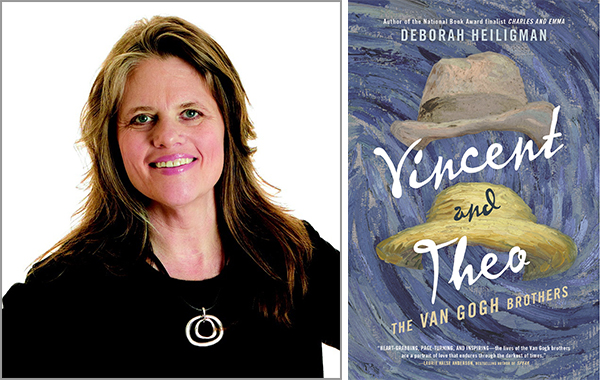
Deborah Heiligman's latest book is the dazzling VINCENT AND THEO, but has many other incredible nonfiction titles to her name (try CHARLES AND EMMA—you will love it).


She is particularly drawn to narrative nonfiction for biographies, because life stories lend themselves well to narrative.

Deborah was thinking about her own theme in life. It's "only connect" by E.M. Forster. "I'm connecting, and I'm trying to connect the reader to someone I'm connecting with."

Her process is connecting to the person that she's writing about in the same way that fiction writers connect to the characters they make up. She's also completely obsessed with the way her subjects connect with each other.

"In biography, you want to get so in deep with the person than telling the story up close ... is the way to do it."

Deborah, who also writes fiction, has an analogy that explains the difference between the two disciplines. Fiction is clay, and you're shaping the story out of that medium. In nonfiction, you start with marble. The material is there, and you have to find the shape within it.

There is a misperception that nonfiction is like writing a book report or a dictionary entry. Our personalities show in the book that we're writing.

Deb wanders in the woods for a really long time, she said. "It takes me the longest time to really get it. Everything that I put in CHARLES AND EMMA had to be in service to the love story." She created a mantra for this book: It's a love story. It's a love story. 

With Vincent and Theo, it was also a relationship book. But what was the relationship about? Most of her research is primary source research. She got "pissed off" very early on at Vincent. She wondered why Theo not only put up with him, but supported him emotionally and financially. That was a question she was trying to answer with the book. Her mantra, once again, became, It's a love story. 

When you do a lot of research, you want to show it off. But that's not your job. Your job is to tell a story (something she learned from listening to Sara Paretsky). With Vincent and Theo, her additional mantra was, "You are telling a story. You are not a scholar."

Deborah's next book—due August 15 with her editor—is a WWII tragedy with a large cast of characters. It's an antiwar story. It's a helper story. And she is sure she will figure out the theme by August 15. (So am I. Deb is an absolute genius.)


Learn more about Deborah Heiligman here.

The Secret of Crafting Engaging Nonfiction Panel is About to Begin!


Moderated by Melissa Stewart (at podium), the panelists are (left to right): Deborah Heiligman, Barbara Kerley, Jason Chin, and Candace Fleming.

Melissa starts out and explains the difference between expository and narrative nonfiction, and shows us statistics that highlight the difference between what the adult gatekeepers prefer (narrative, by far), and how children actually prefer expository nonfiction!

The panel dives into questions about theme, styles, process, the difference between writing fiction and nonfiction, and so much more. Check out the individual posts on each panelist to come!


Sunday, August 1, 2010

Deborah Heiligman's Nonfiction Panel Hot Tip!

"Write down where every quote is from when you write it the first time!!!" (source notes)

Good advice!

Nonfiction Panel: The Rock Stars of Nonfiction, Part 1

Here are a few key insights and habits these great writers shared:

Susan Campbell Bartoletti starts her research in libraries, and has six times as many library cards as credit cards. These libraries have databases and other sources you can't find anywhere else. But she also travels to the places she's writing about, and even spent time at a Ku Klux Klan rally.

She has a secret for knowing when to stop researching: "When the facts begin to repeat themselves, that's when I know it's time to begin writing." (Sometimes research can be a sophisticated form of procrastination.)


Deborah Heiligman: Almost all of her sources are primary. She read Darwin's autobiography and a two-volume set of letters from Emma's family. A line in one of Emma's letters made her cry. "I knew I was hooked. I got absolutely passionately attached to both Charles and Emma."


Tanya Lee Stone calls extreme research "detective work." You have to let go of not knowing what you're going to find and whether it's going to fit into the story you're going to tell. Before she started researching ALMOST ASTRONAUTS, she kept coming across obscure mentions of women who almost became astronauts and got interested; tracking down the women was a big challenge. She interviews lots of people to enhance her baseline research. You want to learn all you can before you interview people, though.


Elizabeth Partridge spoke about connecting with an editor. With nonfiction, you generally send a cover letter, a sample chapter, and an outline. Crafting that forces you to get some clarity on the research you've done (even if your book changes as it's written and polished). She's also used photographs to engage an editor's imagination.

Nonfiction Panel: The Rock Stars of Nonfiction, part 2

BIG laugh in the room when Deborah Heiligman agrees with the point of checking back with your interviewees and letting them read your manuscript to check it... for Charles and Emma Darwin!


Ken Wright is asking great substantive questions, and we're all learning a ton.


Here are the website links (and some great quotes from the session) for these amazing, passionate and so articulate nonfiction authors:


Tanya Lee Stone


"Almost Astronauts started out as a picturebook!... Trust yourself and ask yourself "What is the story I need to tell." (Rather than focusing on the kind of book you think it's going to be.)


"If you don't have a point of view, why are you telling the story?"


Elizabeth Partridge


"You want to have multiple layers in your nonfiction" If it's too straightforward, it will be boring.


advice she still sticks by:


"Have emotion in every single paragraph - every paragraph should have emotional
resonance!"


Deborah Heiligman


"We're all trying to do something original"


her editor told her


"Let the content dictate the form"


(Moral: stay flexible to what you discover - even if it diverges from your proposal.)


"Everything I put in the book has to be in service to the main story you want to tell" (like for Charles and Emma, even for the details of the ship voyage, the ones she included all resonated to the love story that was the story she wanted to tell!)


Susan Campbell Bartoletti -


Tells the story of how she was contracted to write a book on American involvement in World War II, and how it ended up being a book about Hitler Youth instead! Which was her Newbury Honor nonfiction book "Hitler Youth: Growing Up in Hitler's Shadow."


She also related going down to Arkansas to visit the KKK today as research for her upcoming historical nonfiction on the KKK - and how that helped bring the story to life.


And to finish, Deborah Heligman paraphrased a beautiful quote from Isaac Bashevitz Singer:

Is it a story?

Does is have a beginning, middle and end?

Is it a story that needs to be told?

Is it a story that only I can tell?

Why Narrative Nonfiction is Hotter Than Ever: The "Rock Stars" of Nonfiction

Good Morning Conference Goers and blog followers!


Ken Wright moderating, and left to right: Tanya Lee Stone, Elizabeth Partridge, Deborah Heiligman, and Susan Campbell Bartoletti

Early this Sunday Morning we have something worth getting up for... the Narrative Non Fiction is hot Hot HOT panel with multi-award winning author for her nonfiction titles Susan Campbell Bartoletti, National Book Award Finalist for "Charles and Emma: The Darwin's Leap of Faith" Deborah Heiligman, Golden Kite winning author Elizabeth Partridge, multi-award winning author (with an upcoming "The Good, The Bad, and The Barbie: A History of the Doll and her impact on Culture) Tanya Lee Stone and it's moderated by Writers House agent (with a passion for nonfiction) Ken Wright!


As Lin is saying in her introduction, it's a genre that's finally getting it's moment in the spotlight.

Ohh - the panel's about to start!