Monday, August 3, 2020
#SCBWISummerSpec: In Conversation with JASON REYNOLDS, NIC STONE, & CAITLYN DLOUHY
A Conversation with Mac Barnett and Jon Klassen
They've done SIX amazing books together and Jon jokes that they started out as friends but are no longer. Jon is teasing, of course, it's rare authors and illustrators are in touch at all during the picturebook-making process! But these two working closely together equals Caldecott Honors and Horn Book and E.B. White award stickers slapped deservedly on some of our absolutely most favorite picture books of the 21st century. Mac says their working relationship is an 'anabolized' version of the way words and art should work together in a picture book: Two simple organisms (Mac and Jon) combine to be one much stronger, better entity (like the Decepticons combining into The Devastator).
For example:
Mac reads us their book, SAM AND DAVE DIG A HOLE.
![]() |
| 88% sure Mac and Jon would not eat this |
Jon had been talking to Mac about how his I WANT MY HAT BACK series was often difficult to shelve at bookstores and libraries because the books are so wide. So for fun Jon and Mac started spitballing ideas that would lend themselves well to a very tallll book. To Mac and Jon the sky is boring, thus digging down was the answer.
And the art you brainstorm when digging down leads itself very well to being a sequential image series which is another good checkmark to check on the well-made picture book checklist.
Exercise: Try taking advantage of the form or treating something like trim size as a constraint/puzzle to solve even before you pick the plot in a picture book.
Jon and Mac never start with theme or message, they always start with the characters or a visual joke, and how you push that joke beyond the joke into a deeper meaning is one way you can get to your picture book's message. Most funny ideas, says Jon, if you dig deeper on them have a sincere or sad internal, universal truth.
Another benefit of authors and illustrators working together directly, the ability of the art to change or inform the story. Their initial idea of Sam and Dave moving around and missing the diamonds was much, much more complicated visually and had an entire subplot only in the dirt of sparring skeletons and dinosaurs besides the bigger and bigger diamonds. Mac and Jon scrubbed that big, complicated side plot because not only did the diamonds by themselves get great laughs, just having the large diamonds as the art focus on a page meant the images were readable across a crowded room, which Mac says is an important thing to think about when making a picture book.
He mentions the three levels of connection in the world as they apply to reading picture books:
- Only to yourself (kid reading alone)
- One to one connection (kid being read to by a caregiver)
- One to many (kid being read to in a large classroom setting where it's hard to see tiny picture details so some big compositions will shine)
If your book can hit all three of these levels, bonus points to you.
Questions about authors and illustrators working together:
Even if you aren't in touch, authors and illustrators should still consider themselves as equal parts of a team. Mac says authors shouldn't say "So-and-so is illustrating my book," because a picture book is NOT your book yet, it's not even a BOOK without the pictures, so you need to think of the illustrator as having an authorial seat in the picture book making process, too.
Sunday, August 2, 2020
#SCBWISummerSpec A Conversation With Jacqueline Woodson Hosted By Nancy Paulsen
A Conversation with Jane Yolen, Hosted by Heidi E.Y. Stemple
Heidi E.Y. Stemple didn’t want to be a writer when she grew up. In fact, after she graduated from college, she became a probation officer in Florida. It wasn’t until she was twenty-eight years old that she gave in and joined the family business, publishing her first short story in a book called Famous Writers and Their Kids Write Spooky Stories. The famous writer was her mom, author Jane Yolen. Since then, she has published about twenty-five books, including Counting Birds, Fly With Me, You Nest Here With Me, Not All Princesses Dress In Pink, and two Fairy Tale Feasts cookbooks, as well as numerous short stories and poems, mostly for children. Her website is www.HeidiEYStemple.com
Jane and Heidi are in the (virtual) house!
![]() |
| Jane Yolen (top left), Heidi E.Y. Stemple (top right), and interpreter Jennye Kamin (lower) |
Jane starts us with a poem (wow!) Here are highlights of the rest:
Heidi's first question: "Why picture books?"
"Because picture books are the closest to poetry as you can get." – Jane Yolen
Picture books are a way, Jane says, that "I'm able to get poetry up. A book that lifts children up, as well."
On process: Jane starts every day with writing a poem. If she "primes the pump" with a poem, she tells us, the rest of the day, her words can flow.
On compression: "Every word has to count. Most words have to move backwards and forwards. They have to resonate throughout the entire book.... Every time you revise, you'll find more words to take out. (Of course, you also sometimes find more words to put in.)"
Jane's tip: Sometimes, if you write a picture book down as if it's a poem... you'll suddenly see all the words that don't belong.
"It's very important to read it out loud. Even more important, have someone else read it out loud to you... The eye and the ear are different listeners."
They discuss three more elements great picture books need:
Lyricism: "a picture book can almost be sung."
Arc: "you need to go from one place to another."
Visuality: "Picture books are meant to be illustrated." Even if you're not an illustrator, "you still have to think visually."
We also get to hear the story behind Jane writing Owl Moon.
They discuss the difference between "the real, the true, and the actual." Jane advises us that sometimes an actual story from life is just an incident. For Owl Moon, she needed an individual child having an emotional experience. It's not a memoir. It's not point for point real, but it is point for point true.
There's so much more discussed, including revision as "re-visioning," the different kinds of books, Jane's productivity secret ("Butt In Chair - BIC."), and the best advice she's received.
Two more inspirational thoughts from Jane to share here...
About the work Jane puts into her picture book manuscripts:
“Sometimes it takes me longer to write a great picture book than a full novel.”And about writing in hard times:
“Pick up what is bothering you and turn it into a little piece of beauty.” That’s what writers (picture book writers especially) can do.They transition to the Q&A by reading a new picture book they co-wrote, I AM THE STORM, to us. It's beautiful (and beautifully illustrated by Kristen Howdeshell and Kevin Howdeshell.)
Thank you, Jane and Heidi!
#SCBWISummerSpec Editors Panel: Julie Strauss-Gabel
Julie Strauss-Gabel is the president and publisher of Dutton Books for Young Readers.
On acquistions: While Penguin is a big publishing house that does not have an acquisitions board. Acquisitions are editorially directed. Each imprint guides it's own submissions and acquisitions, allowing her to seeing, knowing, acquiring for her list. She follows her tastes and conscience, and to really consider the future of a book.
On hazards of these challenging times (pandemic): Not seeing colleagues every day. Missing casual interactions. It's a reminder of just how human our publishing business is, how much we need each other. It is difficult to do a creative job in isolation. Do your best to keep the lines of communication open best you can.
On falling in love with a manuscript: "I know it when I see it." Because she's spent a long time understanding herself and her tastes, the books she can acquire and edit to success—the manuscripts that would be a good fit for her. It's not necessarily about the best, knowing uniquely for her voice as an editor and the things she's passionate about.
Career advice: Know yourself, know your own work. Know what matters to you, the priorities of your work. To know what you'll fight for and stay true to—and what you're willing to be flexible about. These are all things you'll curate over time.
On the manuscript: Your manuscript has to speak for you. An author can't stand next to a reader and tell them what the words are supposed to say. That book has to do its work for you for a very long time and through many layers of human beings. Success can't be manufactured, it is about people telling other people about books that they love. So, that manuscript need to do it's work for you. Stick to it, keep it on the page. And no short cuts.
On community: Find good partners along the way to give you good feedback.
#SCBWISummerSpec Editors Panel: Neal Porter
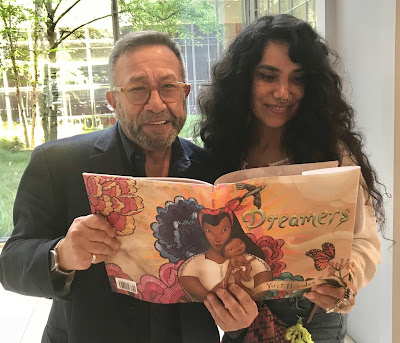
![]() |
| Neal Porter, founder and publisher of Neal Porter Books, with Yuyi Morales, author/illustrator of the award-winning picture book DREAMERS |
Neal Porter is VP and publisher of Neal Porter Books, an imprint at Holiday House, and is also the founder of Roaring Brook Press, an imprint of Macmillan. His books have won a plethora of awards, including the Caldecott Medal, four Caldecott Honors, Geisel Honors, Sibert Honors, the Coretta Scott King Award and Honor for illustration, Pura Belpré Awards, and the Boston Globe-Horn Book Award, and in 2015 he himself was awarded an Eric Carle Honor in the category of Mentor.
I had the pleasure of meeting and having more than one conversation with Neal at an SCBWI conference at Asilomar a few years ago, and I made a point of introducing myself and expressing my respect because ye gods, the man is having a CAREER, you know what I’m saying? He’s been in the children’s publishing industry for 43 years, with positions at too many publishing houses to even try to list, and works with some of the most heralded authors and illustrators in the field, including my personal choice for The Best Picture Book Author/Illustrator On the Planet Earth Right Now, Yuyi Morales.
![]() |
| The man himself, Neal Porter. |
Neal exclusively publishes picture books - 24 picture books spread across 3 seasons per year, to be exact - and some of the books he’s especially proud of are DREAMERS by Yuyi Morales, NINE MONTHS by Miranda Paul and Jason Chin, HEY WATER! by Antoinette Portis, and A PLACE TO LAND by Barry Wittenstein. In fact, he met Miranda, Antoinette, and Barry at SCBWI events, so, you know, SCBWI has served up a few bottles of that particular flavor of lightning.
Neal’s also done the publishing equivalent of finding a movie star working at the local soda fountain - in his case, the soda fountain being an indie bookstore, and the movie star being future Caldecott medalist Erin Stead - but he mostly hears about new talent from agents. He entertainingly describes the three-person staff of Neal Porter as a “vast empire,” but one which doesn’t accept unsolicited material because, you know, three people. Dude is good with irony.
He was not shy about acknowledging the changes and challenges forced upon the publishing industry by the Covid-19 pandemic. He misses the easy spontaneity of strolling down the hall to chat with colleagues, which is a more formal and ritualized process via Zoom. His list is full through 2022, and looking to 2023 means looking toward a reality we can’t yet predict the shape of. At the end of the day the publishing industry is still a personal, intuitive, and selfish (in the sense of only publishing books he truly loves) one for him, but he second guesses his choices more these days because of pandemic-induced uncertainty.
Neal acknowledges that as a 66 year old white guy, he carries an immense amount of privilege that he sometimes struggles to check at the door, but he finds much inspiration and learning from the examples set by his younger colleagues, and is eager to keep finding new work that prioritizes underrepresented voices, confronts racism, and empowers individuals and communities to rise up. Publishing has proven infinitely adaptable, and he believes a good book will always find its audience, no matter the circumstances.
![]() |
| Lin Oliver, Neal Porter, Arthur Levine, Namrata Tripathi, Julia Strauss-Gabel, Stacey Barney, Jill Santopolo, and Brian Truitt during the #SCBWISummerSpec editor panel. |
#SCBWISummerSpec Editors' Panel: Namrata Tripathi
#SCBWISummerSpec Editors Panel: Arthur A. Levine
Arthur says you need to grab the book August 25th to know the full meaning of its essential truth. J
#SCBWISummerSpec Editors Panel: Jill Santopolo
Jill Santopolo is the VP & associate publisher of Philomel Books, an imprint of Penguin Young Readers. She’s edited many award-winning and bestselling titles, including the #1 New York Times bestsellers She Persisted by Chelsea Clinton and Alexandra Boiger, Just Ask by Sonia Sotomayor and Rafael Lopez, Superheroes Are Everywhere by Kamala Harris and Mechal Renee Roe, and Girling Up by Mayim Bialik. When she’s not editing books, Jill is a New York Times bestselling author herself. Her adult novel The Light We Lost has hit multiple bestseller lists in the US and abroad and was Reese Witherspoon’s Book Club pick for February 2018. You can learn more about her at jillsantopolo.com or by following her on instagram or Twitter (@jillsantopolo).
The panel has each editor speaking in turn. A few highlights from what Jill shared:
She thinks about how publishing is at the crossroads of art and commerce. And how "feeling emotion is key to enjoying any kind of art... particularly any kind of art telling a story... like a book."
Expanding on that, she considers what the reader brings to the art, and how "their reaction will determine the success of the book." (If they love it, they'll talk it up. a.k.a. word of mouth. If not, not so much.)
Jill describes the emotions that drive some of the books she's edited, talking about the "Heart of the book."
"The heart of the book is a way the writer's heart and reader's heart reach out to connect." -Jill Santopolo
One example, for She Persisted by Chelsea Clinton and Alexandra Boiger, the heart of the book is "If anyone tells you your voice doesn't matter, don't listen to them."
The heart of a book can be explicit or implicit, and Jill shares more examples, including discussing the heart of the classic Goodnight, Moon.
She explained,
"Goodnight Moon assures readers with the heart message: everything is as it should be, and it's safe to go to sleep."
This was a profound insight to me - because I've never really "got" why Goodnight Moon has been so successful. But now, I understand it better. And I'm thinking about the "heart message" of what I write, too.
Thanks, Jill!
The panel ended with a Q&A, covering what editors wish authors would know, how illustrators can be discovered to be a debut, if age of the writer/illustrator is a thing editors consider, how important is a social media presence, gatekeeping in the industry, and how translators can help debut author/illustrators be discovered.
#SCBWISummerSpec Editors Panel: Stacey Barney
Stacey Barney of G.P. Putnam's Sons kicked off the Editor's Panel at the SCBWI Summer Spectacular by reassuring the publishing community that although she is eager to return to the office, business continues as usual on her end during the pandemic. She quoted Publisher Jennifer Klonsky in reiterating their ongoing mission to "publish books for every reader." She mentioned her experience as an educator prior to becoming an editor, and highlighted books on her list including the award-winning Firebird by Misty Copeland..
A Buzzy Post: the Editors Panel is About to Begin!
Wave hello to your neighbors.
*me waving hi to you*
Settle in.
Get ready to take some notes, do some sketches, be activated.
This should be great!
Saturday, August 1, 2020
A Conversation with LeUyen Pham and Dan Santat, #SCBWISummerSpec
By the end of their conversation, I felt energized and inspired—and also downright lazy. LeUyen and Santat are the epitome of prolific, juggling up to seven different picture book projects at any given time. They also balance marriages and families and dinner and . . . tennis lessons! Turns out, I've been doing it all wrong all along. The answer to real success is: freakin' no sleep!
Okay, here are a few bullet points to recap their discussion:
LeUyen Pham on character design
When beginning a new book, Pham first designs the characters. The look of the characters will
![]() |
| Character designs by LeUyen Pham |
Don't be afraid to start over again and again. It's okay to mess things up. Always give yourself space to change. Pham creates her initial sketches on an iPad using Procreate, throwing shapes on paper to see where they lead her. Shapes become forms, and then personality follows. Working digitally allows her to quickly create sketches while feeling free to ditch them. Working on paper feels too precious, not as easy to let go. She advises to always give yourself space to change.
Understand the principles of design, it is the most important concept to grasp with bookmaking.
Character design is all about silhouette, shape. How does a character read by it's basic shape. Are the character's shapes different one from another?
Use composition to move the audience's eye through the page. That movement needs to carry through each page of the book, like one long line drawn from the title page through the end.
Keep pages evenly weighted--balance.
Dan Santat
First of all, Dan wanted to be sure that everyone congratulates Pham on her Caldecott win this year! Yay! Congrats LeUyen Pham!
Juggling four, five, six books is no big deal for this guy. Time management is the key, though. Each project is broken down into deadlines. And each day, he gives himself several bitesize things to be completed in a day. Santat also finds it necessary to separates tasks within a particular mindset. He might paint all day. Or, he might sketch all day. Whatever he chooses to do that day, he does the easiest task first. It's like a warmup exercise.
Rest! Santat has learned to rest! After years of averaging 4 to 5 hours of sleep per night, he realized the value of rest, and a focus on his overall health. "My whole life can't be about art."
Big part of success is in curating taste--understand why something is good, or bad. For that reason, he reads his book reviews in order to understand others thinking. "You don't want to be in a place where you are stuck in your own beliefs and not open to hearing the ideas of others."
The most important thing about making a book is the concept. Take the time necessary to think of a concept that you can say it in one sentence. If the concept works, if the idea is there, everything else will fall into place.
Keep an idea notebook for journaling ideas as a way of hunting for that concept. Nothing fancy, even garbled, jumbled, thoughts. And don't be precious with those thoughts. Free yourself to say anything, no matter how ridiculous.