
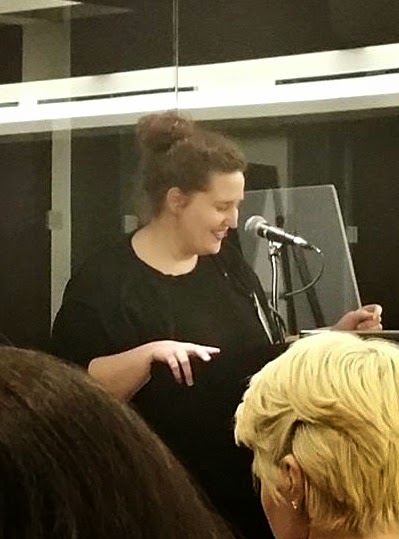
She manages her imprint’s international literature program, and has edited books translated from German, Dutch, and Russian. Emily attended Stanford University, followed by the Columbia Publishing Course, and translates children’s books from Italian. She grew up in Tempe, Arizona, and now lives in Brooklyn.
She talked to us about what that tricky word "literary" means, and how we can achieve it in our writing. But first, she told us the backstory behind a Russian novel coming out on the Arthur A. Levine spring list.
 Called "Playing A Part," it was published just after Russie passed anti-gay propaganda laws. While it wasn't illegal for the book to be published, it could not be shelved with children's books.
After she read about it in The Atlantic, she looked into acquiring it, not knowing whether it was well written or appropriate for their list. She discovered a "gorgeous, beautiful, moving, and sensitive novel." And now it's the first young adult novel to be translated from Russian into English.
"It's crazy that hasn't happened before," she said.
The word "literary" is a tricky one for her. She doesn't love talking about books as literary or commercial because the two things aren't mutually exclusive. And some people are put off by the concept of literary, so she always tries to pair the word "accessible with it."
Here are four items from her list of seven essential literary qualities:
- It's about something. The book tackles a big idea and one of the larger themes of life, challenging the reader to think from a new angle.
- It has voice. Voice is informed by the character and his or her world, and makes your work engaging and feel authentic.
- It has plot. You can tell if your plot is lacking if you can't explain your book's premise in a few sentences (and the usual cause is that your voice is getting in the way).
- It has resonant details. "Every piece of clothing, every meal, every book your characters read" is intentional.


