Showing posts with label Steve Malk. Show all posts

Friday, July 29, 2016

Fiction to Nonfiction and the New Mashups in Between


Four industry stars with four different points of view talked to us about groundbreaking nonfiction.

  • Steve Malk is a literary agent at Writers House, representing some of the biggest names in the business.
  • Susan Campbell Bartoletti writes poetry, short stories, picture books, and novels and nonfiction for young readers. 
  • Linda Sue Park is a Newbery Award winner (for A SINGLE SHARD), and the author of a NYT bestseller called A LONG WALK TO WATER as well as WING & CLAW and YAKS YAK.
  • Elizabeth Partridge has written more than a dozen books, including MARCHING FOR FREEDOM and biographies of Woody Guthrie and Dorothea Lange.


Susan Campbell Bartlett's career opened up when she started to do nonfiction. She learned everything she needed to know about nonfiction in a great 11th-grade English class: taking notes, research, writing. She's written about growing up in coal country, Hitler youth, the Irish potato famine, and the Ku Klux Klan, and Typhoid Mary.

Some of the best advice she's ever received, from Patti Lee Gauch, is to reach inside of yourself and find a personal story.

Linda Sue Park loves writing historical fiction, and she loves grounding it and basing it in fact. She writes stories like she cooks: there is no recipe. Her tinkering, especially with real life events she works into her books, makes the narratives better. She ended up writing fiction because she loves to change things.

A LONG WALK TO WATER is one of her mashups. It's historical fiction based on the true story of a friend of hers who was one of the Lost Boys of Sudan. She interviewed her friend for hours and read his own writing. But the part of his life that she was writing about happened more than 20 years ago, so to make it a dramatic narrative, she wrote in scenes and added dialogue. Even though she interviewed him and got quotes from him, she considers the reproduction fiction. It's recreated from old conversations, and she doesn't think it's truly nonfiction to work this way.

Linda Sue also makes composite characters out of multiple people. Their stories are true, but the combination makes it fiction. Readers have been moved by the book nonetheless, and have raised more than $1.5 million for a water charity in Sudan. The realness of the book is what resonates with readers.

She's working on a mashup with several authors, including Jennifer Donnelly, M.T. Anderson, Candace Fleming and others about Henry VIII. It's called FATAL THRONE and will be out sometime after next fall.

Elizabeth Partridge loves to write biographies. She likes characters who are difficult. This gives grit and multiple layers to work. MARCHING FOR FREEDOM was a challenging book to write because her main characters were all earnest, hardworking, amazing kids and young adults. It's about the march from Selma to Montgomery in 1965, and she wanted to choose a new POV from Martin Luther King Jr's. She found photographs of kids who'd participated in marches and tried to find names of people to interview.

A New Yorker article led her to some kids who'd taken part, and before long, she'd found six or seven kids, whom she interviewed in Selma. "If I wanted this to remain nonfiction, I would have to quote them exactly."

Steven Malk has always loved nonfiction. He was a history major in college, and when he gets to read away from work, he reads all nonfiction. Nonfiction has morphed and taken on a broader definition. There's room for more voices. "It's an interesting time." He talked about Deborah Wiles documentary novels REVOLUTION and COUNTDOWN. "She's doing something very unique."
Other writers/artists to watch are Deborah Hopkinson, Kadir Nelson, Eugene Yelchin and Matt dela Pena, Stephanie Hemphill (and more—he's an encyclopedia of books and creators).

He likes it when books open up conversations about what's fiction and nonfiction. He's a bit looser about it. As long as people are reading, that's a good thing. He grew up in his parents' bookstore, and wasn't snobby about what people were reading.

What's the line between fiction and nonfiction? 

Susan Bartoletti - a book like TERRIBLE TYPHOID MARY is nonfiction. When Mary is thinking, Susan couches it in "might have thought." -

Linda Sue Park - "Facts don't interest me very much. I'm interested in truth." Facts are one tool to getting at the truth. At a Library of Congress event she met a man who wanted to read only fiction, because all nonfiction becomes untrue with future discoveries. This fascinated her, even as she depends on nonfiction writers' work to do their own.

Elizabeth Partridge - She has a hard line between fiction and nonfiction. "I will not make up anything. I will twist myself in knots to not make up something." The weather can be particularly difficult. But she's loving the mashups that are getting more and more out there. She loves how in LOVING VS VIRGINIA the author went inside the characters' heads and told the story in poetry.

"We think of nonfiction of being dry and dates and names and places. But if you can find the emotional spine of your book, it will be powerful."

Steve Malk - You need to own what you're doing. You can't say it's nonfiction if you're making up dialogue. If you say you're writing nonfiction but you don't have sources and you're making things up, it makes you look unprofessional. You need to be very clear to an agent or publisher what you're trying to do. Authors notes and backwater can be helpful, but you have to be able to articulate it for yourself when you are submitting. Don't leave that up to the publisher.

We're also starting to see nonfiction back matter in fiction books, Susan said. That's an interesting mashup.

You have to be honest with yourself about your research and what you're writing. You can't rely on your publisher to vet your work.

"If you're passionate for your topic, you want to get it right. You would be unsatisfied fudging it," Linda Sue said.

Saturday, August 2, 2014

Steve Malk and Linda Pratt: Agent's Panel

Steve Malk of my favorite agency, Writers House! (with Lisa Yee's Peep)

Linda Pratt of my second favorite agency, Wernick and Pratt!


Lin asks the panel what hooks them:

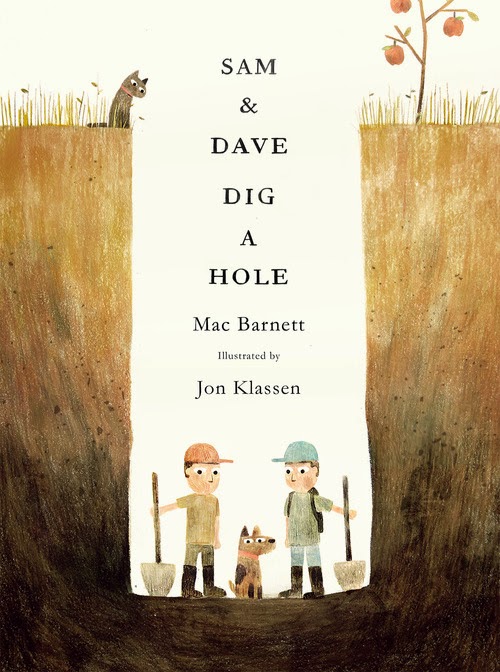
A hole is to dig, and Mac and Jon are digging a hole—
I think that title font is even an homage to the
Krauss/Sendak book, so nice.
Steve: "I love finding something that references a classic but layers their own point of view on top. With Jon Klassen I thought I could see immediately all of his influences but... he put a fresh point of view on top of that... took it in a completely new direction."

Linda: "I'm looking to meet somebody on a page that intrigues me from the very beginning. Something that I haven't seen before that makes me wonder why I haven't seen it before because it's so obviously interesting."

"And cover letter first, I want to meet that character on the page, but I also want to get a sense of the person I'm going to be working with. I want to know you're going to go out in the world as a professional."

Lin wants to know more about Linda's wishes for a cover letter:

Linda: "I want to know you've done your research, a brief summary of what your work is about, why you're submitting to me, and any credentials you have." (Like that you are an SCBWI member, not that you read your book to a bunch of third graders and they say they liked it and/or didn't fling boogers at you.)

Steve: Cover letters are really important, it's your opportunity to establish yourself as a professional. This is your career, so you should be taking it very seriously. If the letter has misspellings, reads like you just dashed it off, you're kind of selling yourself short.

A good cover letter will predispose us to want to like your work because we know you are serious about your career.

Did you know Marla's BOSS BABY is going to be a movie soon?????
Lin asks, "When you're taking on a new client, do you need to see a brand or be able to see the potential of one?"

Steve: The word brand can be tricky, it can scare certain authors, what if you don't have a narrow focus or niche? Your brand is who you are as a writer, it may be that your brand is that you write cross genres. Don't feel boxed in by the word "brand." For illustrators you don't need to feel like you can only work in one style or one character. Let your brand be that you do amazing work, like Marla Frazee. Everything she does is amazing, but her work is not confined to one character.

Linda: Sure, Hunger Games, Twilight, and Mo Willems are a brand of one type, but LeUyen Pham is an amazing talent and has a range of styles, she adapts her style to the book or project.

Did you know LeUyen is illustrating something for SHANNON HALE?!?


The Agents Panel Begins!

From the seats...


And close up!

Left to Right: Sarah Davies and Steve Malk

Left to Right: Erin Murphy and Aleandra Penfold

Left to Right: Rubin Pfeffer, Linda Pratt and Laura Rennert

Sunday, August 7, 2011

Steve Malk - Making the Most of Your Illustration Career: How to Break In, Stay In, and Thrive

Steve looking for a transom he can shimmy through
Originally, I was THRILLED to attend Writers House agent Steve Malk's session because I thought it was about how illustrators should consider moonlighting as cat burglars. So I sat through the whole dang workshop waiting for ANY REFERENCE to jimmying locks or muffling your getaway car's muffler. Nothing helpful about breaking in AT ALL. It's really not worth posting what he said, but I'm contractually obligated to do so:

Steve: People say picture books are down, but I've signed three new illustrators since this time last year. There are no shortcuts in this field, you have to go the extra mile. You just have to work harder, the jobs are out there.

Steve's slideshow contained not diagrams of safes and how to crack them, but quotes from his clients:

Push yourself to the edge in terms of working hard and creating the best images you can. Don't let anyone else outwork you." -- AG FORD

Cover of AG's latest book

You can't be a dabbler, you have to be 100% committed. Certainly, work in the other parts of the arts, Steve even encourages that, but committing fully to your children's book illustration career is going to make your success much easier going.


Well, this next quote could actually apply to thieves. Malcolm Gladwell's 10,000 hours rule:
The people at the very top don't just work harder or even much harder than everyone else. They work much, much harder.

Steve hands out a list of his top 25 books you should know to be the best illustrator you can be as well as six great online resources for illustrators. I'm picking my top five books from that list:

There's a lot of subjectivity involved in how your work is received. But as a general rule: Your portfolio needs to be specific to children's books. Take the weeks, months, or years needed to make your portfolio specialized. There should be a logic to the way your pieces are sequenced.

From Stephanie Graegin's mini promo booklet
Steve shows us an incredible promotional piece made by Stephanie Graegin. The ultimate in a well sequenced portfolio. Steve said out of the 250 editors and art directors and designers she sent her mini-booklet to, nearly all of them commented on how clever and pretty it was, and it started a work buzz for her that's resulted in a number of books under contract.

The two things Steve says you can control in this business are:
  • How people experience your portfolio
  • Being a pleasure to work with

From Christian Robinson's Writers House portfolio


Another new client, Christian Robinson, demonstrated to me, personally, that he'd be a pleasure to work with. I got to meet him this weekend and he totally laughed at all my bad jokes. And they were total stinkers.

From Marla's book THE BOSS BABY (who Steve modeled for!)
Check your ego at the door. Success doesn't come to us quite as quickly as we hope. Everything is an opportunity. We make our own luck.

"Don't make anyone's job harder than it already is." -- MARLA FRAZEE

And Marla's quote could apply to heists! So at least I can end on a useful note.

Friday, August 5, 2011

Steven Malk and Jon Scieszka: No Holds Barred

I highly recommend listening to Jon Scieszka whenever he speaks, but especially when he's with agent Steven Malk! As funny as I'd hoped, their session called: No Holds Barred: An Agent and an Author Give Outspoken Advice on Writing, Submitting, Promoting and Everything in Between, was great.


I think one of the best points was when Steven talked about making career choices. He suggested that author should find a career they'd like to aspire too. It's not about money, but about business choices that most reflect your goals. Jon said that he didn't fully understand the importance of having a plan until he started working with Steven who helps guide him in the right direction.

The back and forth between the two was hilarious! Soccer shorts, The Three Little Pigs Christmas... the jokes kept it lively.


Steven offered some steps toward success, starting with the most important: Write a Book. He suggested learning about the classics and had handouts. Read across the genre to form a bigger picture and foundation.

The talk was really inspiring! Be sure to check them out whenever you can!

Friday, July 30, 2010

It's not Mac & Cheese, it's Mac & Steve! 5 Lessons from Classic Picture Books That Can Help You Launch Your Career

There was a typo in today's conference schedule. I thought, and I believe so did the standing room only crowd, that we were in Room Constellation 1 for Free Mac & Cheese. But it turned out it was only author/raconteur/multiple-pattern-wearing Mac Barnett with his junior agent, the barely memorable Steven Malk.

Mac and Steve didn't have any food to share, but instead some practical lessons on how you can create better picture books by reading classic picture books.

Steve: There's always a place for great picture books. I sent out a book last week that was a real throw back, one editor called it 'the love child of Maurice Sendak and Sandra Boynton.' Editors still love and look to the classics in picture books... I always try to stay away from trends.

Mac: Which brings us to Lesson Number One: Vampire Picture Books.

The slide show starts, all the gorgeous hand-lettering of the rules slides (which you can't see) done by Laura Park.

Lesson #1: Let the Illustrations Do Their Job
 
A masterpiece of storytelling with no words, GOODNIGHT GORILLA 
 
 
A masterpiece of not overwriting the scene, THE STUPIDS STEP OUT
 
 
A masterpiece of leaving the whole joke to the art, THE CARROT SEED

Lesson #2: Understand the Picture Book's Conventions

The Page Turn (Mac thinks this is the most imporant aspect of plotting a picture book and here are some of his favorites)
HENRY'S AWFUL MISTAKE 
 
 
THE MONSTER AT THE END OF THIS BOOK
Page layout formats, when repeated, create a visual rhythm for a book
(As an author, Mac especially enjoys writing wordless, two-page spreads.)
Good visual rhythm and suspenseful page turns in 
 
 
MADELEINE
 
THE HAT (Mac hearts Tomi Ungerer!!!)
 
 
 BILLY TWITTERS AND HIS BLUE WHALE PROBLEM

Lesson #3 The Writing Must Serve the Book
 
Pay a lot of attention to how YOU are going to write your book, not how Dr. Seuss would have written your book. Pick a tone and stick with it—will it be sweet? Or have an edge? If you do want to rhyme, Mac recommends Paul Fussell and Mary Oliver's great books on verse.
 
Some good examples of rhyme from Steve who says there's a logic to why they used rhyme and they read flawlessly:
 

BEAR SNORES ON
 
 
TIME FOR BED
 
 
GUESS AGAIN!

Steve: Read your work out loud to lots of people. People that have never heard it before. Like when the UPS guy comes by, read your story to him.
Mac: Don't read your story to the UPS guy, that's a horrible idea, he'll start losing all your packages if you do that.

Lesson #4, Lesson #5 I will save for conference goers alone to relish. But here's a shot of Steve and Mac being mobbed after their session:
 
And here's illustrator/writer Dan Santat, illustrator of Mac's OH NO!. That is his happy face.