Showing posts with label #SCBWIsummer22. Show all posts

Sunday, August 7, 2022

From Page to Screen: Hollywood Options and Opportunities for Writers of Kidlit: David Bowles


Have you dreamed of your book on the big screen? David Bowles shares his experience and opportunities for writers of KidLit.

Ever wonder why book adaptations remove some of the scenes from the book? Movies and TV need scenes to keep moving forward. Therefore, not every scene makes it to the bring screen. 

If you desire your book, to become a movie, it must be a good book. Book sales can be indicative of making it to Hollywood. Producers act as investors for the film, so they are looking for a return on their investment. 


Authors and writers should learn the screenplay format. Final Draft is the most commonly used software throughout Hollywood. Practice the software to ensure, you can fulfill the requirements of Hollywood. You can also adapt your book into a screenplay.


 Are you sure the book would make a great movie? David offers some books should remain books.

 
They Call Her Fregona

David Bowles is the award-winning author and translator of more than two dozen books for children and teens, among them They Call Me Güero, My Two Border Towns, and The Sea-Ringed World. His work has been published in multiple anthologies, plus venues such as the New York Times, School Library Journal, Translation Review, and the Journal of Children’s Literature. In 2019, David co-founded the activist movement Dignidad Literaria to fight for the literary and cultural dignity of Latinx people in US publishing and education. He presently serves as the vice president of the Texas Institute of Letters.

Missed this workshop? Check out the video archives here. https://www.scbwi.org/event-summer-conference-2022/video-archive/

Enjoyed this recap? RT the post on Twitter so others can check it out. 

Saturday, August 6, 2022

Translators' Zoom Social, hosted by Avery Fischer Udagawa #scbwiSummer22

Did you know that the SCBWI has a member category for Translators? Children deserve to explore their whole planet through books, and translators bring them books written in many languages, in many places. Like writers and illustrators, translators work as independent, creative contractors who benefit from networking, professional development, and a supportive community. 


We had about thirty attendees; the shot above includes those who were okay with turning on their video for the group photo. 

Thanks to the translators for welcoming me to their Translators' Zoom Social tonight even though I'm not a translator. After Avery talked about useful translator resources and translation news, attendees introduced themselves. So many different languages and translation projects going on! Everyone was super-friendly and welcoming.

Sadly, Nanette McGuinness was unable to join us as speaker, but everyone sent her best wishes:

I asked host Avery Fischer Udagawa for resources where people could find out more about translation, and here are just a few:

Translation in SCBWI - "A great place for translators to check out resources and ways to connect."

SCBWI Podcast: The Art Of Translation with Laura Watkinson - "The first episode of the SCBWI Podcast featuring a translator has aired, featuring Laura Watkinson."

"Translators have been among this year’s co-bloggers with Lee Wind at SCBWI The Blog, including myself back in March and Lawrence Schimel in June (here are posts with the label "Translation" on the blog). Regional blogs have also been offering meaty translation content."

Some examples:

A Conversation With Translator Takami Nieda - SCBWI Japan Translation Group

Translation: Claire Storey -Words & Pictures, The SCBWI British Isles Online Magazine

"In industry news, a reminder that the ALSC will now require naming the translator on the cover page, and ideally on the cover, of books considered for the Batchelder Award!"

Batchelder Award Criteria Change: Name The Translator

Revisions to Batchelder Award Aim To Raise Recognition Of Book Translators

"Finally, September, World Kid Lit Month, is a time to celebrate translations for children/teens and is fast approaching! Nanette McGuinness will co-blog with Lee Wind at SCBWI: The Blog during #WorldKidLitMonth."

Avery Fischer Udagawa grew up in Kansas and studied English and Asian Studies at St. Olaf College in Minnesota. She holds an MA in Advanced Japanese Studies from The University of Sheffield. She has studied at Nanzan University, Nagoya, on a Fulbright Fellowship, and at the Inter-University Center for Japanese Language Studies, Yokohama. She writes, translates, and works in international education near Bangkok, where she lives with her bicultural family. She serves as SCBWI and SCBWI Japan Translator Coordinator. Find her on Twitter: @AveryUdagawa.

Closing Keynote: Donna Barba Higuera

Our SCBWI Summer 2022 closing keynote speaker is the delightful Donna Barba Higuera whose The Last Cuentista won the Newbery Award. Her middle grade and picture books reinvent history, folklore, and or her own life experience into compelling storylines and today Donna shares some of those stories.

But first, SCBWI has been a huge part of Donna's journey and she has heard a lot of keynotes throughout the years. So as excited as she was to do one, she looked to past speakers for guidance. Dan Santat’s How To Give a Keynote advice states that you should open with a joke, so Donna baked up one for us:

Two muffins walk into an oven. 
One muffin says to the other, "Ahh, this oven is hot!" 
And the other muffin replies, "Ahhh, a talking muffin!"

THANK YOU DONNA, and DAN.


Donna talks about her family, her wonderful parents and grandparents and the wonderful stories they told her. So many of the stories in Cuentista she heard in her grandmother’s house. They were different from other stories Donna’s peers were being told, Donna’s grandmother cooked differently from other grandmothers, she drove a rusty truck, didn’t have fancy dresses. But it's all of these differences that make Donna's voice today so exemplary. Besides her family folklore, these are some of the books Donna remembers loving as a kid:


Plus this book(?!?) (plus adorable school photo of Donna at that age she was really into that book)…


So not a big surprise that Donna loves the Twilight Zone, Star Wars, The X Files, and more recently the Dr. Whos. Donna is also a huge Trekkie: “These people had a huge influence on my childhood. I saw situations with people and actors that I’d never seen before.” 


In addition to sci-fi, Donna loved Mexican folklore, like Popocatépetl and Iztaccîhuatl the story of a princess and warrior that fell in love and in a pre-Romeo and Juliet fashion have a tragic ending but become neighboring volcanoes. Quetzacoatl and El Conejo is about a god who comes to earth and meets a selfless rabbit who is rewarded for his selflessness by becoming part of the moon (look for it tonight!)

Is Mexican folklore too strange or weird? Donna says no, look at all the strange and weird stuff we have in our current and favorite stories as mentioned above. Donna took those parts of herself, her love Mexican folklore stories and her love of sci-fi and combined them into her own work. 

Donna feels like she’d have no books in the world if it weren’t for her writing family: Donna is also an optometrist and one of her patients happened to mention her local Western Washington SCBWI. Soon after, Donna went to a local event and happened to have her first pages with her now editor, Arthur Levine. Arthur may not even remember having this meeting but Donna does! And that the advice was a little brutal, but from it she learned to slow her story down and she now always makes sure her young readers love her main characters within the first few pages before giving them all the dramatic plot 'goods'. 

Donna talks about meeting her husband at another SCBWI first pages event, and at ANOTHER SCBWI event she met Lin Oliver as well as editor Nick Thomas, who loved the first pages she shared there that eventually became Lupe Wong:


Donna touches briefly on book bans: 
I have something to say to people who want to erase these stories. You are challenging those with dreams of escape or who want more. You are challenging them because you don’t understand them. We are all people with folklore and cuentos of our parents, grandparents and ancestors. For those of you who are trying to remove books from our schools... I dare you to erase those from children’s imaginations, no one can steal our imaginations...

Donna's advice to book creators this weekend: 
Slow down, take your time, it’s an amazing journey. Some of you are going to meet people today, even virtually, who will become your friends for decades. Help each other along the way, and keep nurturing your dreams and the child in yourself. 

And if you ever see Donna at an event, please say hi:


Disability Reset: Karol Ruth Silverstein

Karol Ruth Silverstein (she/her/disabled) has been an active member of the SCBWI for over 20 years. Her debut young adult novel, Cursed (Charlesbridge Teen), was loosely drawn from her experience of being diagnosed with juvenile arthritis at thirteen and won the prestigious Schneider Family Book Award in 2020. Karol has identified as disabled since the age of 21 and is active on the Writer’s Guild of American West’s Disabled Writers Committee.

Karol asks us to change how we think, talk, and write about disability starting with our word choices. She's aware she does not need to convince this audience on the importance of language, that when we consistently use stigma-enforcing language it reinforces and internalizes that stigma in its readers.

As Karol revised her Cursed manuscript, she herself was reticent to call her main character disabled, but as she looked at all of the things the character was living through on a daily basis, Karol realized that it was an accurate description, even if the character herself wouldn’t have used that word for herself.

The preferred term is 'disabled' and Karol shares many examples of how the world is often treating people and viewing and describing things through an ableist lens:


Karol says as long as we continue to ‘cringe’ at using the word ‘disabled,’ that a child with a disability perceives that not mentioning it means there is something wrong with being it. Karol wants us to #saytheword rather than all of these euphemisms, the word we should be using is disabled. 

She also understands that we don’t know what we don’t know—but that a person's best course of action is not to argue or make excuses, but to admit it, apologize, and do better—Lizzo being a great example of this when she apologized and then rerecorded one of her songs to omit a derogatory term.

Children's book creators have both a responsibility to model good behavior in some or all of our characters while also creating authentic characters. Karol always wants to be a part of the solution, so for her she tries to model the good behavior and only let characters exhibit inappropriate language/ignorance if it’s necessary to the story.

The words lame, crazy, and insane are all also problematic in regards to mental health and something to move away from, a mistake Karol made herself in one of her books. She sees now those word choices could be deemed lazy writing anyway, and it was something she wanted to rectify in the reprints. See how fully replaceable crazy and insane are in the paperback edit of Karol’s book:

Cultural competency readers for all: 

Karol has arthritis, as does her main character in Cursed, but Karol still had a teen reader with arthritis as well as a doctor specializing in its treatment read her work for a present-day lens on what teens today are experiencing with diagnosis and treatment. Disability is tough to read for because each disability is so different. She recommends contacting hospitals and parent groups and that authors or their publishers should pay for a reader like this once a book is under contract.

In closing, Karol urges everyone to also check out Stella Young’s TED Talk. It's linked here as well as in the handout for Karol's session that will be available when the recorded version of the session is posted in a few days.


Hear more from Karol on Twitter @KRSilverstein, Instagram @KRSilverstein2019 and at www.karolruthsilverstein.com

The Query Cupcake with Kayla Cichello

Kayla Cichello is an agent with Upstart Crow Literary, she's open to picture books through YA and illustrators. Some of her clients include Ana Otaru, author of the upcoming picture book Masquerade for Grandpa (Atheneum/S&S, 2023), as well as author-illustrator Kirbi Fagan, illustrator of Summer of the Tree Army (Sleeping Bear, 2021).

Kayla wants your query to an agent to be as irresistible and delicious as a cupcake is to a toddler. Like a well-made cupcake, a query has a couple of important parts: Intro; Summary; and a Bio.

A quality query starts with the email subject line: For Kayla, please put the title of your story in the subject line, not just "children's book" and include the genre for extra appeal.

The Intro should contain the manuscript's basic info like genre and word count, as well as why you are querying that particular agent. Intros should also include a one or two-sentence pitch summarizing your manuscript (see Eddie Gamarra's session for a whole session on how to craft a pithy pitch), and HOOKS.


Kayla uses Dragons Love Tacos as an example showing what on the surface seems to be just a funny silly book still has deeper themes, something editors are looking for in all picture book manuscripts.

Kayla also covers pitches, bios, and gives examples of excellent summaries for both picture book and MG/YA queries in addition to this handy breakdown of what to include in your summary: 


Mining Memories As a Creative Tool with Baptiste Paul


Baptiste Paul is the award-winning author of The Field, To Carnival, I Am Farmer: Growing an Environmental Movement in Cameroon and Climb On. His works have garnered many starred reviews from Kirkus, Booklist, and School Library Journal, and several titles have been translated into multiple languages. He loves writing stories inspired by his childhood in Saint Lucia, and featuring words from his native language, Creole. Baptiste is also a mentor for We Need Diverse Books and the co-author of several works with Miranda Paul, including their newest collaboration, Peace. He lives in Wisconsin with his family. More at baptistepaul.net.

Baptiste mines his memories as a tool for every book he writes. 

Baptiste ask us all to write some of the sounds, the smell, the sight, the feelings that made our life interesting. He says, "Your goal is take your readers on a journey with you. If this is your goal then you have to wow your readers."

The best way to tap into your memories is use your senses (sight, sound, smell, taste, feel).

Baptiste shares the steps of his PROCESS:

SPARK
The first part of his process starts with a SPARK. Take that spark of an idea and ask: Who? What? Why? When? How? What comes to you from your own childhood memories when you ask those questions about a spark. For example: children playing outside. What comes up? What do you think of when you ask yourself those questions? 


REFLECTION
In this step, Baptiste encourages us to go deep here. To ask: Why do I want to tell this particular story? And then, in this step, make lists of all the sensory details. 

"When you are mining your memories, consider your words. Make sure they are colorful. Make sure they are ones that will take your reader on a journey."

CONNECTION
What is the universal element in your story? 
After you dig deep into memory, ask yourself: Is this universal? Is it an experience children can relate to? List the ways it's universal. And why!

WRITING EXERCISE


Baptiste asks us to close our eyes and think of our first day at school. 
Now list three examples of how you used your senses to experience that first day of school. 
    What do I see?
    What do I hear? 
    What do I feel?
    What do I smell? 
    What do I taste? 

And what a treat to listen to Baptiste, as he closes his eyes, to recall each of these for his own first day. 

Baptiste encourage everyone: Each time you go into a memory, go to a place that is quiet, and continue to ask yourself: Who, what, why when, where, and how. And then repeat the process over and over. 


Kayla Miller: Illustrating The Graphic Novel #scbwiSummer22


Kayla Miller is the author and illustrator of the New York Times best-selling Click graphic novel series and co-author of its spin-off series Besties. They studied at the University of the Arts in Philadelphia and graduated with a BFA in Illustration. Kayla currently lives and works in New York state, and when not writing or drawing, they enjoy watching bad movies, trying to cook new recipes, playing board games, and reading other people’s graphic novels.  More info at Kayla-Miller.com, Twitter @Kayke, Instagram at @Kayke.

In this session, Kayla talked about illustrating graphic novels, ably assisted by ASL interpreters: Steve and Jenny.

In school, Kayla said that in school, there weren't many courses that dealt directly with graphic novels. Kayla took some creative writing classes but felt they were missing out on visual narrative, so they also took a Narrative Cinema course. They point out both graphic novels and cinema use many similar techniques.


Graphic novels, however, have a smaller budgets and smaller teams. If you're a graphic novel creator, you need to learn how to be organized, meet deadlines, wear many different hats, working closely with others.


The illustrator needs to decide what the characters look like. You need to design the characters that you can easily draw many, MANY times. Here's Kayla's lineup of characters for some of their books:


Don't count on having room for text. Kayla pointed out that you can convey so much about the character in the illustrations in other ways:


Using film terminology can help with communication. Kayla gave examples such as distance, establishing shot, close up, etc. 

Kayla showed us how varying aspects like just the angle can change the emotional impact, character info, and reader experience. Lighting can show passage of time as well as conveying mood. Decisions about staging the shot can also convey info that is not necessarily known by the character in the story as well as focusing a reader's attention on a particular aspect.

Kayla suggests using a mirror or webcam to try out different emotions as well as body language, to better learn how to "push it" in your illustrations. Kayla says they will watch videos of someone skateboarding if having to draw someone skateboarding, to help get a better sense of the physicality.


You can use panels to control pacing, says Kayla. Having a series of similar small panels will convey the feeling of time passing slowly. Big panels can help convey big emotions or stop time in a single moment. Kayla also discussed how varying the shape of panels can change the mood.

When designing panels, it's important to keep readability in mind, and how alignment can control how a reader will read the page. Kayla showed how grouping and ungrouping panels via gutter placement can help readers (especially young readers) not get confused. Kayla also discussed the importance of word bubble design, and how to be aware of readability over a full spread.


Throughout, Kayla is always aware of reader experience. They even mentioned how they vary the horizontal gutters because in some e-readers, the pages might end up close together and get confusing.

In the Q&A, Kayla said they do all their work on their iPad now. They use Photoshop for easier workflow when working with their team. Kayla keeps spreads organized by name.

When trying to get noticed via webcomics, Kayla advises formatting your webcomics so that they will be easy to translate to print in terms of paging. With support from a colorer and a letterer, Kayla can do a graphic novel in a year.

Wow, what an amazing session! Anyone interested in illustrating graphic novels definitely needs to watch Kayla's session replay.


Feeling Stories with Kelly Starling Lyons

Kelly Starling Lyons is a founding member of The Brown Bookshelf, teaching artist, and award-winning children’s book author. She has written more than 20 books for young readers that span from easy readers to picture books and chapter books. Among her acclaimed titles are My Hands Tell a Story, Caldecott Honor winner, Going Down Home with Daddy, Christopher Award winner, Tiara’s Hat Parade, and Notable Social Studies Trade Book for Young People, Sing a Song: How Lift Every Voice & Sing Inspired Generations. She’s also the author of popular series including Jada Jones, Miles Lewis and Ty’s Travels which won a Geisel Honor Award for Zip, Zoom. Kelly lives in Raleigh and was named to Good Morning America’s 2021 Inspiration List: Who’s Making Black History. Learn more about her at www.kellystarlinglyons.com. 

Kelly Starling Lyons presents her session on Picture Books


The full title of Kelly's breakout session is "Feeling Stories: Creating Picture Books That Pack an Emotional Punch."

Kelly opens with some tips on writing picture books, including:

- There are no absolute rules

- Child main character should solve problem on their own (but elders can be important - they are in Kelly's work)

- Leave room for the art to tell the story, too

- Craft each page turn like a mini-cliffhanger

- It needs to stand up for repeated readings

With mentor text examples and exercises, Kelly walks us through ways to create emotion. Mining our memories and experiences. Keeping a journal or file of ideas. Looking at our life with a "writer's eye."

She suggests that #1, we make a list of:

Best and worst school or family memories (from when you were 4-8 years old)

and/or

Experiences or relationships that inspired you or changed you

An example Kelly gives is girls at school making fun of her outfits.

Next, #2, she asks us to write down, for each item on our memory list, our emotions -- how did we grow or change?

As an example, Kelly tells us about those mean girls at school - and how she experienced embarrassment at first for being picked on, then fear because some of the girls were tough, then anger at being picked on, then relief when she figured out how to deal with them, then finally empowerment in being able to stand proud in the outfits she chose to wear.

Kelly quotes Jacqueline Woodson's inspiring words:

"...when I write, I go back and I remember who I was, and I start crafting my characters from that place. My writing starts with something that I know deeply, and then put it onto and into my characters." –Jacqueline Woodson

Show emotion with Touch, Dialog, Smells, Sounds, Taste  - think about how you can bring emotions to life. "It's really important to use sensory detail..." Keep in mind the illustrator will be focusing on what the character sees, and you can focus on the other senses!

#3, Kelly has a write a scene, 

and then #4 asks us to create a character who is dealing with the emotional truth of our memory. 

Consider: What does our character want? And what is standing in our character's way? "We have to feel that longing." And raise the stakes. Why does it matter so much? How do you make the reader feel how much it means? What's at stake if the character doesn't get it?

There's lots more, with Kelly answering audience questions, talking about self-publishing and how there are no shortcuts, her own publishing journey and being published by multiple publishing houses, and many more examples, from Kelly's own books and other mentor texts, too.

Final gem of advice:

Write from your heart

Creating Memorable Characters That Readers Can Cheer and Celebrate: Ernesto Cisneros


Ernesto Cisneros is the nationally acclaimed author of Efrén Divided. Ernesto shares how to create memorable characters that readers can cheer for and celebrate!
Ernesto begins the presentation with thinking about your circle of your friends. Who are your friends, best friends, acquaintances? What are their positive/negative quirks about them? Do they put ketchup on all their food? Do they never tie their shoe laces? 
 
Ernesto reminds the participants that you can mesh the quirks and characteristics of different people throughout your childhood! You can take something as simple as a name and then develop the personality from other references. 

We all have quirks, these quirks make characters memorable. When you're thinking of a scene, Ernesto shares the importance of making the scene exciting, confusing, or dramatic. For example, when your characters are in the kitchen washing dishes, incorporate a leaky faucet, or something the audience will remember about the character. 

When it comes to creating other characters within the story, Ernesto draws from unfavorable experiences. Think of the people you didn't get along with in school. Why didn't you like them? Brainstorm their traits. Maybe they teased you, maybe they hogged the ball at recess. This can be a character that is disliked in a book. 

Here are three takeaways to creating memorable characters: 

  • Avoid stereotypes 
  • Write from the heart
  • Remember your childhood

Ernesto Cisneros is the nationally acclaimed author of Efrén Divided. He was born and raised in Santa Ana, California, where he still teaches.  As an author, he believes in providing today’s youth with an honest depiction of characters with whom they can identify. Efrén Divided is an Indies Introduce/Next Pick, Amazon Top MG of 2020 So Far list, and is a ProjectLit Selection, and winner of the 2020 Poppy Award in MG, 2 International Latino Book Awards, as well as the prestigious 2021 Pura Belpré Medal and an SCBWI Crystal Kite Award in 2021. 

Instagram: cisne.writes 

Twitter: @Author_Cisneros 

Website: www.ernestocisneros.com

Missed this workshop? Check out the video archives here. https://www.scbwi.org/event-summer-conference-2022/video-archive/


Enjoyed this recap? RT the post on Twitter so others can check it out. 


Live Drawing With TeMika Grooms at #scbwiSummer22

After getting inspired by all the sessions so far at the conference, it was the perfect to do some LIVE DRAWING. ASL interpreters: Genaere and Corinna. 

A longtime SCBWI volunteer with a love for writing and illustrating children’s books, TeMika Grooms also manages graphics and illustrations produced to support the SCBWI.  She provides logistical help with illustration-focused membership benefits and event programming.  TeMika has volunteered for the organization at many levels supporting others with the same passion for developing the craft. Her latest illustrated book by Senator Raphael G. Warnock, Put Your Shoes On And Get Ready, will be released by Philomel Books in November 2022.  Learn more about her work at TeMikaTheArtist.com. 

While we sketched, TeMika told us about her own illustration journey. In 2004, she discovered the SCBWI and started learning how to become a better storyteller. She was delighted to find a community of supportive people who understand and appreciate children's books.

Everyone's journey is different, says TeMika. You need to be patient throughout the process. 

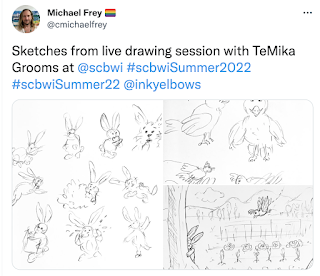
Here are just a few of the sketches people came up with during this fun timed prompt session!


TIPS FOR ALL ILLUSTRATORS:

Don't forget to fill out and/or update your SCBWI Profile. TeMika says that SCBWI is always interested in artists to highlight. She also suggests participating in the monthly Draw This! art prompt.

TeMika also strongly recommends checking out the workshops and courses offered by regional chapters.

Here's what I ended up drawing during TeMika's fun and inspiring session: