Showing posts with label #LA18SCBWI. Show all posts

Sunday, August 5, 2018

Thank you from all of us on SCBWI Team Blog - #LA18SCBWI Edition! (Save the Dates for #NY19SCBWI and #LA18SCBWI)


Thanks for joining us on this virtual adventure—a highlights reel of the inspiration, craft, business, opportunity, and community that make up the SCBWI Summer Conference.

From left to right, your #LA18SCBWI Team Bloggers:
Lee Wind, Jaime Temairik, Jolie Stekly, Martha Brockenbrough, Adria Quiñones, and Don Tate.

And we hope you'll save the dates for the upcoming:
SCBWI 20th Annual Winter Conference
New York City, Feb 8-10, 2019
Online conference registration posted in October at www.scbwi.org
and
SCBWI 48th Annual Summer Conference
Los Angeles, Aug 9-12, 2019
Online conference registration post in March at www.scbwi.org
Until then, keep writing and illustrating!

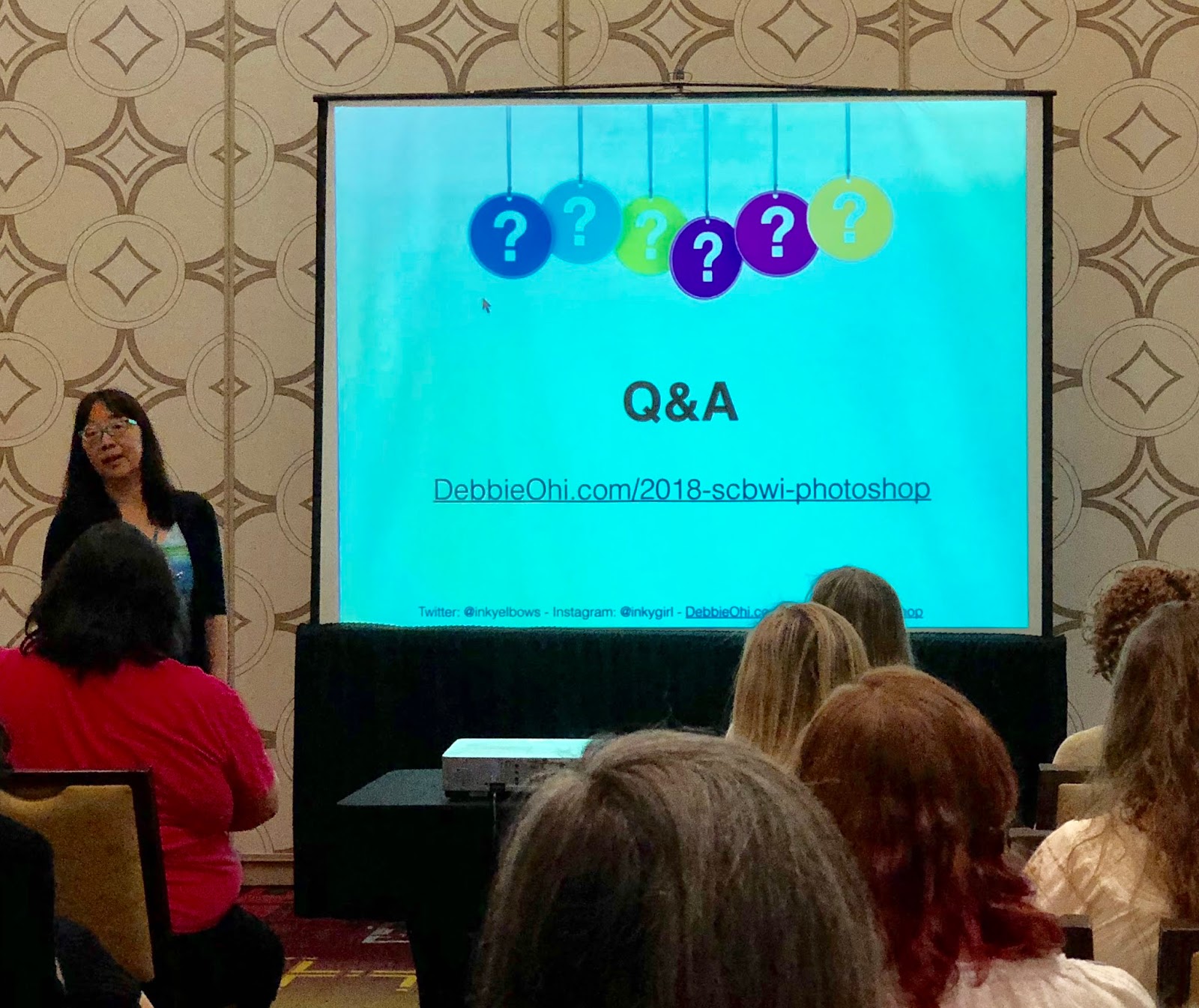
Photoshop Tips for Illustrators: Debbie Ridpath Ohi

Oh, boy!—what an abundance of information Debbie Ridpath Ohi offered to illustrators. Debbie is a social media guru, but she's also a successful illustrator and an SCBWI success story. She won the portfolio showcase at the 2010 SCBWI LA Conference, and has gone on to illustrate several books, including Sam & Eva and Where Are My Books? (Simon & Schuster), more.

Fortunately, most of what Debbie offered in her workshop is also available on her website, including BONUS MATERIALS!

The Autograph Party!

The finale of the 2018 SCBWI Summer Conference is a celebration of the whole three past days, full of inspiration and community, and chances to meet and have books signed by the amazing conference faculty!

The Roller-Coaster Line for Lois Lowry...


And all the authors and illustrators at this Sunday end-of-conference signing...


Keynote Bruce Coville

We are so sorry to miss Marc Brown due to a family emergency and are sending him every good thought and wish. In his stead, Bruce Coville has graciously stepped in to give us a closing keynote. As you may know, Bruce Coville has published over 100 books for children and young adults, including the international bestseller My Teacher is an Alien, the four book “Unicorn Chronicles” series, and Jeremy Thatcher, Dragon Hatcher. Before becoming a full time writer in 1986, Bruce was a teacher, a toymaker, a magazine editor, a gravedigger, and a cookware salesman. In 2001 he created FULL CAST AUDIO, an audiobook company devoted to producing full cast, unabridged recordings of material for family listening. He has produced over 120 audiobooks, directing and/or acting in most of them. 

Here is a taste of his keynote:


Bruce knows most of us are here because we have this crazy belief that children are worth our best efforts. Crazy because society seems to be saying one thing but doing another.

“…How can we not call ourselves crazy to believe kids matter when our society seems to believe it’s more important to give bankers their bonuses than children their books in school?”

Take a look at why our craft matters, what you do as children’s book creators has the opportunity to reach out far into the future.

“Our children are in crisis, and not just the ones at the border in cages… Children are told they're important as consumers, that they should buy things, but we’re not giving them anything that feeds their hearts.”

Bruce reads a fan letter to us, from a boy who'd read all of Bruce’s books as a kid, and the thoughts and themes that Bruce shared in those books shaped the way the boy looked at the world, ultimately informing what he did with his life which was to go into medicine, saving people all over the world in its most needy locales.

Bruce saved this letter in a folder he calls ‘To Look at on Bad Days’.

Think about what you write or draw as perhaps having a Butterfly Effect on future generations.

The ripples of stories through generations fascinate Bruce, one thing you write or one picture you paint can change a person’s heart forever. “That is what we have a chance to do every time we create our art. Bring to that creative effort your full heart.”

You cannot know all the effects your work will have on the world or how.

You don’t need to be an earnest angel, you can be ironic, silly, a little naughty, but no matter what, do it with your best heart.

Bruce’s last word of advice is do not start your story with a message.

Start instead with your own good heart: Fabulous characters, intriguing situations and out of that will come what needs to come.

"The right story at the right moment is like an arrow to the heart, it can catch and hold a hurt and bring it to the surface."

You will change the world, you can’t help but do so simply by being here, and you won’t know how you did. Every creative action is a pebble making ripples that will spread out to places you can’t even imagine, and from there, those ripples will set other waves in motion, and on and on.

Every act of courage, moment of compassion, every kindness matters.

Go home, get busy, drop some pebbles in the pond, says Bruce.

Dashka Slater: Reviving Your Stalled Career

Dashka Slater is the author of many fabulous picture books as well as the much lauded 2017 YA true crime novel, THE 57 BUS. But between these latest titles and her first few, Dashka felt stalled in her career for years. During that time, she bravely reached out to a fellow author she thought might be in a similar position, Marsha Diane Arnold. They became complaining buddies—Dashka highly recommends this as a coping strategy.

As she looks back on those formative seven years of not selling, Dashka sees now it made her a much better writer and author, and that reflecting on that stalled time will help her the next time this happens because she has also learned this career is not a straight road.

Dashka shares some goals for this session:

Goal #1: Diagnose the stall
Goal #2: Get your mojo back
Goal #3: Know that you are not alone
Goal #4: Protect yourself against future stalls

Dashka contacted other writers besides Marsha that also had seemed to stall. Here are a few of those stall examples and ways in which they got themselves out of there (note: you may be stalled in one or all of these ways, and that's okay!).


  • Personnel changes with your publisher
  • Mergers
  • Recessions
  • Legislation (budget cuts at local or national levels)
  • Personal life
  • Creative blocks
  • Technological Changes (the internet is free! Wikipedia is just as good as a book?!)
  • Market fads
  • Changes in taste + style
  • Losing your mojo
The Sputter Stall: Everything is going along fine, until it doesn't. Lisa Wheeler sold ten books and then... she didn't sell anymore. Her publishing contacts changed or left the industry, the recession crept in, all of her new work was being rejected.

The Market Change Stall: Melissa Stewart says 21 of her books were cancelled after the contracts were signed (Education budget cuts led to drastic library budget cuts. And the Internet became an alternate source for science facts that may have once only been available in physical books).

So what do you do when all of these stalls happen? And look! They happened to amazing people we think are stall-proof!

Dashka's partial Do and Don't list for getting out of stalls:

Do: Fight for your career. It's worth it.
Don't: Beat yourself up. Most of the reasons the stalls happened are out of your control.
Do: Stay connected.
Don't: Believe what you see on social media, it's much better to meet a peer in person and not just via their highlight reel on Facebook.

Do: Cultivate beginner's mind. This is the most important key to ending a stall to Dashka.

The breakout session attendees partner up and discuss what stalls they are feeling and do some brief commiserating. They then help each other brainstorm ideas for getting out of their stall(s).

Here are some of the things Lisa, Melissa, Marsha, and Dashka did to get out of their stalls, think about how that might work for you, too:

Diversify, embrace every new opportunity like: Apps, Educational Materials, Books for Hire, New Genres, Social media platform development, or Teaching. Be doing things to make some money on the side related to your field if not exactly selling a manuscript.

Representation. Either for the first time or as a change up with your existing agent.

Eliza Wheeler Keynote


Eliza Wheeler
Eliza Wheeler is the extraordinary author-illustrator of Miss Maple's Seeds, which debuted as a New York Times best seller list. She's illustrated many picture books, including Wherever You Go by Pat Zietlow Miller (an SCBWI member who just hit the NYT list this week!)

And she's illustrated several novels, including the Newbery Honor-winning Doll Bones by Holly Bolack, The Left-Hnaded Fate by Kate Milford, and the Cody series by Tricia Springstubb.

A SCBWI suc cess story, she won the National Grand Prize for best portfolio in 2011, and was a Sendak Fellowship recipient in 2017.

Here are some of her very beautiful books.


Eliza's keynote took us on a journey through her process, through the human brain, through JRR Tolkien's creation of a language and the Hobbit and Lord of the Rings series, which took 18 years to be published in three volumes when Tolkien was 63 years old.

Eliza identified 7 stages of creativity (with 1/2 stages for checking in)

  • Dig
  • Inspire 
  • Collage
  • Runner
  • Ignite
  • Refine
  • Assess

She deliberately breaks her work into phases to keep productive and happy. It's vital that she not try for perfection in initial stages, she said.

A lot of her process involves deep focus on her brain and its state. Your mood affects your work.

  • In an anxious mode you're less likely to take a chance on creativity. 
  • In a positive mood, dopamine floods into the brain and makes you do two things. 
  • When it comes to getting great ideas, the farther and more freely your thoughts can roam, the better.
She shared with us how we can best prime our brains—and it's a delightful surprise. Pick a familiar chore and do it in a state of enjoyment. So, for example: 


  • do the dishes
  • take a walk
  • take a shower
  • nap

Eliza recommends we keep a notebook or phone within reach so we can document flashes of inspiration wherever you are. This ignite phase often comes in short bursts. Don't try to push it.

And if you're feeling frustrated with how your work is going, remind yourself that the marks you make aren't you. The marks are a map to where you need to go next, and they will guide you to the better marks. (And you can always go take a nap and come back to them later.)

She talked about some of the feelings we can get, and what they mean, including:

Anxiety: You're judging yourself
Boredom:  you haven't spent enough time saturating yourself in your ideas
Stress: you're trying to consider too many pieces at once
Fried: you've pushed it too far. Go refresh yourself and come back later.

Learn more about Eliza Wheeler
Eliza Wheeler on Facebook

From Wherever You Go by Pat Zietlow Miller and Eliza Wheeler

Panel: The Secret of Crafting Engaging Nonfiction - Candace Fleming

SCBWI Golden Kite Award Winner Candace Fleming writes nonfiction and fiction (more than 40 books!). Most of her nonfiction is historical YA, but she has recently taking a foray into science picture book nonfiction.

How is writing nonfiction different from writing fiction?

Candace says, "I always think of everything I write in terms of cake. As a writer it's my job to create a cake that all of you want to gobble up in three minutes. When I write fiction I get to buy all the ingredients I want to put in a cake that I pick out myself, like coconut and chocolate chips and maple syrup. When I write nonfiction the goal is exactly the same, but I didn't get to go to the grocery store, I have to use the ingredients my partner Eric brings home, like flax seed and pepto bismol, and find a way to make that into a gobble-able cake."

What's your favorite part of writing nonfiction? 

The biggest part of nonfiction is figuring out how to take all the research you do and turn it into a compelling story for readers. Candace says you do three years of research and travel, if you can, because it's the amount of research that determines the variety of ingredients available to your 'cake'.

"You don't want me to tell you everything I learned in three years, you want me to tell you a story. And it's a story the way I see it. [Anyone up here on this panel] could take that same research and make a completely different book."

How do you pick your stories?

"... My book needs a Vital Idea. I'm not going to write this book just because it's a cool piece of history, there has to be something more, something bigger, something that connects to readers."

"The vital idea of the giant squid book is mystery. We know more about dinosaurs than we do about giant squid yet there are still 100,000 of them swimming around us today."

"When I know the vital idea, then I know what's going to go into my book. Only after I do enough research do I know what my story is truly about."

"The Romanov family book, the original thought was it would be about Anastasia, the book now is not that, it's not just her life, it's about what 3% of the population with 90% of the wealth do to a society... What's the ultimate result when rulers don't pay attention to the people they are governing or take their wellbeing into account..."

"I xerox everything, I tab everything I research for three years, that whole time I'm searching for my vital idea." And with that vital idea figured out finally, Candace will go back and re-review this research with vital idea goggles on. She tells us she has 60 pages of research on faberge eggs, but you won't find one mention of those eggs in her Romanov book.


What's Candace working on now?

"I'm in the throes of a book I'm working on, a biography on Charles Lindbergh. We think about him as being the first to conquer transatlantic flight, but he had a secret research facility about wanting to conquer death, to replace organs like you replace airplane parts..."

And Charles Lindbergh was America First, he wanted us to join the Nazis, he was on the board of the eugenics society until 1974 at his death and just recently we discovered he had three other families in Germany! Candace thinks a lot of where we are in America today politically and racially was propogated from exactly the sort of mindset and culture that a person like Lindbergh represented.

Meg Flemming: Nurturing Productivity: Strategies for the Highs...and the Sighs

Meg Flemming is an award-winning children's book author include: I Heart You; Ready, Set, Sail; and Ready, Set, Build. Her forthcoming book is Sometimes Rain.

Meg is going old school with paper and pencil to take the room through a workshop to get toward a greater place of productivity.

Spill the Tea...Meg asks us to write down any gossip, things that have happened, things we need to get off our minds. This is one way we can get started, by having a bit of a routine to get your mind to that place where it's time to write.

"Artists are people who have learned to live with doubt and do the work anyway." -Julia Cameron

Meg reminds us that it is a choice to do this, and that we have the courage to do this work. Yay, us!

You're not here to keep your stories in the drawer. You're here because you have something you want to share. Get it out. Work on it.

Know the difference between who's in your field and who's in your court. Meg asks everyone to make two lists (two columns): industry people and non-industry people. Then separate them out between those that give you positive feedback and negative feedback. From the non-industry positives, are friends and family who don't know the business but they are encouraging. Great. Eliminate the non-industry negatives for feedback. Gone. With those in the industry, feedback can be tricky, that feedback that might feel negative needs to be weighed. Helpful feedback should ring true, if it doesn't, ignore it. Continue to turn to those in the industry who provide positive and helpful feedback.


We should also ask ourselves how social media is serving us. Write it down. Is it helping you? Or is it distracting you?

Ask yourself if you're using your creativity in the right space.

Be kind to your creative self.


Ammi-Joan Paquette: Unusual Story Structures: Strategies, Options, and Ideas to Twist Your Narrative


Ammi-Joan Paquette is a senior agent with Erin Murphy Literary Agency, representing all types of children’s and young adult literature. She is also the author of The Train of Lost Things, the Princess Juniper series, and picture books including Ghost in the House, Elf in the House, Bunny Bus, and The Tiptoe Guide to Tracking Fairies. With acclaimed author Laurie Ann Thompson, she is also the co-author of the ‘nonfiction with a twist’ series, Two Truths and a Lie. In her agent acquisitions, Joan is particularly drawn to richly voiced, unforgettable characters and settings, as well as tightly paced, well-plotted stories with twists and turns that keep you guessing right until the end. Visit her on the web at www.ajpaquette.com

**

Ammi-Joan's focus in this session is mostly on longer form projects (i.e., novels) but she advises that many of the concepts discussed could also work for picture books.

Defining story structure as the framing point, looking through the lens at your story. How are you going to tell this particular story in the way most meaningful to you? A quote she shares:
"Every story demands a different structure. No universal structure exists. It's why that mopey old saw about there being only seven plots or some bullshit is, well, bullshit. If you distill them down to their barest (and in many ways most meaningless) essencce, sure, that's true. But the art is in the arrangement. The structure you build around the plot to support the story is where the elegance lies. - Chuck Wendig
Ammi-Joan divided up the different kinds of out-of-the-box books into six categories:

1. Structure by Narrator
Out of the box examples include: Ibi Zoboi's American Street, R. J. Palacio's Wonder

2. Structure by Mosaic (smaller stories that add up to a larger whole)
Out of the box examples include: though mostly this is in adult books so far - And the Mountains Echoed by Khaled Hosseini and The Cardboard Kingdom by Chad Sell.

3. Structure by Device
Out of the box examples include: Monster by Walter Dean Meyers (in the form of a screenplay) and Regarding the Fountain: A Tale, in Letters, of Liars and Leaks byKate Klise, Illustrated by M. Sarah Klise

4. Structure by Time
Out of the box examples include: Before I Fall by Lauren Oliver (time looping) and One Day by David Nicholls

5. Structure by Deception (unreliable narrators)
Out of the box examples include: The False Prince by Jennifer A. Nielsen, Fingersmith by Sarah Waters

6. "Meta" structure (a book within a book)
Out of the box examples include: The French Lieutenant's Woman by Vintage Fowles, The Princess Bride by William Goldman


Ammi-Joan speaks of so much more, including" the tussle between craft and magic" and how the reader needs "a logical and clearly visible path through the madness" (of a complicated structure.)

final take-away:

Your structure needs to add something to the story. Otherwise it's just showing off.

Libba Bray: Digging for the Truth

Libba Bray is the #1 New York Times best-selling author of the Gemma Doyle trilogy; the Michael L. Printz Award-winning Going Bovine; Beauty Queens (a Los Angeles Times Book Prize Finalist); and the Diviners series.

Libba, for many years, attended a writing workshop where the group wrote to from prompts, uncensored. Writers could then share but then only receive positive feedback because it was all new writing.

Libba takes this room of writers on that same journey.

Libba reads a poem titled: Where I'm From

The first prompt starts with the line: "Where I'm from..."

Set your own timer now and write for 10 minutes.

"I love to see all of your heads bent in concentration. That is amazing."

Brave readers share with the room.
Ready for one more? 

Write a piece that begins with the words, "Have you forgotten me?"

I'm going to be honest with you, Blog Friends, I'm not sure...scratch that, I know I can't do this one without falling to pieces. This is a clear indication that Libba is getting this room of writers to get to the truth, because when you feel it viscerally, in the question alone without even putting one word on the page, something powerful is happening. 

Libba listens intently.
Illustrator Katherine A Taylor approached this prompt through illustration.


Sometimes just setting a timer for ten minutes and writing and telling yourself that you're not going to sensor yourself allows you to create amazingly powerful work. Trust me, we heard the power in the room. Just wow! 

Sangeeta Mehta: Self-Publish Like a Traditional Publisher

Sangeeta Mehta


Sangeeta Mehta was an acquiring editor at Little, Brown Books for Young Readers and Simon Pulse before starting her own editorial services company, which focuses on middle grade and young adult fiction. She has written several articles about self-publishing for Jane Friedman Media, including “The Business of Self-Publishing Children’s Picture Books,” “Shepherding a Self-Published Picture Book to Success,” and “Should Children’s Book Authors Self-Publish?” A Member-at-Large of the Editorial Freelancers Association, Sangeeta founded the organization’s Diversity Initiative. She also serves on the board of The Word, a nonprofit working to build a more inclusive publishing community. Follow her on Twitter @sangeeta_editor or visit www.mehtabookeditingnewyork.com.

**

Sangeeta starts out by sharing self-publishing success stories, how to determine your publishing goal, answers the question/offers us the mantra "What would a traditional publisher do?", shares resources, and fields questions from the attendees.

Success stories:

Edgar Allen Poe and Virginia Woolf and Beatrix Potter who took matters into their own hands.

More recent examples of break-out self publishing success include The Martian by Andy Weir, Still Alice by Lisa Genova, Milk and Honey by Rupi Kaur.

In children's books,

Amanda Hocking's Watersong
Beth Reekles' The Kissing Booth (published as a teenager on Wattpad and won an award there.)
Christopher Paolini's Eragon
Carl-Johan Forssén Ehrlin's The Rabbit Who Wants To Fall Asleep
John and Jennifer Churchman's The SheepOver

She cautions that it's very hard to make it the way these authors have. One of the ways to help make it happen for you is to figure out your self-publishing goal.

Some of the goals for self-publishing Sangeeta shares that we might consider:

-to hone your craft
-to be part of a writing community
-undertake a project that may or may not be lucrative
-create a family keepsake
-become an entrepreneur or leverage your position as an entrepreneur
- promote your backlist
- get "discovered"

Sangeeta shares about WattPad, InkedVoices (an online critique forum), and cites Beth Revis and Cassandra Claire as examples of hybrid authors, who do both traditional publishing and self-publishing.

The heart of the session is this:
If you have a traditional deal, it's the editor who is the center of everything. If you're self-publishing, YOU'RE the center of everything.

She breaks down what the different departments at a traditional publisher do, including the:

editorial department (developmental edits, etc...)

managing editorial department (scheduling everything, copyediting, proofreading, etc...)

design department (interior and cover, etc...)

contracts department (consider if you're hiring professionals i.e,, an illustrator, etc...)

marketing department (including setting publication date, price, advanced reader copies, trades shows, etc...)

publicity department (submit book for review and award consideration, etc.... Shout out to SCBWI's Spark Award for books published in non-traditional ways.)

Hot tip: Pitch articles that tie into your book but aren't necessarily about your book.

subsidiary rights department sells or licenses your book (foreign, translation, audio, etc...)

sales departments (gets your book into bookstores, etc...)

Where to focus first when all this responsibility is on you? Sangeeta suggests we focus on our goals, and let those guide us.

She shares lots of resources, talks about the value of paying for a Kirkus review, being the local hero where you live, shares checklists, discusses how much to invest in your book, "series potential," and so much more!

A few articles Sangeeta recommends:

Check out this article Sangeeta wrote where she interviewed Zetta Elliott, Brent Hartinger, Cheryl Klein, and Stephen Mooser about their experiences and advice self-publishing children's books.

And this article on Reedsy, How much does self publishing really cost? 

(Another resource for authors self-publishing is the nonprofit Independent Book Publishers Association.)

Kevin Lewis: The Truth About Trucks, Trains, and Toddlers: Creating Enduring Works for the Very Young

Kevin Lewis! Kevin Lewis! Kevin Lewis! I'd never heard him speak before and he's been one of the highlights of my conference. He's a former editor, current agent and author, so he really knows every facet of the market as well as cares about craft.

Run don't walk to any Kevin Lewis talk you can attend, he's also like Mem Fox in giving you a master class on how to read a story out loud.

Here're a few of my favorite things I learned from Kevin about writing for toddlers:

Keep it short.

Understand that your audience is going to exhibit their cognitive abilities. You think your manuscript can be longer than Eric Carlie’s Very Hungry Caterpillar? Think again. 


Make the reader (the parent) the star, and make it easy for them to star:

Sound it out, toddlers are just getting to know rich language, sound words are delicious and fantastic to include. Study Denise Fleming's (and Kevin's) books for great sound words and onomatopoeia.

Act it out. Give the parent actions to repeat that are fun or build anticipation during the reading, look at TICKLE MONSTER or PRESS HERE.

Clown around, let the parent/reader laugh, too. Look at books like SILLY SALLY or THE MONSTER AT THE END OF THIS BOOK.

Final thoughts from Kevin on writing for toddlers:


1. Incorporate good poetry into you, and it will spout out of you, you’ll find yourself finding good words and connecting things in your own work better.
2. Don’t act your age, lay on floor! See things from a toddler's perspective and strength.

"We get so caught up in teaching a child, that we forget we should be paying attention to what *they* want to learn."


Panel: The Secret of Crafting Engaging Nonfiction

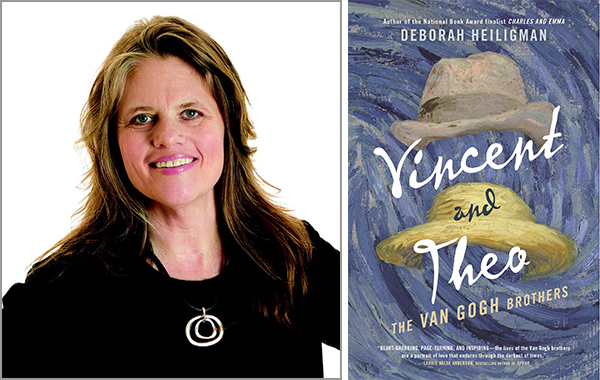
Deborah Heiligman's latest book is the dazzling VINCENT AND THEO, but has many other incredible nonfiction titles to her name (try CHARLES AND EMMA—you will love it).


She is particularly drawn to narrative nonfiction for biographies, because life stories lend themselves well to narrative.

Deborah was thinking about her own theme in life. It's "only connect" by E.M. Forster. "I'm connecting, and I'm trying to connect the reader to someone I'm connecting with."

Her process is connecting to the person that she's writing about in the same way that fiction writers connect to the characters they make up. She's also completely obsessed with the way her subjects connect with each other.

"In biography, you want to get so in deep with the person than telling the story up close ... is the way to do it."

Deborah, who also writes fiction, has an analogy that explains the difference between the two disciplines. Fiction is clay, and you're shaping the story out of that medium. In nonfiction, you start with marble. The material is there, and you have to find the shape within it.

There is a misperception that nonfiction is like writing a book report or a dictionary entry. Our personalities show in the book that we're writing.

Deb wanders in the woods for a really long time, she said. "It takes me the longest time to really get it. Everything that I put in CHARLES AND EMMA had to be in service to the love story." She created a mantra for this book: It's a love story. It's a love story. 

With Vincent and Theo, it was also a relationship book. But what was the relationship about? Most of her research is primary source research. She got "pissed off" very early on at Vincent. She wondered why Theo not only put up with him, but supported him emotionally and financially. That was a question she was trying to answer with the book. Her mantra, once again, became, It's a love story. 

When you do a lot of research, you want to show it off. But that's not your job. Your job is to tell a story (something she learned from listening to Sara Paretsky). With Vincent and Theo, her additional mantra was, "You are telling a story. You are not a scholar."

Deborah's next book—due August 15 with her editor—is a WWII tragedy with a large cast of characters. It's an antiwar story. It's a helper story. And she is sure she will figure out the theme by August 15. (So am I. Deb is an absolute genius.)


Learn more about Deborah Heiligman here.

Workshop: Teens and Their Bodies: Carolyn Mackler

Carolyn Mackler is the acclaimed author of the YA novel The Earth, My Butt, and Other Big Round Things (A Michael L. Printz Honor Book) and its brand-new sequel, The Universe Is Expanding and So Am I. She is also the author of Infinite in Between, Tangled, The Future of Us, Vegan Virgin Valentine, Guyaholic, and Love and Other Four-Letter Words, and the middle grade novel, Best Friend Next Door. Carolyn’s award-winning books have received many starred reviews, appeared on best seller lists, and been translated into more than 25 languages. She is currently finishing a middle grade novel, midway through a new YA, and thinking about a novel for adults.


Mackler's interest in viewing adolescence through the body can be traced back to her own adolescent experiences--as a teenager in a body that seemed very different from the bodies of her schoolmates. "The body was so angst-y for me."

"I write realistic fiction," she said, "and the body will come up continually--it's a constant conversation at all ages, whether you're five and hoping to grow, or 15 and hoping stop growing, or 45. Everybody has a teen story."

She recounted experiences from her own adolescence, ranging from sexual aggression to sexual empowerment. "The body has both power and limits. This is why I write YA. This is why I read YA." Judy Blume was a favorite author because she dealt with things like boobs, scoliosis and sexual awakening.

Mackler described how one has body issues, body concerns in adolescence--pimples, thighs, too skinny, too fat, too big, not big enough, not hairy enough, too hairy, the wrong kind of hair, too light, too dark, stretch marks. "A body no being a problem didn't ring true to me."

"There is so much going on around adolescence and body. I read to help me understand the weirdness," Mackler said. She also noted, "Books are the safest place to learn about sex. You can close the book, you can let it go over your head... You read about it to learn so you don't have to do it."

"You never know what a kid needs--that's why we write."

________

Many of the books mentioned in the workshop--Dumplin', Puddin'--were by white writers and/or featured white, cis main characters. Here's a few diverse recommendations:

Gabi, A Girl in Pieces, by Isabel Quintero. Somehow it's often left off of positive fat representation lists. It doesn't center her weight; she also ends up with a cute boyfriend..

Girl Mans Up by M-E Girard.  A gender-non-conforming gay teen figuring out she she belongs and how to be herself (and gets a bad-ass girlfriend along the way).

Piecing Me Together, by Renee Watson. A Black teen discovers herself as an artist. It touches on weight, also attractiveness, racism and other issues, as the occur in life. Brilliant.

The Poet X, by Elizabeth Acevedo has a MC who is living out issues of power and control in her body--her mother's fear of her sexuality is SO real, as is her own struggle with it.

Yaqui Delgado Want to Kick Your Ass, by Meg Medina. A young teen is bullied and the effects are played out on her body. Searing. A must-read.

Lily Malcom: Conveying Emotion: Breathing Life into Your Characters

Lily Malcom is Vice President and executive art director of Dial Books for Young Readers. She's art directed many great books and talented illustrators including Corinna Luyken, Judy Schachner, David Small, Zach O'Hora, Erin Stead, Jerry Pinkney, and Jon Agee.

Lily shares a number of awesome tips to make your characters unique and bursting with... character.

Here are a few:

Main characters can convey emotion through their eyes, yes! But be sure that emotion spreads to their eyebrows, too. And what other accessories can be emotive? Think of Ladybug Girl's wings for a start.

The size and placement of your characters on the page are hugely important. You can use that space that they take up on the page and the way it changes page to page to make a huge impact. A big change in size or placement of a character page to page results in a powerful page turn that shocks the reader. You can also speed up the action this way, or slow down the action with spots and vignettes.


Visual narrative, Lily explains, is what is shown on the page, it’s separate from the text, and should bring something new to the text. Visual subplots of characters not even mentioned in the text are fantastic as long as they aren’t scene stealing from the main plot and main characters. Think of Judy Schachner's elephant in SARABELLA'S THINKING CAP.


Lily shares with us some of the AMAZING spreads full of supporting character action from Jon Agee's forthcoming THE WALL IN THE MIDDLE OF THE BOOK. Go preorder it now.

To get to your most powerful page turns, Lily recommends you sketch it all out in dummy format on cheap paper, even if it’s over 32 pages that you end up sketching, get all your ideas out. She says you can then go back and kill your darlings.


Lily always prints out and tapes together dummy books to go through with the editor to see pages turns so there’s drama and cliff hangers on as many pages as possible.

The Secret of Crafting Engaging Nonfiction Panel is About to Begin!


Moderated by Melissa Stewart (at podium), the panelists are (left to right): Deborah Heiligman, Barbara Kerley, Jason Chin, and Candace Fleming.

Melissa starts out and explains the difference between expository and narrative nonfiction, and shows us statistics that highlight the difference between what the adult gatekeepers prefer (narrative, by far), and how children actually prefer expository nonfiction!

The panel dives into questions about theme, styles, process, the difference between writing fiction and nonfiction, and so much more. Check out the individual posts on each panelist to come!